
If you are planning a home improvement or construction project, you may wonder how many cubic feet is 80 lbs of concrete. This is one of the most common questions people ask when buying concrete mix for patios, sidewalks, fence posts, slabs, and small repairs.
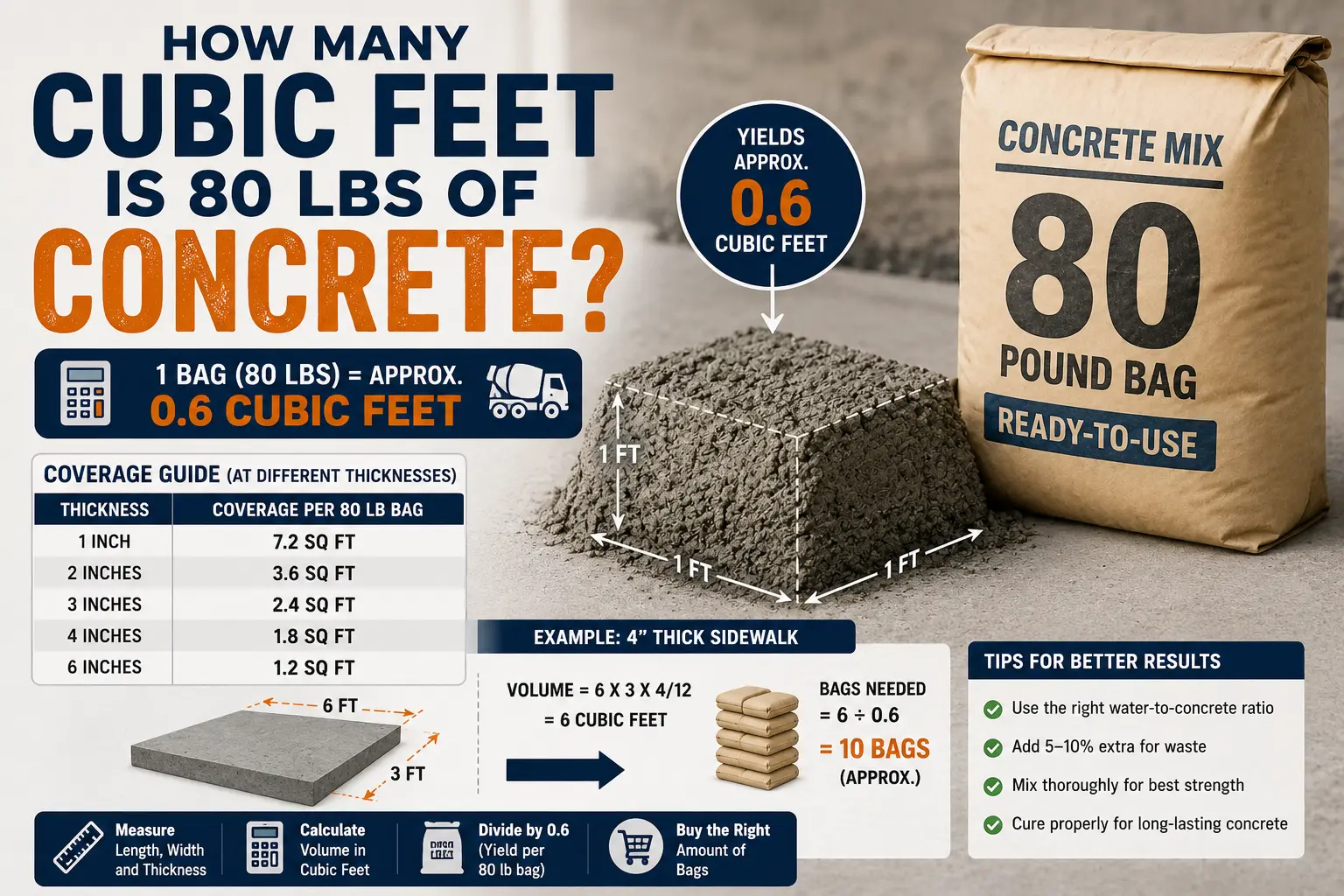
The simple answer is that an 80 lb bag of concrete typically yields about 0.6 cubic feet of finished concrete when mixed properly with water. However, the exact amount can vary slightly depending on the concrete mix, moisture levels, and how the material is prepared.
Understanding concrete volume is important because it helps you:
- Buy the correct number of bags
- Avoid wasting money
- Prevent project delays
- Calculate slab coverage accurately
Whether you are a beginner DIYer or an experienced contractor, knowing how concrete volume works makes every project easier.
Understanding Concrete Volume
Before calculating concrete needs, it helps to understand how volume measurements work.
What Cubic Feet Means
Concrete is measured in cubic feet because it fills three-dimensional spaces:
- Length
- Width
- Depth
A cubic foot is the amount of space inside a cube that measures:
- 1 foot long
- 1 foot wide
- 1 foot high
The formula looks like this:
Volume=Length×Width×Depth
Concrete projects always involve volume because concrete fills an area with thickness.
Why Concrete Is Measured by Volume
Unlike lumber or fencing, concrete is not measured only by length. It must fill a physical space.
For example:
- A sidewalk needs thickness
- A patio needs depth
- Fence posts need holes filled
That is why cubic feet and cubic yards are used in construction.
How Many Cubic Feet Is 80 lbs of Concrete?
The standard answer is:
80 lb concrete bag≈0.6 cubic feet
Most major concrete brands produce roughly the same yield.
Standard Yield of an 80 lb Bag
An 80 lb bag of premixed concrete usually creates:
- About 0.6 cubic feet
- Roughly 17 liters
- Around 0.022 cubic yards
This estimate assumes proper water mixing and normal conditions.
Why the Yield May Change Slightly
The final volume can vary because of:
- Water content
- Air pockets
- Mixing technique
- Concrete brand
- Aggregate size
Still, 0.6 cubic feet is the accepted industry average.
How Concrete Yield Is Calculated
Concrete bags list weight, but projects require volume calculations.
Weight vs Volume
Weight measures heaviness.
Volume measures space.
An 80 lb concrete bag weighs 80 pounds before mixing, but once mixed with water, it expands into usable volume.
This is why:
- Heavy weight does not directly equal larger coverage
- Different materials can weigh differently but fill similar space
Moisture and Mixing Factors
Adding too much water can weaken concrete.
Adding too little water can create poor consistency.
Manufacturers usually recommend:
- About 3 quarts of water for an 80 lb bag
Proper mixing helps achieve the expected 0.6 cubic feet yield.
80 lb Concrete Bag Coverage Chart
One of the easiest ways to estimate concrete is by using coverage charts.
Coverage by Thickness
Here is how much area one 80 lb bag covers at different thicknesses.
| Thickness | Coverage Area |
|---|---|
| 1 inch | About 7.2 square feet |
| 2 inches | About 3.6 square feet |
| 3 inches | About 2.4 square feet |
| 4 inches | About 1.8 square feet |
| 6 inches | About 1.2 square feet |
Practical Reference Table
| Project Type | Typical Thickness | Coverage Per 80 lb Bag |
|---|---|---|
| Sidewalk | 4 inches | 1.8 sq ft |
| Patio | 4 inches | 1.8 sq ft |
| Fence Post | Varies | 1–2 posts |
| Small Pad | 3 inches | 2.4 sq ft |
These estimates help prevent underbuying materials.
How to Calculate Concrete Needed for a Project
Calculating concrete is easier than most people think.
Basic Formula
Use this formula:
Concrete Volume=Length×Width×Depth
All measurements should be converted into feet.
Step-by-Step Calculation
Suppose you want to pour a slab:
- Length = 10 feet
- Width = 8 feet
- Thickness = 4 inches
First convert thickness into feet:
4 inches=124 feet
Now calculate volume:
10×8×124=26.67 cubic feet
Now divide by the yield of one 80 lb bag:
0.626.67≈45 bags
You would need about 45 bags.
Common Project Examples
| Project | Approximate Bags Needed |
|---|---|
| Fence post hole | 1–2 bags |
| Mailbox post | 1 bag |
| Small patio | 30–50 bags |
| Sidewalk section | 20–40 bags |
Real-World Examples of 80 lb Concrete Coverage
Real examples make the calculations easier to understand.
Sidewalk Example
Imagine a sidewalk section:
- 6 feet long
- 3 feet wide
- 4 inches thick
Volume:
6×3×124=6 cubic feet
Bags required:
0.66=10 bags
You would need around 10 bags.
Fence Post Example
A fence post hole may measure:
- 1 foot deep
- 10 inches wide
Usually:
- One 80 lb bag fills most standard post holes
Larger holes may require two bags.
Small Patio Example
Suppose you want a patio:
- 12 feet by 12 feet
- 4 inches thick
Volume:
12×12×124=48 cubic feet
Bags needed:
0.648=80 bags
This shows why larger projects often use ready-mix trucks instead of bags.
Comparing 60 lb vs 80 lb Concrete Bags
Many stores sell both 60 lb and 80 lb bags.
Coverage Differences
| Bag Size | Approximate Yield |
|---|---|
| 60 lb | 0.45 cubic feet |
| 80 lb | 0.6 cubic feet |
Cost Efficiency
80 lb bags usually provide:
- Better value per cubic foot
- Fewer bags to carry
- Faster mixing
However, they are heavier and harder to lift.
Which One Is Better?
Choose 60 lb bags if:
- You want easier lifting
- You are doing small repairs
Choose 80 lb bags if:
- You need larger volumes
- You want fewer bags overall
- You are working on patios or slabs
Common Mistakes When Estimating Concrete
Concrete calculations often go wrong because of simple mistakes.
Ignoring Thickness
Many people calculate only length and width.
Depth matters just as much.
A thicker slab requires much more concrete.
Forgetting Waste
Concrete projects almost always need extra material.
Experts recommend adding:
- 5% to 10% extra
This helps cover:
- Spillage
- Uneven ground
- Mixing mistakes
Using Wrong Measurements
Always convert inches into feet before calculating volume.
For example:
- 6 inches = 0.5 feet
- 4 inches = 0.333 feet
Incorrect conversions can ruin estimates.
Expert Tips for Working With Concrete
Small improvements can make concrete projects much smoother.
Mixing Properly
Use the correct water ratio.
Concrete should look:
- Thick
- Smooth
- Workable
Too much water weakens the final product.
Buying Extra Bags
Running out of concrete during a pour can create weak joints and uneven finishes.
Always buy slightly more than estimated.
Pouring and Curing Tips
For stronger concrete:
- Pour evenly
- Remove air pockets
- Keep the surface moist while curing
- Avoid rapid drying in hot weather
Proper curing improves durability and strength.
Why Concrete Volume Matters
Concrete calculations affect:
- Budget
- Labor
- Structural strength
- Material waste
Underestimating concrete can stop projects halfway.
Overestimating wastes money and creates disposal problems.
Learning concrete volume calculations helps homeowners and contractors work more efficiently.
Converting Cubic Feet to Cubic Yards
Large concrete projects are often measured in cubic yards.
The conversion formula is:
1 cubic yard=27 cubic feet
An 80 lb bag yields:
0.6 cubic feet≈0.022 cubic yards
This is useful when comparing bagged concrete with ready-mix truck pricing.
Frequently Asked Questions
1. How many cubic feet does an 80 lb bag of concrete make?
An 80 lb bag of concrete usually makes about 0.6 cubic feet when mixed properly.
2. How much area does an 80 lb bag cover?
At 4 inches thick, one bag covers about 1.8 square feet.
3. How many 80 lb bags are in a cubic yard?
A cubic yard contains 27 cubic feet. Since each bag yields 0.6 cubic feet:
0.627=45 bags approximately
You need about 45 bags.
4. Is 80 lb concrete better than 60 lb concrete?
Both work well, but 80 lb bags are usually more cost-effective for larger projects.
5. How much water do you add to an 80 lb concrete bag?
Most manufacturers recommend around 3 quarts of water, but always check the bag instructions.
10. Conclusion
Understanding how many cubic feet is 80 lbs of concrete can save time, money, and frustration during construction projects. In most cases, an 80 lb bag of concrete yields approximately 0.6 cubic feet of finished concrete.
This knowledge helps you calculate slab coverage, estimate project costs, and determine how many bags you need for patios, sidewalks, fence posts, and other DIY projects.
By using proper formulas, checking thickness carefully, and buying a little extra material, you can complete concrete projects more confidently and avoid common estimating mistakes.
Discover more
how many square feet will a 10kw heat strip heat