
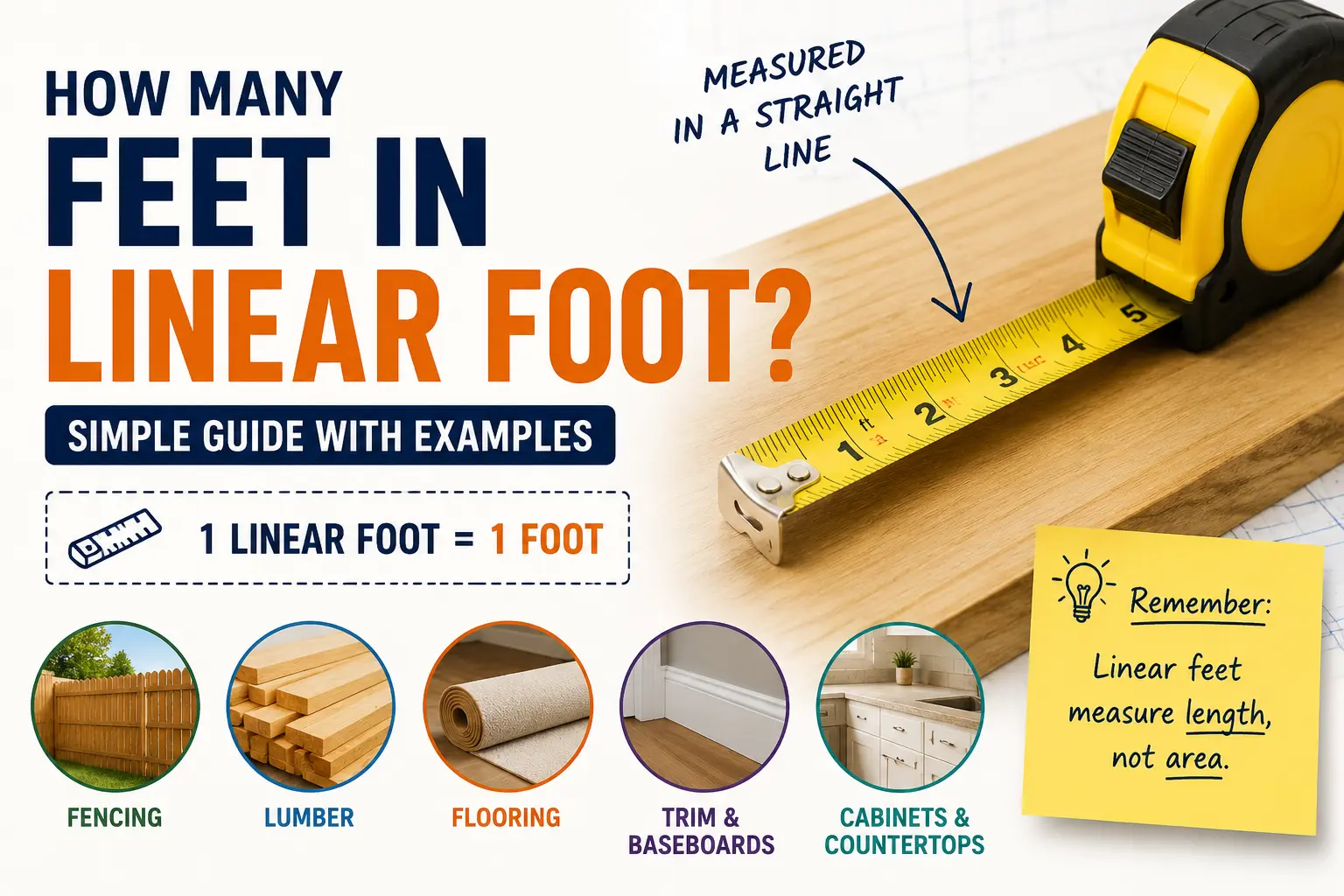
Many people ask, “how many feet in linear foot?” because the term sounds more complicated than it really is. The good news is that a linear foot is simply one foot measured in a straight line. In other words, one linear foot equals one regular foot in length.
The confusion usually happens when people compare linear feet with square feet or cubic feet. These are different types of measurements used in construction, flooring, lumber, fabric, fencing, and home improvement projects.
Understanding linear feet can help you avoid buying too much or too little material. Whether you are installing flooring, building a fence, purchasing lumber, or measuring cabinets, knowing how linear feet work makes projects easier and more accurate.
What Is a Linear Foot?
A linear foot is a measurement of length. It measures only one dimension: distance in a straight line.
If something is 10 linear feet long, it means it is 10 feet from one end to the other.
Simple Definition
A linear foot equals:
1 linear foot=1 foot
That is the entire concept.
The word “linear” simply means the measurement is taken in a straight line.
Why People Get Confused
People often think a linear foot is different from a regular foot because of the extra word “linear.” However, the measurement itself is exactly the same.
The difference comes from how the measurement is used.
For example:
- A regular foot can describe any length
- A linear foot specifically refers to measuring length only
This is common in industries such as:
- Flooring
- Carpentry
- Plumbing
- Fabric sales
- Landscaping
- Fencing
How Many Feet in Linear Foot?
The direct answer is simple:
1 linear foot=1 foot
So:
- 5 linear feet = 5 feet
- 12 linear feet = 12 feet
- 20 linear feet = 20 feet
There is no conversion needed because they are the same unit of length.
Linear Foot vs Regular Foot
Here is the easiest way to understand it:
| Measurement | Meaning |
|---|---|
| Foot | Standard unit of length |
| Linear Foot | Length measured in a straight line |
The actual size does not change.
Understanding Linear Measurements
Linear measurements focus on one dimension only: length.
Length Only Measurement
When measuring linear feet, you only care about:
- How long something is
- The distance from one point to another
Width and height do not matter unless you are converting to another type of measurement.
For example:
- A 10-foot board = 10 linear feet
- A 10-foot pipe = 10 linear feet
- A 10-foot fence section = 10 linear feet
When Width and Height Matter
Width and height become important when measuring:
- Square footage
- Cubic footage
- Area
- Volume
This is where many people mix up measurements.
Linear Foot vs Square Foot
Linear feet and square feet are completely different measurements.
Key Differences
| Measurement Type | Measures | Dimensions Used |
|---|---|---|
| Linear Foot | Length | 1 dimension |
| Square Foot | Area | 2 dimensions |
| Cubic Foot | Volume | 3 dimensions |
Comparison Table
| Example | Linear Feet | Square Feet |
|---|---|---|
| 12-foot board | Yes | No |
| 12×12 floor | No | Yes |
| Fence length | Yes | No |
| Room area | No | Yes |
Real-Life Examples
Imagine you buy fencing material.
If the fence is:
- 50 feet long
- 6 feet tall
You usually buy fencing by linear feet because the important measurement is the total length of the fence.
Now imagine flooring for a room:
- 10 feet wide
- 12 feet long
The flooring is measured in square feet because both length and width matter.
The formula is:
Square Feet=Length×Width
So:
10×12=120 square feet
How to Calculate Linear Feet
Calculating linear feet is very easy.
Basic Formula
The formula is:
Linear Feet=Length in Feet
That means you simply measure the length.
Step-by-Step Process
Here is a simple process:
- Measure the object’s length
- Convert inches to feet if necessary
- Add all lengths together
Example
Suppose you have:
- One board = 8 feet
- Another board = 6 feet
- Another board = 10 feet
The total is:
8+6+10=24 linear feet
Easy Conversion Chart
| Feet | Linear Feet |
|---|---|
| 1 foot | 1 linear foot |
| 5 feet | 5 linear feet |
| 10 feet | 10 linear feet |
| 25 feet | 25 linear feet |
| 50 feet | 50 linear feet |
Common Uses of Linear Feet
Linear feet are used in many industries and home projects.
Flooring
Some flooring materials are sold by linear feet, especially:
- Vinyl rolls
- Carpet rolls
- Baseboards
- Trim
For example:
- A carpet roll may be 12 feet wide
- You buy the length you need in linear feet
Lumber
Lumber yards commonly use linear feet.
Examples include:
- Wooden boards
- Molding
- Trim
- Beams
If you purchase:
- Five boards that are 8 feet long
You have:
5×8=40 linear feet
Fencing
Fence companies estimate projects using linear feet because fences are measured by total length.
If your yard perimeter is:
- 120 feet
You need:
- 120 linear feet of fencing
Fabric and Carpeting
Fabric stores often sell material by linear feet or linear yards.
The width stays fixed, but the length changes based on what you buy.
Cabinets and Countertops
Kitchen contractors measure countertops and cabinets in linear feet to estimate pricing.
For example:
- 15 feet of cabinets
- 20 feet of countertop space
Practical Examples of Linear Foot Calculations
Real-world examples make the concept easier to understand.
Fence Project Example
Suppose you want to fence three sides of your yard:
- Side 1 = 40 feet
- Side 2 = 30 feet
- Side 3 = 40 feet
Total fencing:
40+30+40=110 linear feet
You would need about 110 linear feet of fencing.
Flooring Example
You buy a vinyl flooring roll that is:
- 12 feet wide
Your room is:
- 12 feet long
You need:
- 12 linear feet of flooring
Because the width already matches the room width.
Lumber Example
You need trim for a room with these wall lengths:
- 10 feet
- 10 feet
- 12 feet
- 12 feet
Total trim needed:
10+10+12+12=44 linear feet
You should also buy extra material for waste and mistakes.
Common Mistakes People Make
Understanding these mistakes can save money and time.
Mixing Square Feet and Linear Feet
This is the most common mistake.
Remember:
- Linear feet measure length
- Square feet measure area
They are not interchangeable.
Ignoring Width
Sometimes people forget that width matters in flooring or fabric projects.
Example:
- Two rolls may both be 10 linear feet long
- But one roll could be wider than the other
That changes how much area they cover.
Wrong Material Estimates
Incorrect measurements can cause:
- Material shortages
- Extra expenses
- Project delays
Always measure carefully before buying.
Expert Tips for Measuring Linear Feet
Professionals use a few simple tricks to improve accuracy.
Measuring Tools
Useful tools include:
- Tape measure
- Laser measure
- Measuring wheel
Laser tools work especially well for large spaces.
Double-Checking Measurements
Measure twice before purchasing materials.
Even small mistakes can create problems during installation.
Buying Extra Materials
Most experts recommend buying:
- 5% to 10% extra material
This helps cover:
- Cutting waste
- Installation errors
- Future repairs
Why Linear Feet Matter in Construction
Linear measurements simplify pricing and planning.
Contractors use linear feet because:
- It speeds up estimating
- It standardizes measurements
- It makes pricing easier
Examples include:
- Plumbing pipes
- Electrical wiring
- Baseboards
- Gutters
- Shelving
Without linear measurements, estimating projects would become more difficult and confusing.
Linear Feet vs Linear Yards
Some people also confuse linear feet with linear yards.
Here is the difference:
1 yard=3 feet
So:
1 linear yard=3 linear feet
This is common in:
- Fabric stores
- Landscaping
- Construction supplies
How Businesses Price by Linear Foot
Many companies charge by linear foot because it simplifies billing.
Examples:
- Fence installation
- Cabinet installation
- Gutters
- Countertops
- Deck railings
For example:
- A contractor may charge $25 per linear foot for fencing
If your fence is 100 feet:
100×25=2500
Total cost:
- $2,500
Frequently Asked Questions
1. Is a linear foot the same as a foot?
Yes. One linear foot equals one regular foot.
2. Why is it called a linear foot?
It is called a linear foot because the measurement follows a straight line and measures only length.
3. How do you calculate linear feet?
Measure the total length in feet and add all sections together.
4. What is the difference between linear feet and square feet?
Linear feet measure length. Square feet measure area using length and width.
5. Where are linear feet commonly used?
Linear feet are commonly used for fencing, lumber, flooring, pipes, cabinets, trim, and fabric.
10. Conclusion
Understanding how many feet in linear foot is actually very simple. One linear foot equals one foot. The term “linear” only means the measurement is taken in a straight line.
Knowing the difference between linear feet and square feet can help you avoid costly mistakes in home improvement and construction projects. Whether you are buying lumber, measuring fencing, installing flooring, or planning a renovation, linear feet make estimating materials much easier.
By learning how to calculate and use linear feet correctly, you can shop smarter, plan better, and complete projects with more confidence.
Discover more