

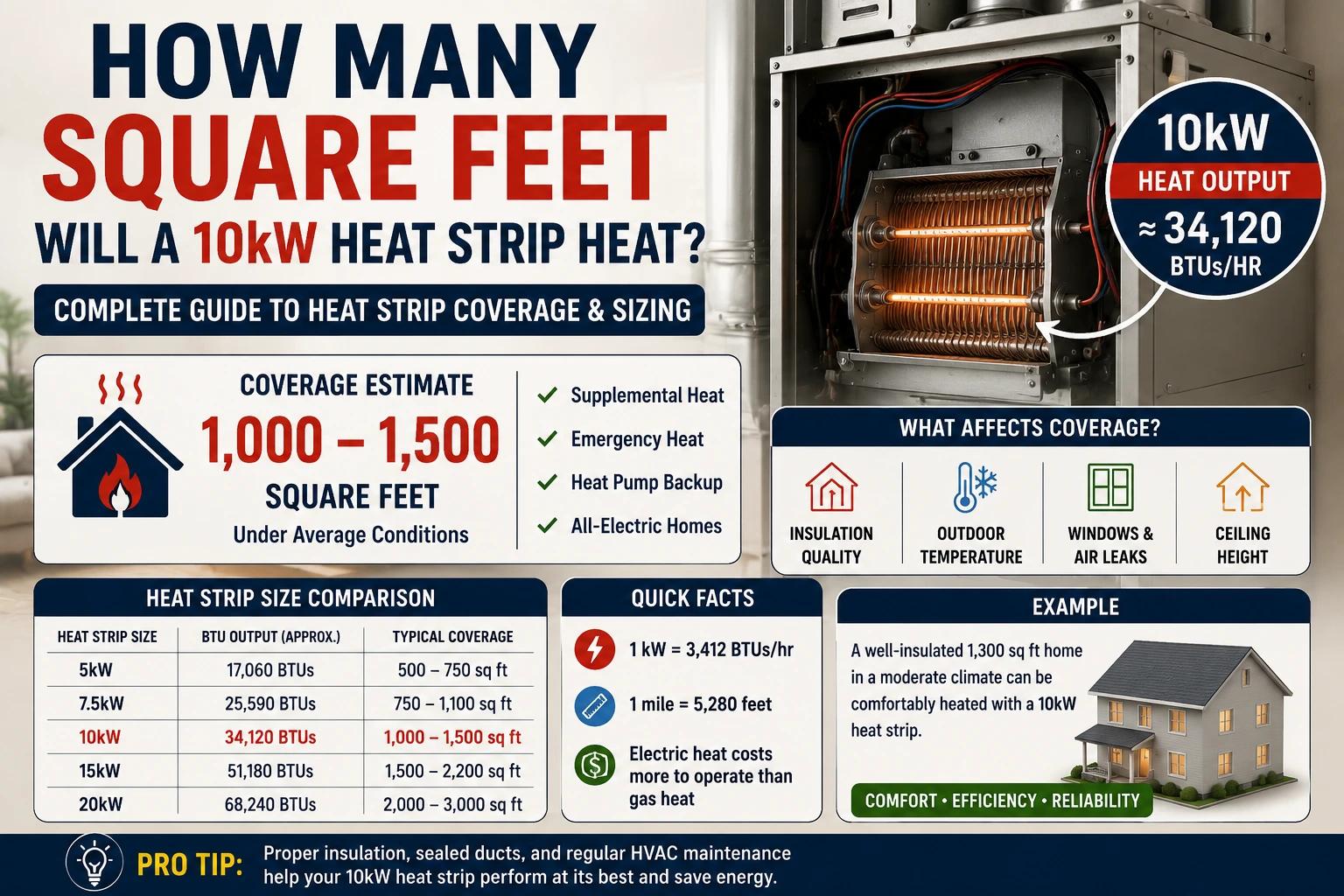
If you are asking “how many square feet will a 10kW heat strip heat,” the short answer is that a 10kW heat strip can typically heat around 1,000 to 1,500 square feet under average conditions. However, the exact coverage depends on several important factors, including insulation, climate, ceiling height, windows, and overall HVAC efficiency.
Heat strips are commonly used in electric furnaces and heat pump systems as supplemental or emergency heating. Many homeowners rely on them during colder months, especially in areas where temperatures drop below what a heat pump can efficiently handle. Choosing the correct heat strip size is important because an undersized unit may struggle to heat your home, while an oversized unit can increase electricity costs unnecessarily.
In this guide, you will learn how 10kW heat strips work, how much square footage they can heat, BTU calculations, sizing formulas, efficiency tips, and common mistakes homeowners make when choosing electric heat strips.
What Is a 10kW Heat Strip?
A heat strip is an electric heating element installed inside an HVAC air handler or furnace. It works similarly to a giant toaster by converting electricity into heat.
How Heat Strips Work
When your thermostat calls for heat, electricity passes through heating coils inside the air handler. The coils become hot, and the HVAC blower pushes warm air throughout the home.
Heat strips are often used:
- As backup heat for heat pumps
- In all-electric homes
- During emergency heating situations
- In mobile homes and apartments
Unlike gas furnaces, heat strips do not burn fuel. Instead, they rely completely on electricity.
Common HVAC Applications
A 10kW heat strip is commonly installed in:
- Residential heat pump systems
- Manufactured homes
- Small to medium-sized houses
- Supplemental heating systems
Because electric heat strips are easy to install, many HVAC systems use them for auxiliary heating.
How Many Square Feet Will a 10kW Heat Strip Heat Exactly?
A standard 10kW heat strip usually heats:
- Approximately 1,000 to 1,500 square feet
This estimate assumes:
- Average insulation
- Standard 8-foot ceilings
- Moderate winter climate
- Properly sealed windows and doors
Average Square Footage Estimate
| Heat Strip Size | Approximate Coverage |
|---|---|
| 5kW | 500–750 sq ft |
| 7.5kW | 750–1,100 sq ft |
| 10kW | 1,000–1,500 sq ft |
| 15kW | 1,500–2,200 sq ft |
| 20kW | 2,000–3,000 sq ft |
These are general estimates only. Actual performance depends heavily on your home’s energy efficiency.
BTU Output Calculation
A 10kW heat strip produces approximately:
10,000 watts×3.412=34,120 BTUs per hour
This means a 10kW heat strip generates around 34,120 BTUs of heat output per hour.
Understanding Heat Strip Heating Capacity
To understand heating coverage better, it helps to know how watts and BTUs relate.
Watts to BTU Conversion
Electric heat is often measured in kilowatts (kW), while HVAC capacity is commonly measured in BTUs.
The conversion formula is:
1 kW=3,412 BTUs/hour
Using this formula:
10 kW=34,120 BTUs/hour
This BTU rating determines how much heating power the system can provide.
Factors Affecting Heating Performance
Even though a 10kW strip produces the same BTU output everywhere, actual heating coverage varies because of:
- Home insulation
- Air leaks
- Outdoor temperatures
- Ceiling height
- Duct efficiency
- Sun exposure
Two homes with the same square footage may require completely different heating capacities.
10kW Heat Strip Coverage Table
| Home Condition | Estimated Coverage |
|---|---|
| Excellent insulation | 1,500–1,700 sq ft |
| Average insulation | 1,000–1,500 sq ft |
| Poor insulation | 700–1,000 sq ft |
| Very cold climates | Lower coverage |
| Mild climates | Higher coverage |
This table shows why square footage alone does not determine heating needs.
Factors That Affect How Much Area a 10kW Heat Strip Can Heat
Several important variables influence heating performance.
Insulation Quality
Good insulation reduces heat loss and allows the heat strip to warm larger spaces efficiently.
Homes with:
- Modern insulation
- Double-pane windows
- Proper attic sealing
usually require less heating power.
Poorly insulated homes lose heat quickly, reducing effective coverage.
Ceiling Height
Most heating estimates assume:
- 8-foot ceilings
Higher ceilings increase room volume, meaning more air must be heated.
For example:
- A 1,200 sq ft home with 12-foot ceilings may require more heating than a 1,500 sq ft home with standard ceilings.
Climate and Outdoor Temperature
Climate significantly affects heat strip performance.
In mild southern climates:
- A 10kW strip may comfortably heat 1,500 sq ft or more.
In colder northern climates:
- The same system may struggle beyond 1,000 sq ft.
Window Efficiency
Older windows can dramatically increase heat loss.
Energy-efficient windows help:
- Maintain indoor temperatures
- Reduce HVAC runtime
- Lower electricity bills
Large single-pane windows often reduce heating efficiency.
10kW Heat Strip vs Other Heat Strip Sizes
Comparing heat strip sizes helps homeowners choose the correct option.
5kW vs 10kW
| Feature | 5kW | 10kW |
|---|---|---|
| BTU Output | 17,060 BTUs | 34,120 BTUs |
| Typical Coverage | 500–750 sq ft | 1,000–1,500 sq ft |
| Electricity Use | Lower | Higher |
A 10kW unit provides roughly double the heating power of a 5kW strip.
15kW vs 10kW
| Feature | 10kW | 15kW |
|---|---|---|
| BTU Output | 34,120 BTUs | 51,180 BTUs |
| Coverage | 1,000–1,500 sq ft | 1,500–2,200 sq ft |
| Operating Cost | Moderate | Higher |
Larger homes often require 15kW systems for sufficient heating.
How to Calculate Heating Needs for Your Home
Professional HVAC sizing uses detailed load calculations, but simple estimates can provide a starting point.
Basic Square Footage Formula
A rough estimate uses:
- 20 to 30 BTUs per square foot
Example:
1,200 sq ft×25 BTUs=30,000 BTUs
Since a 10kW strip produces about 34,120 BTUs, it may adequately heat this space.
Manual BTU Estimation
Factors increasing BTU needs include:
- Cold climates
- Poor insulation
- Large windows
- High ceilings
Factors reducing BTU needs include:
- Energy-efficient construction
- Mild climates
- Compact layouts
Common Mistakes When Sizing Heat Strips
Many homeowners make sizing errors that affect comfort and efficiency.
Choosing Based Only on Square Footage
Square footage alone does not determine heating requirements.
Two identical-sized homes may need completely different heating capacities because of insulation and climate differences.
Ignoring Electrical Capacity
A 10kW heat strip requires significant electrical power.
Improper electrical setup can:
- Trip breakers
- Reduce efficiency
- Create safety hazards
Always verify electrical compatibility.
Oversizing the Heat Strip
Bigger is not always better.
Oversized systems may:
- Increase electricity costs
- Cycle too frequently
- Reduce efficiency
Neglecting Ductwork Efficiency
Leaky ducts waste heated air before it reaches living spaces.
Poor ductwork can reduce effective heating performance significantly.
Benefits and Drawbacks of 10kW Heat Strips
Advantages
Benefits include:
- Reliable supplemental heat
- Simple installation
- No gas combustion
- Fast heating response
- Good compatibility with heat pumps
Limitations
Potential drawbacks include:
- Higher electricity usage
- Increased utility bills
- Reduced efficiency in extreme cold
- Dependence on proper insulation
Electric resistance heating is effective but usually costs more to operate than gas heating systems.
Expert HVAC Tips for Better Heating Efficiency
HVAC professionals recommend:
- Sealing air leaks
- Improving attic insulation
- Replacing old windows
- Using programmable thermostats
- Cleaning HVAC filters regularly
- Scheduling annual HVAC inspections
These improvements can help a 10kW heat strip heat larger spaces more efficiently.
Real-World Examples of 10kW Heat Strip Performance
Example 1: Well-Insulated Home
A modern 1,400 sq ft home in a mild climate may heat comfortably with a 10kW strip.
Example 2: Older Home
A poorly insulated 1,200 sq ft home in a cold climate may struggle with only 10kW of heat.
Example 3: Mobile Home
Many manufactured homes between 900 and 1,300 sq ft use 10kW heat strips successfully.
9. FAQs
How many square feet will a 10kW heat strip heat?
A 10kW heat strip typically heats around 1,000 to 1,500 square feet under average conditions.
How many BTUs does a 10kW heat strip produce?
A 10kW heat strip produces approximately 34,120 BTUs per hour.
Is a 10kW heat strip enough for a 1500 sq ft home?
It may be sufficient in a well-insulated home with moderate winter temperatures.
Does insulation affect heat strip performance?
Yes, insulation greatly impacts how efficiently a heat strip can heat a space.
Are heat strips expensive to run?
Electric heat strips can increase electricity costs because resistance heating uses significant power.
10. Conclusion
Understanding how many square feet will a 10kW heat strip heat helps homeowners choose the right HVAC setup for comfort and efficiency. In most cases, a 10kW heat strip can heat approximately 1,000 to 1,500 square feet, depending on insulation, climate, ceiling height, and overall home efficiency. With an output of about 34,120 BTUs per hour, this heating option works well for many residential heat pump systems and supplemental heating applications. However, accurate HVAC sizing should always consider more than square footage alone. By improving insulation, sealing air leaks, and maintaining your HVAC system properly, you can maximize the performance and efficiency of a 10kW heat strip throughout the winter season.
Discover more