

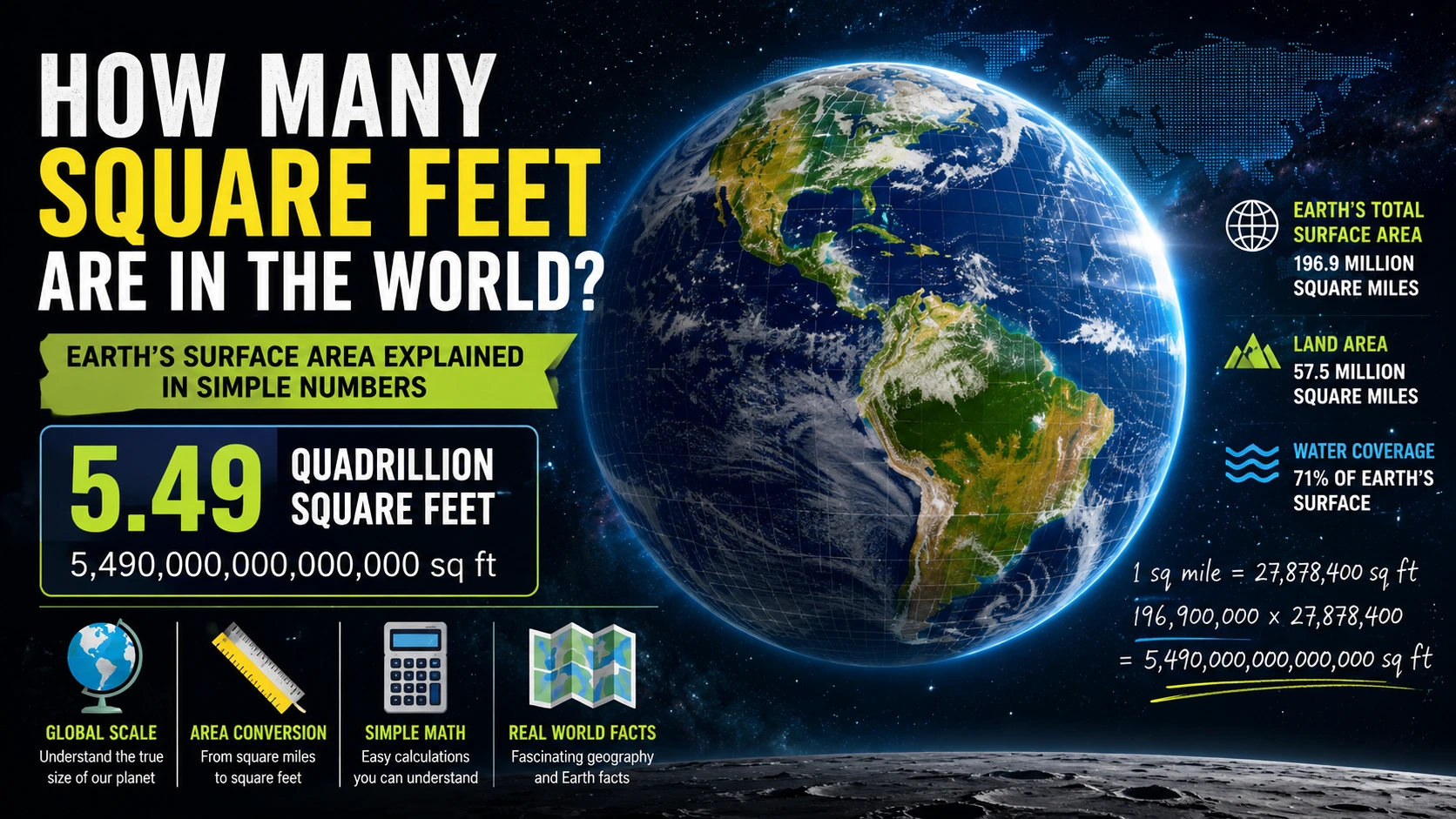
When people ask “how many square feet are in the world,” they are usually referring to the total surface area of Earth expressed in square feet. While square feet are commonly used to measure homes, offices, and land parcels, applying this unit to an entire planet creates an incredibly large number.
The Earth covers hundreds of millions of square miles. Once converted into square feet, the figure becomes almost impossible to imagine. In this guide, we’ll break down the calculation, explain the science behind Earth’s surface area, and provide practical comparisons to help you understand just how enormous our planet really is.
Understanding What “The World” Means
Before calculating the number of square feet in the world, we need to clarify what “the world” means.
The term can refer to:
- The entire surface of Earth, including oceans, lakes, rivers, and land.
- Only the land area of Earth, excluding water bodies.
These two measurements produce very different answers.
For most scientific calculations, the world’s size refers to the total surface area of Earth.
How Many Square Feet Are in the World? Quick Answer
The Earth’s total surface area is approximately:
- 196.9 million square miles
- 5.49 quadrillion square feet
That means the world contains roughly:
5,490,000,000,000,000 square feet
or
5.49 quadrillion square feet.
If you only count Earth’s land area, the figure is approximately:
1.61 quadrillion square feet
because land covers only about 29% of the planet’s surface.
Earth’s Surface Area Explained
To understand where these numbers come from, let’s look at Earth’s composition.
Total Surface Area
Earth’s total surface area is approximately:
| Measurement | Value |
|---|---|
| Square kilometers | 510 million km² |
| Square miles | 196.9 million mi² |
| Square feet | 5.49 quadrillion ft² |
This measurement includes every ocean, continent, island, desert, forest, and ice sheet on the planet.
Water Coverage
Water dominates Earth’s surface.
Approximately:
- 71% of Earth is covered by water.
- Oceans contain about 96.5% of all Earth’s water.
- Water area equals roughly 139 million square miles.
The Pacific Ocean alone covers more area than all of Earth’s land combined.
Land Coverage
Land makes up about:
- 29% of Earth’s surface
- 57.5 million square miles
This includes:
- Continents
- Islands
- Mountains
- Deserts
- Forests
- Agricultural land
- Urban areas
Converting Earth’s Area Into Square Feet
Let’s calculate the answer step by step.
Square Miles to Square Feet Formula
The standard conversion is:
1 square mile=27,878,400 square feet
Step-by-Step Calculation
Earth’s surface area:
196.9 million square miles
Calculation:
196,900,000 × 27,878,400
Result:
5,489,256,960,000,000 square feet
Rounded:
5.49 quadrillion square feet
This is the most widely accepted estimate when discussing the square footage of the entire world.
Total Land Area of Earth in Square Feet
Some people are more interested in how many square feet of land exist rather than total surface area.
Earth contains approximately:
- 57.5 million square miles of land
Converting:
57,500,000 × 27,878,400
Result:
1,603,008,000,000,000 square feet
Rounded:
1.6 quadrillion square feet of land
This includes all habitable and uninhabitable land masses.
Land Distribution by Continent
| Continent | Approximate Share of Land |
|---|---|
| Asia | 30% |
| Africa | 20% |
| North America | 16% |
| South America | 12% |
| Antarctica | 9% |
| Europe | 7% |
| Australia | 6% |
Earth Area Conversion Table
The following table shows Earth’s size using different units.
| Unit | Earth’s Total Surface Area |
|---|---|
| Square Kilometers | 510 Million |
| Square Miles | 196.9 Million |
| Acres | 126 Billion |
| Square Feet | 5.49 Quadrillion |
| Square Inches | 790.4 Quadrillion |
These conversions help scientists, geographers, and engineers compare measurements across different systems.
Visualizing How Large That Number Really Is
A figure like 5.49 quadrillion square feet is difficult to comprehend.
Let’s compare it with things we know.
Comparison With Average Homes
An average home may measure:
- 2,000 square feet
Earth’s surface could fit:
- More than 2.7 trillion homes
Even if every person on Earth owned multiple houses, there would still be enormous space remaining.
Comparison With Football Fields
A standard American football field covers roughly:
- 57,600 square feet
Earth’s surface area equals approximately:
- 95 billion football fields
That’s enough fields to circle the globe countless times.
Comparison With Major Cities
Some of the world’s largest cities cover thousands of square miles.
Earth’s total area is still millions of times larger than any urban region.
This demonstrates how vast our planet truly is.
Why Measuring the World in Square Feet Matters
At first glance, measuring Earth in square feet might seem unnecessary. However, it has practical applications.
Education
Teachers often use area conversions to help students understand:
- Scale
- Measurement systems
- Geography
- Mathematics
Science
Scientists calculate Earth’s surface area when studying:
- Climate change
- Ocean coverage
- Ecosystems
- Population distribution
Urban Planning
Governments and planners use area measurements for:
- Land development
- Infrastructure planning
- Resource allocation
Environmental Studies
Understanding Earth’s size helps researchers track:
- Deforestation
- Agricultural expansion
- Habitat loss
- Conservation efforts
Common Mistakes When Calculating Earth’s Area
Many people make errors when converting planetary measurements.
Confusing Land Area With Total Area
Earth’s total surface area includes oceans.
Using land area alone significantly reduces the answer.
Using Linear Instead of Square Measurements
A square mile is not converted the same way as a mile.
Area measurements must be squared during conversion.
Forgetting Water Coverage
Since oceans cover most of Earth, excluding them removes more than two-thirds of the planet’s surface area.
Rounding Too Early
Because Earth’s area involves huge numbers, excessive rounding can create large inaccuracies.
Interesting Facts About Earth’s Surface Area
Here are some fascinating facts about the world’s size:
- Earth’s total surface area is about 510 million square kilometers.
- Oceans cover roughly 361 million square kilometers.
- Land covers approximately 149 million square kilometers.
- Antarctica alone spans around 5.4 million square miles.
- The Pacific Ocean covers more than 63 million square miles.
- Only a small percentage of Earth’s land is heavily urbanized.
- Most of Earth’s surface remains untouched by major development.
These facts help put the planet’s immense scale into perspective.
How Earth’s Surface Compares to Other Planets
Although Earth feels enormous, it is not the largest planet in our solar system.
| Planet | Relative Surface Area |
|---|---|
| Mercury | Smaller than Earth |
| Mars | About 28% of Earth’s area |
| Venus | Similar to Earth |
| Jupiter | More than 120 times Earth’s surface area |
| Saturn | Vastly larger than Earth |
This comparison highlights both the size of Earth and the immense scale of our solar system.
Frequently Asked Questions
1. How many square feet are in the world exactly?
Earth contains approximately 5.49 quadrillion square feet of total surface area.
2. How many square feet of land are on Earth?
Earth has roughly 1.6 quadrillion square feet of land area.
3. What percentage of Earth is land?
About 29% of Earth’s surface is land, while approximately 71% is covered by water.
4. Why is Earth’s area measured in square feet?
Square feet provide a familiar unit of measurement that helps people visualize large areas through conversion.
5. How many acres are in the world?
Earth’s total surface area equals approximately 126 billion acres.
Conclusion
If you’ve ever wondered how many square feet are in the world, the answer is approximately 5.49 quadrillion square feet when considering Earth’s entire surface area. This includes both land and water. If you’re interested only in land, Earth contains about 1.6 quadrillion square feet.
While these numbers are almost too large to imagine, converting Earth’s surface into square feet provides an interesting way to understand the immense scale of our planet. Whether you’re studying geography, performing area conversions, or simply satisfying your curiosity, knowing how many square feet are in the world offers a fascinating perspective on the size of Earth and our place upon it.
Discover more
how many feet above sea level is houston