

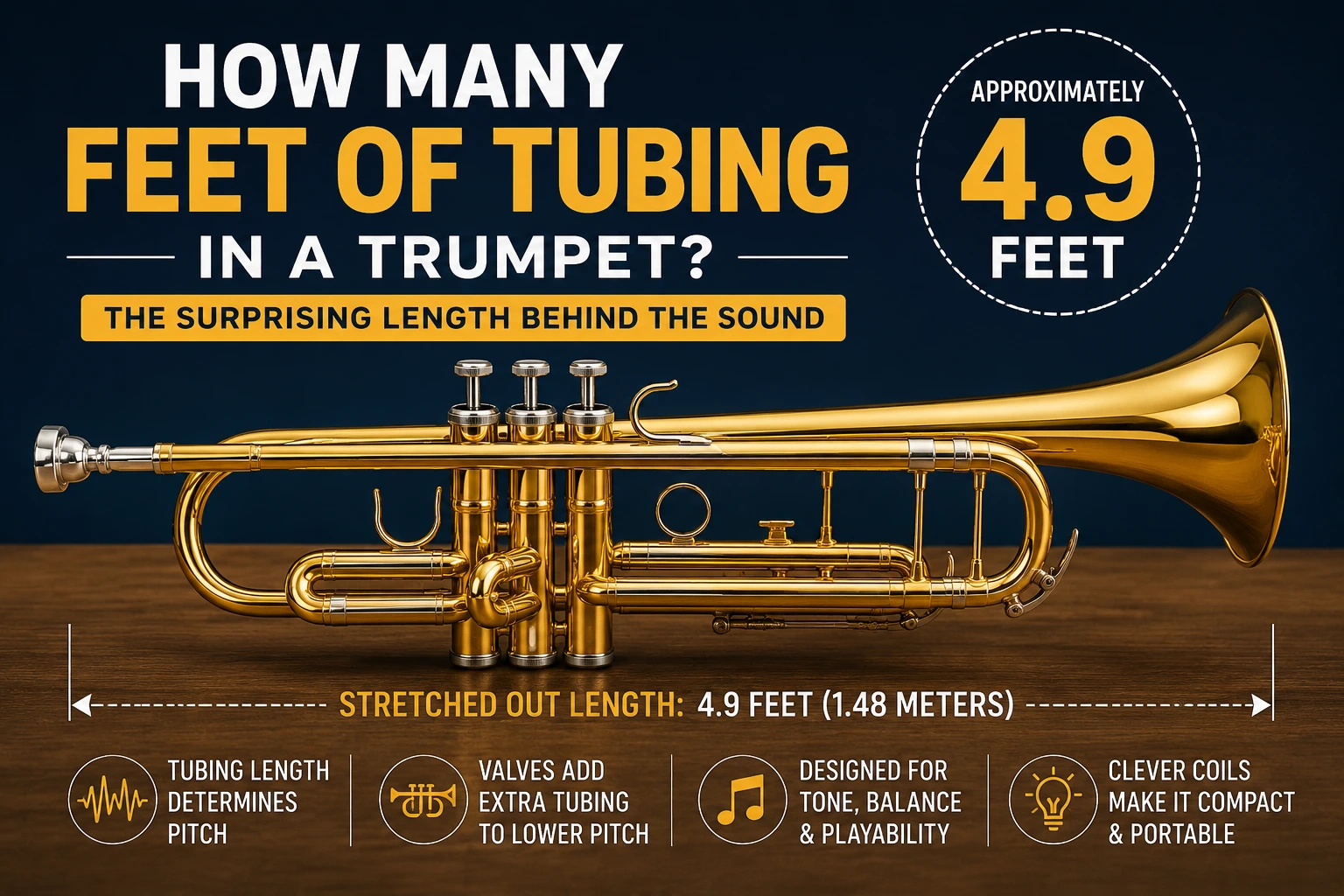
If you’ve ever looked at a trumpet, you may have wondered: how many feet of tubing in a trumpet? Although a trumpet appears compact, it actually contains a surprising amount of tubing packed into its curved design.
A standard Bb trumpet contains approximately 4.9 feet (1.48 meters) of tubing. If all the tubing were stretched into a straight line, it would be nearly five feet long. This tubing length is one of the most important factors determining the instrument’s pitch, tone, and playability.
Understanding trumpet tubing length helps musicians appreciate how brass instruments work and why their design has remained largely unchanged for centuries. In this guide, we’ll explore trumpet measurements, tubing length, acoustics, valve systems, and fascinating facts about this popular brass instrument.
Quick Answer: How Much Tubing Does a Trumpet Have?
For those looking for a quick answer:
| Trumpet Type | Approximate Tubing Length |
|---|---|
| Bb Trumpet | 4.9 feet (1.48 m) |
| C Trumpet | 4.5 feet (1.37 m) |
| Piccolo Trumpet | 2.3 feet (0.7 m) |
| Bass Trumpet | 8–9 feet (2.4–2.7 m) |
The most common trumpet used in schools, bands, and orchestras is the Bb trumpet, which contains approximately 4.9 feet of tubing.
Understanding Trumpet Tubing Length
To understand how many feet of tubing in a trumpet, it’s helpful to learn how brass instruments produce sound.
Unlike string instruments, brass instruments rely on vibrating air columns. When a player buzzes their lips into the mouthpiece, the air travels through the tubing and creates sound waves.
The total length of the tubing directly affects the instrument’s fundamental pitch.
Why Tubing Length Matters
The longer the tubing:
- The lower the pitch
- The deeper the sound
- The larger the instrument generally becomes
The shorter the tubing:
- The higher the pitch
- The brighter the sound
- The more compact the instrument
This principle applies to all brass instruments.
The Relationship Between Length and Pitch
A trumpet’s tubing length determines its key. Most standard trumpets are tuned to Bb because approximately 4.9 feet of tubing produces the correct fundamental pitch for that key.
Even slight changes in tubing length can affect tuning accuracy.
How Many Feet of Tubing in a Standard Bb Trumpet?
A standard Bb trumpet contains approximately:
4 feet 10 inches to 4 feet 11 inches (about 4.9 feet)
Or:
- 58–59 inches
- 1.48 meters
This measurement includes:
- Leadpipe
- Main tuning slide
- Valve slides
- Bell section tubing
When combined, all these components create the total air pathway inside the instrument.
Exact Measurements
While manufacturers vary slightly, most professional Bb trumpets fall within a very small range:
| Manufacturer Type | Tubing Length |
|---|---|
| Student Trumpet | 4.8–4.9 feet |
| Intermediate Trumpet | 4.9 feet |
| Professional Trumpet | 4.9–5.0 feet |
Small differences mainly affect response and intonation rather than the instrument’s key.
Why Most Trumpets Use This Length
Instrument makers have determined over centuries that roughly five feet of tubing offers the ideal balance between:
- Playability
- Tone quality
- Projection
- Tuning stability
That’s why modern Bb trumpets are remarkably consistent worldwide.
What Happens If You Stretch Out All the Tubing?
Many people are surprised to learn that a trumpet contains almost five feet of tubing despite being only about 19 inches long physically.
This is possible because the tubing is carefully wrapped into loops and curves.
If you could completely straighten the tubing:
- It would stretch nearly five feet long
- It would be difficult to hold
- Valve placement would become impractical
- Transport would be inconvenient
The coiled design makes the instrument compact while preserving the required acoustic length.
How Trumpet Valves Change Tubing Length
One of the most ingenious aspects of trumpet design is the valve system.
The three valves allow players to alter pitch by adding extra tubing.
First Valve
The first valve adds extra tubing that lowers the pitch by approximately a whole step.
Additional tubing:
- About 3 inches
Second Valve
The second valve lowers pitch by a half step.
Additional tubing:
- About 1.5 inches
Third Valve
The third valve lowers pitch by approximately one and a half steps.
Additional tubing:
- About 6 inches
Combined Valve Lengths
When valves are combined:
| Valve Combination | Additional Tubing |
|---|---|
| 1 | Moderate |
| 2 | Small |
| 3 | Large |
| 1+2 | Greater |
| 2+3 | Significant |
| 1+3 | Large |
| 1+2+3 | Maximum |
This system allows the trumpet to produce a full chromatic scale.
Trumpet Tubing Length Compared to Other Brass Instruments
Trumpets may seem large until compared with other brass instruments.
| Instrument | Tubing Length |
|---|---|
| Piccolo Trumpet | 2.3 feet |
| Bb Trumpet | 4.9 feet |
| Flugelhorn | 5.5 feet |
| Trombone | 9 feet |
| French Horn | 12–18 feet |
| Tuba | 16–20 feet |
This comparison shows why tubas produce very low notes and why piccolo trumpets play much higher pitches.
Why Is a Trumpet Coiled Instead of Straight?
A straight five-foot brass tube would be awkward and difficult to play.
The coiled design offers several advantages:
Improved Portability
Musicians can easily carry the instrument.
Better Balance
Weight is distributed evenly in the hands.
Easier Valve Placement
Valves can be positioned comfortably for finger movement.
Enhanced Durability
Compact instruments are less likely to bend or become damaged.
This clever engineering has helped make the trumpet one of the world’s most popular brass instruments.
How Tubing Length Affects Sound Quality
Tubing length influences much more than pitch.
Tone
Longer tubing often creates:
- Richer tones
- Warmer sounds
- Greater depth
Shorter tubing typically produces:
- Brighter tones
- More brilliance
- Faster response
Intonation
Precise tubing measurements help maintain accurate tuning across all notes.
Even a small manufacturing error can affect performance.
Projection
The relationship between tubing, bell design, and air flow determines how effectively sound carries through a concert hall or stadium.
Different Trumpet Types and Their Tubing Lengths
Not all trumpets have the same tubing length.
Bb Trumpet
Most common trumpet worldwide.
Tubing:
- Approximately 4.9 feet
Uses:
- School bands
- Jazz ensembles
- Concert bands
- Solo performance
C Trumpet
Common in orchestras.
Tubing:
- Approximately 4.5 feet
Characteristics:
- Slightly brighter sound
- Easier orchestral transposition
Piccolo Trumpet
Very small trumpet.
Tubing:
- Approximately 2.3 feet
Characteristics:
- Extremely high range
- Brilliant tone
Bass Trumpet
Much larger instrument.
Tubing:
- Approximately 8–9 feet
Characteristics:
- Lower register
- Darker sound
Interesting Facts About Trumpet Tubing
Here are some fascinating facts:
- Modern trumpets contain nearly five feet of tubing.
- Ancient trumpets were often straight rather than coiled.
- The trumpet’s tubing diameter gradually widens toward the bell.
- Valves were not widely adopted until the 19th century.
- Professional trumpet makers measure tubing with extreme precision.
- Tiny changes in tubing length can noticeably affect tuning.
These details demonstrate the remarkable engineering behind the instrument.
Common Misconceptions About Trumpet Length
A Bigger Trumpet Always Means More Tubing
Not necessarily. Different wraps and designs can make instruments appear larger or smaller.
The Bell Determines Pitch
The bell influences tone and projection, but tubing length primarily determines pitch.
All Trumpets Have the Same Length
Different trumpet types have significantly different tubing lengths.
Valves Create Notes by Themselves
Valves only redirect air through additional tubing. The player’s lips and airflow actually create the sound.
Expert Tips for Trumpet Players
If you’re learning trumpet, keep these tips in mind:
Maintain Clean Tubing
Dirt buildup can restrict airflow and affect tone.
Empty Water Frequently
Condensation accumulates inside the tubing during play.
Check Valve Alignment
Poorly aligned valves can disrupt airflow.
Tune Regularly
Use the tuning slide to maintain accurate pitch.
Handle Slides Carefully
Bent slides can affect tubing length and intonation.
Good maintenance helps preserve the instrument’s designed acoustics.
Frequently Asked Questions
1. How many feet of tubing in a trumpet exactly?
A standard Bb trumpet contains approximately 4.9 feet (1.48 meters) of tubing.
2. Why does a trumpet need so much tubing?
The tubing length determines the instrument’s pitch and allows it to play in the key of Bb.
3. Is all trumpet tubing the same length?
No. Different trumpet types such as C trumpets, piccolo trumpets, and bass trumpets have different tubing lengths.
4. How much tubing do trumpet valves add?
The valves add varying lengths of tubing, allowing players to lower pitch and play additional notes.
5. What brass instrument has the longest tubing?
The tuba generally has the longest tubing among common brass instruments, often exceeding 16 feet.
Conclusion
So, how many feet of tubing in a trumpet? The answer is approximately 4.9 feet of tubing in a standard Bb trumpet. While the instrument appears compact, nearly five feet of carefully coiled brass tubing create the air pathway that produces its distinctive sound.
This tubing length plays a critical role in determining pitch, tone, tuning, and overall performance. Whether you’re a beginner musician, a curious student, or simply interested in instrument design, understanding trumpet tubing reveals the remarkable engineering behind one of the world’s most recognizable brass instruments.
discover more
how many feet per second is 1 mph