
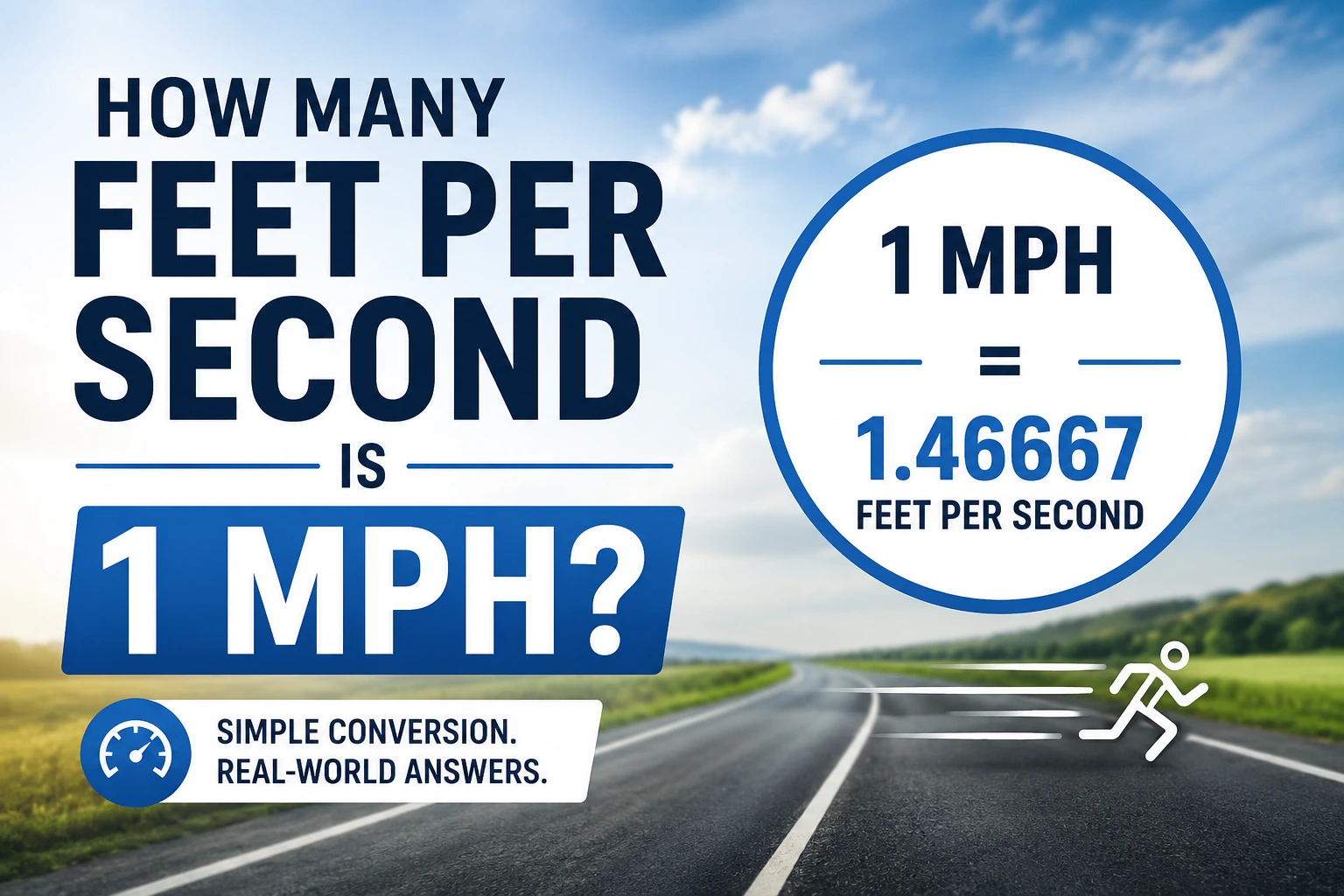
If you’ve ever wondered how many feet per second is 1 mph, you’re not alone. Speed conversions are common in physics, engineering, transportation, sports analysis, and everyday calculations.
The simple answer is:
1 mph=1.46667 ft/s
So, a speed of 1 mile per hour equals approximately 1.47 feet per second.
While that answer is straightforward, understanding how the conversion works can help you solve many other speed-related problems. In this guide, you’ll learn the exact formula, practical examples, conversion charts, and useful tips for converting miles per hour to feet per second quickly and accurately.
Understanding MPH and Feet Per Second
Before diving deeper into how many feet per second is 1 mph, it’s helpful to understand what these units measure.
What Is MPH?
MPH stands for miles per hour.
It measures how many miles an object travels in one hour. This unit is commonly used in:
- Road speed limits
- Vehicle speedometers
- Transportation systems
- Aviation and logistics
For example:
- Walking speed: 3–4 mph
- Running speed: 6–10 mph
- City driving speed: 25–35 mph
- Highway driving speed: 55–75 mph
What Is Feet Per Second?
Feet per second (ft/s or fps) measures how many feet an object travels in one second.
This unit is often used in:
- Physics calculations
- Engineering projects
- Ballistics
- Sports performance analysis
- Construction planning
Because it measures movement per second rather than per hour, it can provide a more detailed picture of motion.
How Many Feet Per Second Is 1 MPH?
The exact conversion is:
1 mph=1.4666667 ft/s
Rounded to two decimal places:
1 mph = 1.47 feet per second
This means an object moving at 1 mile per hour travels approximately 1.47 feet every second.
Quick Conversion Formula
To convert miles per hour into feet per second, use:
ft/s=mph×1.46667
This conversion factor works for any speed measured in miles per hour.
For example:
- 5 mph × 1.46667 = 7.33 ft/s
- 10 mph × 1.46667 = 14.67 ft/s
- 20 mph × 1.46667 = 29.33 ft/s
Step-by-Step Conversion of MPH to Feet Per Second
Let’s see where the conversion factor comes from.
Step 1: Convert Miles to Feet
One mile equals:
1 mile=5280 feet
Step 2: Convert Hours to Seconds
One hour equals:60×60=3600 seconds
Step 3: Divide Distance by Time
36005280=1.4666667
Therefore:1 mph=1.4666667 ft/s
This is the exact reason why every mph value is multiplied by 1.46667 when converting to feet per second.
Why Convert MPH to Feet Per Second?
Many technical and practical situations require speeds to be expressed in feet per second rather than miles per hour.
Some reasons include:
Better Precision
Feet per second gives a more detailed measurement for short-distance movement.
Engineering Calculations
Engineers often work with feet and seconds when designing structures or analyzing motion.
Physics Problems
Most introductory physics exercises involve distance traveled per second.
Sports Analysis
Athletes’ speeds are sometimes evaluated in feet per second to measure acceleration and performance.
Safety Calculations
Stopping distances and reaction times are easier to calculate using feet per second.
MPH to Feet Per Second Conversion Chart
Here’s a handy conversion table.
| MPH | Feet Per Second |
|---|---|
| 1 | 1.47 |
| 2 | 2.93 |
| 3 | 4.40 |
| 4 | 5.87 |
| 5 | 7.33 |
| 10 | 14.67 |
| 15 | 22.00 |
| 20 | 29.33 |
| 25 | 36.67 |
| 30 | 44.00 |
| 40 | 58.67 |
| 50 | 73.33 |
| 60 | 88.00 |
| 70 | 102.67 |
| 80 | 117.33 |
This chart can save time when performing quick speed conversions.
Real-World Examples of 1 MPH in Feet Per Second
Understanding how many feet per second is 1 mph becomes easier when you see it in everyday situations.
Example 1: Walking Slowly
An individual walking at approximately 1 mph moves about:
- 1.47 feet every second
- 88 feet every minute
This is a slow strolling pace.
Example 2: Shopping Cart Movement
A shopping cart being pushed gently across a store floor may move close to 1 mph.
Every second it travels roughly:
- 1.47 feet
Example 3: Mobility Devices
Some mobility scooters and wheelchairs operate at speeds near 1 mph in certain controlled environments.
The same conversion applies.
Example 4: Construction Equipment
Slow-moving machinery often travels at low speeds measured in mph, but engineers frequently convert those values into feet per second for calculations.
Common MPH to FPS Conversions
Many people need conversions beyond 1 mph.
Here are some common examples.
| Speed (MPH) | Feet Per Second |
|---|---|
| 1 mph | 1.47 ft/s |
| 5 mph | 7.33 ft/s |
| 10 mph | 14.67 ft/s |
| 15 mph | 22.00 ft/s |
| 20 mph | 29.33 ft/s |
| 30 mph | 44.00 ft/s |
| 40 mph | 58.67 ft/s |
| 50 mph | 73.33 ft/s |
| 60 mph | 88.00 ft/s |
A useful shortcut is remembering:
- 10 mph ≈ 15 ft/s
- 30 mph ≈ 44 ft/s
- 60 mph ≈ 88 ft/s
Practical Applications of MPH to FPS Conversion
Physics
Physics students frequently convert speeds when solving problems involving:
- Motion
- Acceleration
- Velocity
- Distance traveled
Feet per second often fits better into equations using feet and seconds.
Engineering
Civil and mechanical engineers use feet per second when evaluating:
- Traffic flow
- Machine operation
- Structural performance
- Moving equipment
Sports
Sports analysts sometimes measure:
- Sprint speed
- Running velocity
- Athlete acceleration
Feet per second can provide more detailed performance metrics.
Transportation
Transportation planners use speed conversions for:
- Traffic studies
- Road design
- Pedestrian movement analysis
- Safety evaluations
Common Mistakes When Converting MPH to Feet Per Second
When learning how many feet per second is 1 mph, people often make these mistakes.
Using the Wrong Conversion Factor
The correct multiplier is:
1.46667
Using incorrect values can produce significant errors.
Forgetting to Convert Hours Into Seconds
Many mistakes occur because people remember that a mile equals 5,280 feet but forget that an hour contains 3,600 seconds.
Rounding Too Early
For greater accuracy:
- Use 1.46667 during calculations
- Round only at the final step
Mixing Unit Systems
Avoid combining:
- Miles with meters
- Feet with kilometers
- Hours with seconds
Always keep units consistent.
Expert Tips for Fast Speed Conversions
Here are a few professional shortcuts.
Memorize the Core Number
Remember:
1 mph = 1.47 ft/s
Everything else becomes easy.
Estimate Quickly
For rough calculations:
- Multiply mph by 1.5
Example:
20 mph × 1.5 ≈ 30 ft/s
Actual answer:
29.33 ft/s
The estimate is close enough for many situations.
Use Reference Speeds
Memorize these benchmarks:
- 10 mph = 14.67 ft/s
- 30 mph = 44 ft/s
- 60 mph = 88 ft/s
They help with mental math.
Double-Check Units
Always confirm whether a problem requires:
- Feet per second
- Meters per second
- Miles per hour
Using the wrong unit is one of the most common conversion errors.
FAQs
1. How many feet per second is exactly 1 mph?
Exactly, 1 mph equals 1.4666667 feet per second. Rounded to two decimal places, it becomes 1.47 ft/s.
2. What formula converts mph to feet per second?
Multiply the speed in miles per hour by 1.46667.
Formula:
Feet per second = MPH × 1.46667
3. Is 1 mph faster than 1 foot per second?
Yes. Since 1 mph equals approximately 1.47 ft/s, it is faster than 1 foot per second.
4. How many feet per second is 60 mph?
60 mph equals:
60 × 1.46667 = 88 ft/s
Therefore, 60 mph is approximately 88 feet per second.
5. Why do engineers use feet per second?
Feet per second provides more detailed measurements for short time intervals and is useful for engineering, construction, transportation, and physics calculations.
Conclusion
If you’re wondering how many feet per second is 1 mph, the answer is simple: 1 mph equals approximately 1.47 feet per second. This conversion comes from the fact that one mile contains 5,280 feet and one hour contains 3,600 seconds.
Understanding the relationship between mph and feet per second makes it easier to solve physics problems, engineering calculations, transportation studies, and everyday speed conversions. By remembering the conversion factor of 1.46667, you can quickly convert any miles-per-hour value into feet per second with confidence and accuracy.
discover more
how many square feet for 10 chickens