

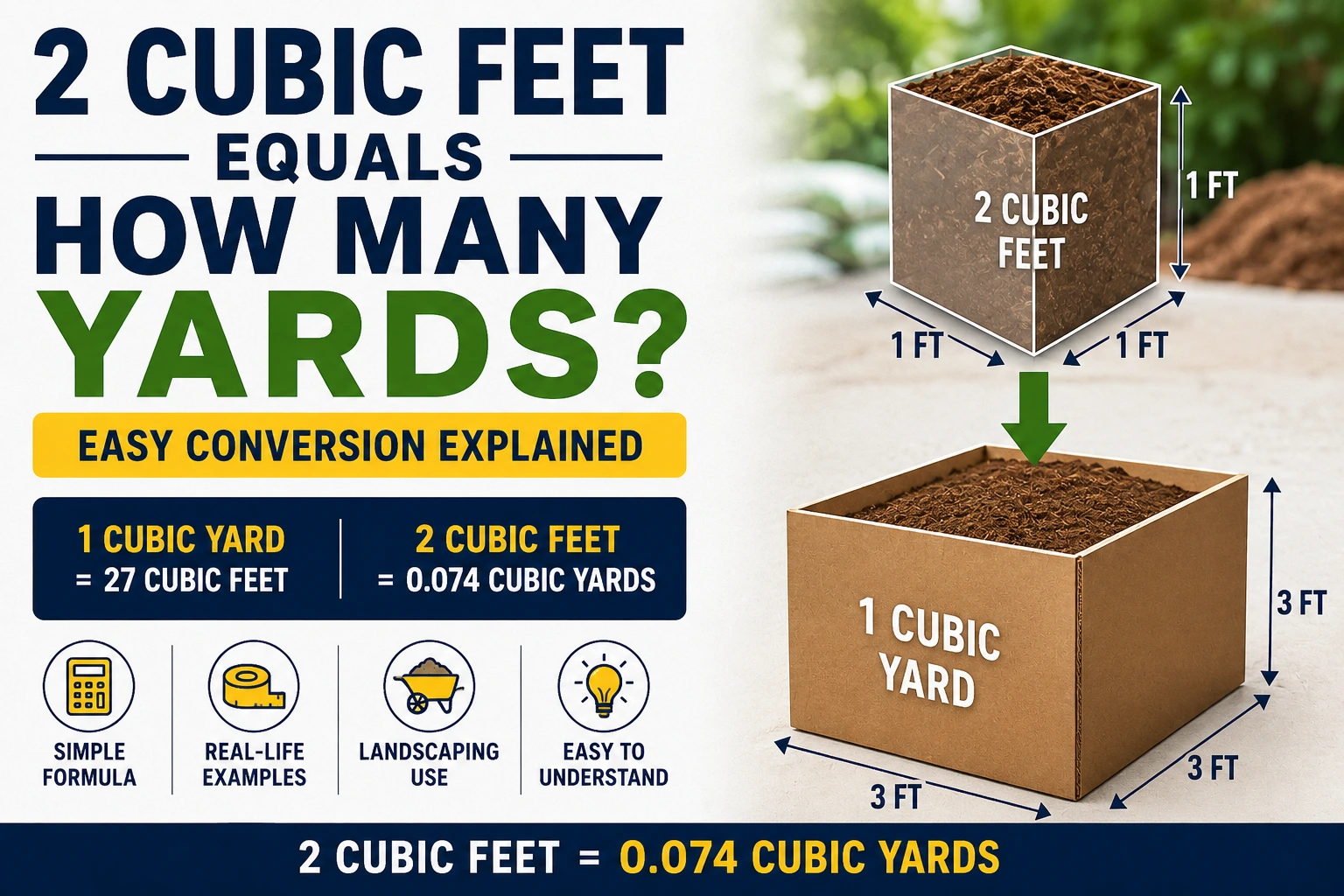
If you are wondering “2 cubic feet equals how many yards,” the quick answer is that 2 cubic feet equals approximately 0.074 cubic yards. This conversion is commonly used in landscaping, gardening, construction, and home improvement projects where materials like soil, mulch, gravel, sand, or concrete are measured in cubic yards.
Many people get confused between cubic feet and cubic yards because both measure volume, not length. Understanding how these units work can save you money, prevent ordering mistakes, and help you estimate materials more accurately.
Whether you are filling a garden bed, buying mulch, or calculating concrete, learning cubic yard conversions is an important practical skill.
Understanding Cubic Feet and Cubic Yards
Before converting measurements, it helps to understand what these units actually mean.
What Is a Cubic Foot?
A cubic foot is a unit of volume. It measures the amount of space inside a cube that is:
- 1 foot long
- 1 foot wide
- 1 foot high
Mathematically:
1 cubic foot=1 ft×1 ft×1 ft
Cubic feet are often used for:
- Small landscaping projects
- Appliance sizes
- Refrigerators
- Soil bags
- Storage space
For example:
- A bag of mulch may contain 2 cubic feet.
- A washing machine may hold several cubic feet of space.
What Is a Cubic Yard?
A cubic yard is a larger unit of volume.
It represents a cube that is:
- 3 feet long
- 3 feet wide
- 3 feet high
Mathematically:
1 cubic yard=3 ft×3 ft×3 ft
Because:
3×3×3=27
One cubic yard equals 27 cubic feet.
Cubic yards are commonly used for:
- Bulk mulch
- Gravel delivery
- Concrete
- Large landscaping jobs
- Excavation work
2 Cubic Feet Equals How Many Yards?
Now let’s answer the main question directly.
To convert cubic feet into cubic yards, divide by 27.
The formula is:
Cubic Yards=27Cubic Feet
For 2 cubic feet:
272=0.074 cubic yards
Quick Answer Explained
So:
- 2 cubic feet = 0.074 cubic yards
- Rounded value = 0.07 cubic yards
This is a very small amount compared to a full cubic yard.
To help visualize:
- One cubic yard equals 27 bags of 1 cubic foot material.
- Or about 13.5 bags of 2 cubic foot material.
Cubic Feet to Cubic Yards Conversion Chart
Here is a quick reference chart for common conversions.
| Cubic Feet | Cubic Yards |
|---|---|
| 1 cubic foot | 0.037 cubic yards |
| 2 cubic feet | 0.074 cubic yards |
| 5 cubic feet | 0.185 cubic yards |
| 10 cubic feet | 0.370 cubic yards |
| 20 cubic feet | 0.741 cubic yards |
| 27 cubic feet | 1 cubic yard |
| 54 cubic feet | 2 cubic yards |
This chart is especially useful when buying:
- Soil
- Compost
- Sand
- Decorative rock
- Concrete mixes
How to Convert Cubic Feet Into Yards Step by Step
The process is simple once you know the formula.
Simple Formula
Use this equation:
Cubic Yards=27Cubic Feet
Step 1: Identify Total Cubic Feet
First, determine how many cubic feet you have.
Example:
- 2 cubic feet
Step 2: Divide by 27
Now divide:
2÷27=0.074
Step 3: Round if Needed
Most contractors round to:
- 0.07 cubic yards
Example Calculations
Here are more examples to make the conversion easier.
Example 1: 5 Cubic Feet
5÷27=0.185 cubic yards
Example 2: 15 Cubic Feet
15÷27=0.556 cubic yards
Example 3: 54 Cubic Feet
54÷27=2 cubic yards
Real-Life Examples of 2 Cubic Feet
Understanding practical uses makes the measurement easier to remember.
Mulch Bags
Many mulch bags sold at garden centers contain:
- 2 cubic feet
If your landscaping project requires:
- 1 cubic yard of mulch
You would need:
27÷2=13.5 bags
So you would buy:
- 14 bags approximately
Soil for Gardening
Raised garden beds often use soil measured in cubic feet.
Example:
A small raised bed may require:
- 10 cubic feet of soil
Conversion:
10÷27=0.37 cubic yards
Concrete Projects
Concrete is usually ordered in cubic yards.
Small DIY projects may only need a fraction of a yard.
For example:
- Fence posts
- Small slabs
- Garden borders
Knowing how to convert cubic feet prevents over-ordering.
Why Cubic Yard Measurements Matter
Many suppliers sell bulk materials by the cubic yard.
If you do not understand conversions, you might:
- Buy too much material
- Buy too little material
- Waste money on delivery
- Delay your project
Correct calculations help you:
- Stay on budget
- Estimate accurately
- Reduce waste
- Plan transportation
This is especially important for:
- Landscaping
- Masonry
- Excavation
- Concrete work
Common Conversion Mistakes
Many people make simple but expensive errors when converting measurements.
Confusing Feet With Cubic Feet
Feet measure length.
Cubic feet measure volume.
For example:
- 3 feet is a distance
- 3 cubic feet is space volume
Forgetting to Divide by 27
Some people incorrectly multiply instead of divide.
Remember:
1 cubic yard=27 cubic feet
Ignoring Material Compression
Materials like mulch and soil settle over time.
You may need:
- Extra soil
- Additional mulch
Especially after rain or compaction.
Rounding Too Early
Rounding too soon can create inaccurate totals for large projects.
Keep decimals until final calculations.
Expert Tips for Measuring Volume Correctly
Professionals use a few simple strategies to improve accuracy.
Measure Carefully
Always measure:
- Length
- Width
- Depth
Use consistent units.
Convert Everything to Feet First
If measurements are in inches:
- Convert to feet before calculating volume.
For example:
12 inches=1 foot
Add Extra Material
Contractors often add:
- 5% to 10% extra material
This covers:
- Spillage
- Settling
- Uneven surfaces
Use Online Calculators
Many landscaping websites offer free cubic yard calculators.
These tools help estimate:
- Soil
- Gravel
- Sand
- Concrete
Cubic Feet vs Cubic Yards Comparison Table
| Feature | Cubic Feet | Cubic Yards |
|---|---|---|
| Size | Smaller unit | Larger unit |
| Best For | Small projects | Bulk projects |
| Common Use | Soil bags | Truck deliveries |
| Conversion | 27 cubic feet = 1 yard | 1 yard = 27 cubic feet |
| Typical Materials | Potting soil | Gravel and concrete |
When Should You Use Cubic Feet or Cubic Yards?
Choosing the right unit depends on project size.
Use Cubic Feet For:
- Small gardening jobs
- Indoor storage
- Appliance capacity
- Small DIY tasks
Use Cubic Yards For:
- Large landscaping jobs
- Driveways
- Concrete pouring
- Excavation projects
- Bulk material orders
As a general rule:
- Small quantities = cubic feet
- Large quantities = cubic yards
Practical Landscaping Scenario
Imagine you want to fill a flower bed.
Dimensions:
- 9 feet long
- 3 feet wide
- 0.5 feet deep
Volume formula:
Volume=Length×Width×Depth
Calculation:
9×3×0.5=13.5 cubic feet
Convert to cubic yards:
13.5÷27=0.5 cubic yards
This means you need:
- Half a cubic yard of soil
Or:
- Around 7 bags of 2 cubic foot soil
FAQs
2 cubic feet equals how many yards exactly?
2 cubic feet equals approximately 0.074 cubic yards.
How many 2 cubic foot bags make a cubic yard?
You need about 13.5 bags of 2 cubic foot material to equal 1 cubic yard.
Why do contractors use cubic yards?
Cubic yards are easier for measuring and delivering large amounts of material like concrete, gravel, and mulch.
Is cubic yard bigger than cubic foot?
Yes. One cubic yard equals 27 cubic feet.
How do I convert cubic feet to cubic yards quickly?
Divide the number of cubic feet by 27.
Conclusion
Understanding “2 cubic feet equals how many yards” is important for landscaping, gardening, construction, and home improvement projects. Since one cubic yard equals 27 cubic feet, 2 cubic feet converts to approximately 0.074 cubic yards.
While this may seem like a small amount, accurate volume calculations can save time, money, and materials. Whether you are buying mulch, filling garden beds, ordering concrete, or planning a landscaping project, knowing how cubic feet and cubic yards relate helps you make smarter decisions.
By using simple formulas, conversion charts, and practical examples, anyone can confidently convert cubic feet into cubic yards without confusion.
Discover more