

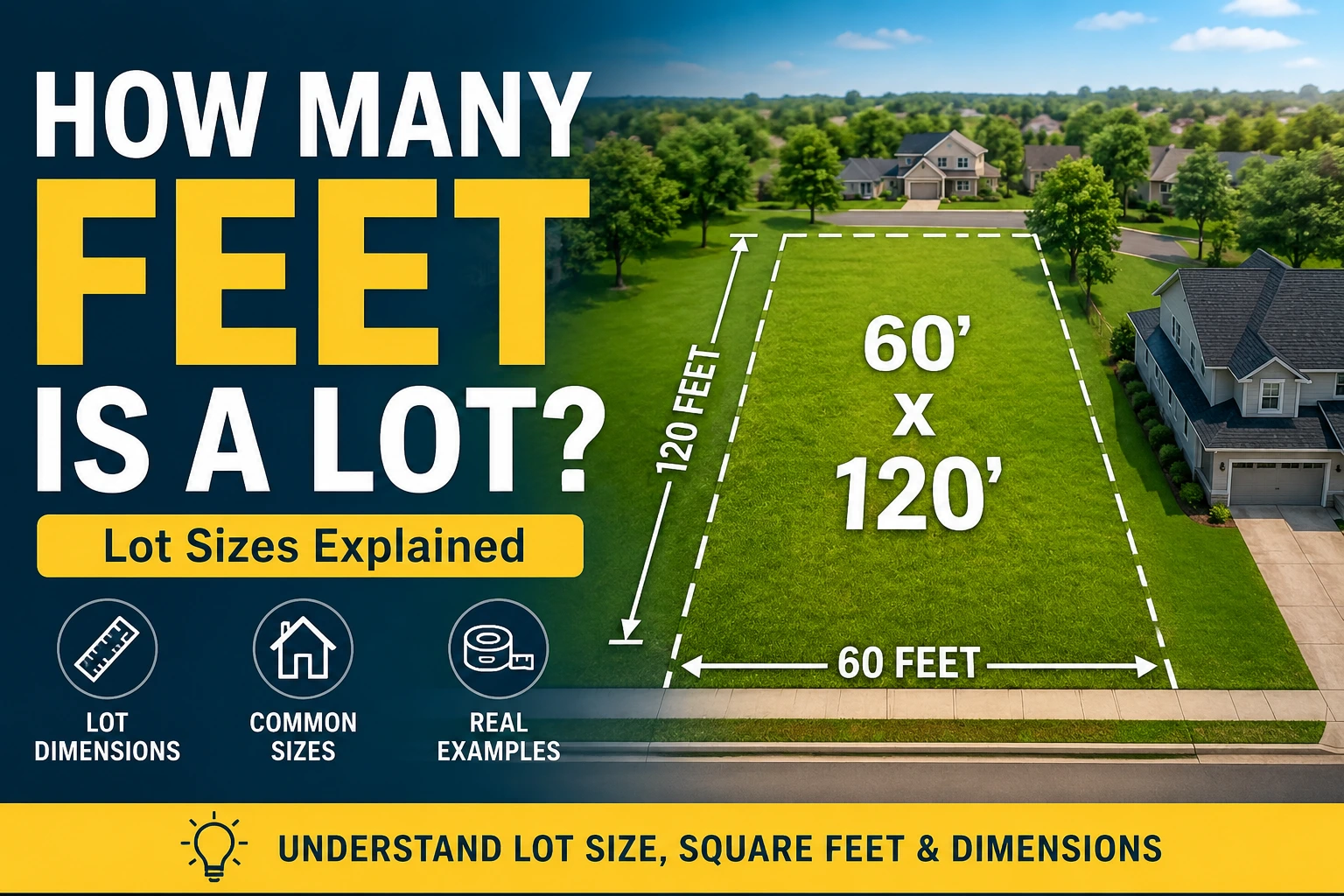
When people ask “how many feet is a lot,” they are usually trying to understand the size of a piece of land. The answer is not always simple because a lot does not have one fixed size. A lot can be small, medium, or very large depending on where the property is located and how the land is divided.
In real estate, lot size is usually measured in square feet. Some lots are also measured in acres. A standard residential lot in many suburban neighborhoods is often around 60 feet wide and 100 to 120 feet deep. However, city lots can be much smaller, while rural lots can be several acres in size.
Understanding lot measurements helps buyers, homeowners, and investors compare properties more easily. It also helps you know how much space you have for building, parking, landscaping, or future expansion.
What Does “Lot” Mean in Real Estate?
A lot is a piece of land legally separated for ownership or development. It can contain a house, commercial building, or remain empty.
Real estate agents often describe lots using dimensions such as:
- 50 x 100 feet
- 60 x 120 feet
- 80 x 150 feet
These numbers represent the width and depth of the property.
For example:
- A 50 x 100 lot means the land is 50 feet wide and 100 feet deep.
- Total area = 5,000 square feet.
Difference Between Lot Size and House Size
Many people confuse house size with lot size.
Here is the difference:
| Measurement | Meaning |
|---|---|
| House Size | Total indoor living space |
| Lot Size | Entire land area around the property |
A house may be 2,000 square feet, but the lot could be 8,000 square feet. The remaining space may include:
- Driveways
- Front yards
- Backyards
- Gardens
- Side spaces
How Many Feet Is a Standard Lot?
There is no universal standard lot size, but many residential neighborhoods follow common patterns.
Here are some typical lot dimensions:
| Lot Type | Common Dimensions | Total Square Feet |
|---|---|---|
| Small Urban Lot | 25 x 100 ft | 2,500 sq ft |
| Standard Suburban Lot | 60 x 100 ft | 6,000 sq ft |
| Larger Family Lot | 80 x 120 ft | 9,600 sq ft |
| Estate Lot | 150 x 200 ft | 30,000 sq ft |
In many suburban areas, a lot between 5,000 and 10,000 square feet is considered average.
Urban vs Suburban vs Rural Lots
Lot sizes vary greatly by location.
Urban Lots
City properties are usually smaller because land is expensive.
Typical urban lots:
- 20 to 40 feet wide
- 80 to 100 feet deep
These lots maximize building density.
Suburban Lots
Suburban homes generally offer larger yards and more privacy.
Typical suburban lots:
- 50 to 80 feet wide
- 100 to 150 feet deep
These are common for family homes.
Rural Lots
Rural properties are often measured in acres rather than feet.
One acre equals:
1 acre=43,560 square feet
Rural lots may range from:
- 1 acre
- 5 acres
- 10 acres or more
Understanding Lot Measurements
To fully understand how many feet is a lot, you need to know how land measurements work.
Width and Depth
Most lots are measured by:
- Frontage (width)
- Depth (distance from front to back)
For example:
Lot Area=Width×Depth
If a lot is:
- 60 feet wide
- 120 feet deep
Then:
60×120=7,200 square feet
Square Feet Explained
Square feet measure total land area.
Imagine a square that is:
- 1 foot long
- 1 foot wide
That equals 1 square foot.
Land area combines thousands of these small squares together.
Common Lot Size Examples in Feet
Here are some real-world examples to help visualize lot sizes.
Small City Lots
Dimensions:
- 25 x 100 feet
Area:
25×100=2,500 square feet
Best for:
- Townhouses
- Compact homes
- Urban developments
Average Family Home Lots
Dimensions:
- 60 x 110 feet
Area:
60×110=6,600 square feet
Best for:
- Detached homes
- Front and back yards
- Garages
Large Estate Lots
Dimensions:
- 150 x 200 feet
Area:
150×200=30,000 square feet
Best for:
- Luxury homes
- Swimming pools
- Large gardens
- Guest houses
Lot Size Conversion Chart
This chart helps compare different lot measurements.
| Square Feet | Approximate Dimensions | Acre Equivalent |
|---|---|---|
| 2,500 sq ft | 25 x 100 ft | 0.057 acre |
| 5,000 sq ft | 50 x 100 ft | 0.115 acre |
| 7,200 sq ft | 60 x 120 ft | 0.165 acre |
| 10,000 sq ft | 100 x 100 ft | 0.23 acre |
| 21,780 sq ft | 150 x 145 ft | 0.5 acre |
| 43,560 sq ft | 208.7 x 208.7 ft | 1 acre |
How to Calculate Lot Size in Feet
Calculating lot size is easier than many people think.
Simple Formula
Use this formula:
Area=Length×Width
Example Calculations
Example 1
Lot dimensions:
- 70 feet wide
- 120 feet deep
Calculation:
70×120=8,400 square feet
Example 2
Lot dimensions:
- 80 feet wide
- 150 feet deep
Calculation:
80×150=12,000 square feet
For irregularly shaped lots, professional surveyors may use advanced measurement tools.
How Many Feet Is a Lot Compared to Everyday Objects?
Visual comparisons make land size easier to understand.
| Lot Size | Comparison |
|---|---|
| 2,500 sq ft | Small basketball court |
| 5,000 sq ft | Average suburban yard |
| 10,000 sq ft | About 4 tennis courts |
| 1 acre | Around 16 tennis courts |
Another simple way to imagine a lot:
- A standard parking space is about 180 square feet.
- A 5,000-square-foot lot could fit around 27 parking spaces.
Factors That Affect Lot Dimensions
Several factors determine how large or small a lot can be.
Zoning Laws
Local governments create zoning rules that control:
- Minimum lot sizes
- Building setbacks
- Property use
Some neighborhoods require wider lots for larger homes.
Neighborhood Planning
Developers design communities differently.
Older neighborhoods often have:
- Smaller lots
- Narrow streets
Newer suburban communities may offer:
- Larger yards
- Wider driveways
Property Shape
Not all lots are perfect rectangles.
Common shapes include:
- Corner lots
- Pie-shaped lots
- Irregular parcels
This affects usable space even if total square footage stays the same.
Why Lot Size Matters
Lot size is important for many reasons.
Building Space
Larger lots allow:
- Bigger homes
- Additional garages
- Outdoor living areas
Smaller lots may limit construction options.
Privacy
More land usually means:
- Greater distance from neighbors
- Less noise
- More outdoor freedom
Property Value
Lot size can directly impact real estate value.
Generally:
- Larger lots cost more
- Corner lots may have premium pricing
- Lots in popular neighborhoods are more expensive
However, location often matters more than raw size.
Common Mistakes When Measuring a Lot
Many buyers misunderstand lot measurements.
Avoid these common mistakes:
Confusing Linear Feet With Square Feet
A lot that is 100 feet long does not mean it is 100 square feet.
You must multiply length by width.
Ignoring Irregular Shapes
Curved or angled lots may have less usable space.
Forgetting Easements
Utility companies may have legal access to parts of the property.
This can reduce usable building space.
Assuming Bigger Is Always Better
Large lots require:
- More maintenance
- Higher landscaping costs
- Increased property taxes
Expert Tips for Understanding Land Measurements
Here are practical tips from real estate professionals.
Read Property Surveys Carefully
A survey shows:
- Exact boundaries
- Structures
- Easements
- Utility lines
Use Online Mapping Tools
Many county websites provide:
- Parcel maps
- Lot dimensions
- Property records
Compare Usable Space
Two lots with identical square footage may feel very different depending on shape and layout.
Think About Future Needs
Consider:
- Home additions
- Parking
- Pools
- Gardens
- Outdoor entertaining
Buying slightly more land now may save money later.
FAQs
How many feet is a normal house lot?
A normal suburban house lot is often around 60 feet wide and 100 to 120 feet deep, totaling about 6,000 to 7,200 square feet.
How many square feet is a standard lot?
A standard residential lot is usually between 5,000 and 10,000 square feet, depending on location.
Is a 50 x 100 lot big?
Yes, a 50 x 100 lot is considered a decent size for many homes. It provides 5,000 square feet of land.
How many feet are in one acre?
One acre equals 43,560 square feet.
How do I calculate lot size?
Multiply the lot’s width by its depth to determine total square footage.
Conclusion
Understanding how many feet is a lot becomes much easier once you learn the basics of land measurement. A lot does not have one fixed size because property dimensions vary by location, zoning, and intended use. Small urban lots may only be 2,500 square feet, while suburban and rural properties can be much larger.
The most important thing is knowing how width, depth, and square footage work together. Whether you are buying land, comparing properties, planning construction, or simply learning about real estate, understanding lot dimensions helps you make smarter decisions.
By using simple formulas, comparison charts, and practical examples, you can quickly estimate property sizes and understand what different lot measurements actually look like in real life.
Discover more
how many square feet of run per chicken