
If you have ever looked at a map, walked through downtown streets, or researched land sizes, you may have wondered: how many square feet is a city block? The answer is not always simple because city blocks vary widely depending on the location, road layout, and urban planning design.
Still, most city blocks fall within a common size range. Understanding these measurements can help with real estate planning, construction estimates, land comparison, and even general curiosity about urban spaces.
In this guide, you will learn the average square footage of a city block, how city block sizes differ between cities, and how to calculate block dimensions yourself.
What Is a City Block?
A city block is a section of land surrounded by streets or roads on all sides. In most urban areas, blocks form part of a grid layout that helps organize neighborhoods, businesses, and transportation routes.
City blocks are used in:
- Urban planning
- Property development
- Navigation systems
- Real estate mapping
- Construction projects
The size of a city block depends on how a city was designed. Older cities often have smaller and irregular blocks, while modern cities may use larger rectangular layouts.
How Many Square Feet Is a City Block on Average?
On average, a typical city block contains between 80,000 and 325,000 square feet.
However, there is no universal standard. Some city blocks are compact and walkable, while others are much larger.
A commonly referenced city block measurement is:
- 300 feet × 300 feet
- Total area = 90,000 square feet
Another common urban block size is:
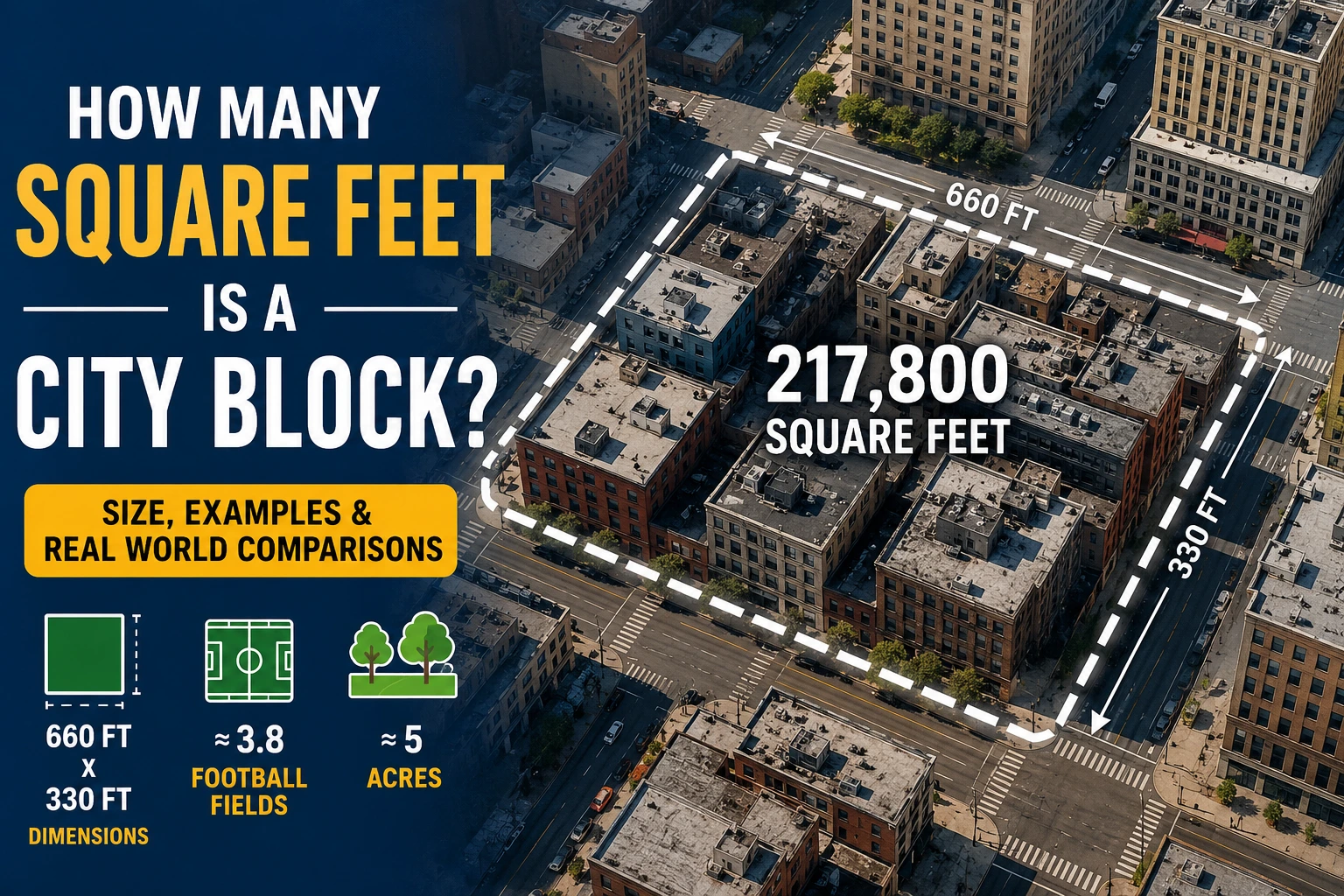
- 660 feet × 330 feet
- Total area = 217,800 square feet
So, when people ask how many square feet is a city block, the answer usually depends on the city being discussed.
Average City Block Size Range
| City Block Type | Dimensions | Square Feet |
|---|---|---|
| Small Block | 200 × 200 ft | 40,000 sq ft |
| Medium Block | 300 × 300 ft | 90,000 sq ft |
| Large Block | 660 × 330 ft | 217,800 sq ft |
| Extra Large Block | 1,000 × 1,000 ft | 1,000,000 sq ft |
Standard City Block Measurements
Different cities use different planning systems. Below are the most common categories of city block sizes.
Small City Blocks
Small blocks are common in older downtown districts and pedestrian-friendly neighborhoods.
Typical dimensions:
- 200 × 200 feet
- 250 × 250 feet
These smaller blocks improve walkability and create more intersections for traffic flow.
Medium City Blocks
Medium blocks are the most common in residential and mixed-use areas.
Examples include:
- 300 × 300 feet
- 330 × 330 feet
These usually range between 90,000 and 110,000 square feet.
Large City Blocks
Large blocks appear more often in suburban developments or modern urban layouts.
Typical dimensions include:
- 660 × 330 feet
- 600 × 600 feet
These blocks can exceed 200,000 square feet.
City Block Size Comparison Table
Here is a simple comparison chart showing how city block sizes relate to acres and football fields.
| Measurement | Square Feet | Acres |
|---|---|---|
| Small City Block | 40,000 sq ft | 0.92 acres |
| Medium City Block | 90,000 sq ft | 2.07 acres |
| Large City Block | 217,800 sq ft | 5 acres |
| One Acre | 43,560 sq ft | 1 acre |
| Football Field | 57,600 sq ft | 1.32 acres |
This comparison makes it easier to visualize land size.
How to Calculate the Square Footage of a City Block
Calculating city block size is straightforward once you know the dimensions.
The formula is:
Square Feet=Length×Width
Example 1
If a city block measures:
- Length = 300 feet
- Width = 300 feet
Calculation:
300×300=90,000
Result:
- 90,000 square feet
Example 2
If a block measures:
- Length = 660 feet
- Width = 330 feet
Calculation:
660×330=217,800
Result:
- 217,800 square feet
Why City Block Sizes Differ
One reason the question “how many square feet is a city block” has different answers is because cities were built differently over time.
Urban Planning Styles
Some cities were designed using strict grid systems. Others developed naturally over centuries.
Grid systems usually create:
- Uniform blocks
- Easier navigation
- Consistent dimensions
Organic city layouts often create:
- Uneven block shapes
- Variable street widths
- Irregular measurements
Historical Development
Older cities tend to have smaller blocks because they were built before cars became common.
Modern cities often feature:
- Wider roads
- Larger developments
- Bigger commercial zones
Downtown vs Suburban Areas
Downtown districts generally use smaller blocks for walkability.
Suburban zones often use larger blocks to fit:
- Parking lots
- Shopping centers
- Large apartment complexes
Famous City Block Examples
Different cities have very different block measurements.
Manhattan, New York
Manhattan blocks are famous for their rectangular shape.
Typical dimensions:
- 264 feet × 900 feet
Approximate size:
- 237,600 square feet
These long blocks are part of Manhattan’s iconic grid system.
Chicago
Chicago uses more uniform square blocks.
Typical dimensions:
- 330 × 660 feet
Approximate size:
- 217,800 square feet
Phoenix
Phoenix features larger suburban-style blocks.
Many blocks exceed:
- 600 × 600 feet
- 360,000 square feet
City Block Compared to Acres and Football Fields
People often compare city blocks to acres or sports fields to better understand size.
City Block vs Acre
One acre contains:
- 43,560 square feet
A medium city block around 90,000 square feet equals roughly:
43,56090,000≈2.07
So, a medium city block is about 2 acres.
City Block vs Football Field
A standard American football field including end zones covers about:
- 57,600 square feet
That means:
- A medium city block is roughly 1.5 football fields
- A large city block may equal 3–4 football fields
Common Uses for City Block Measurements
Understanding city block size has many practical applications.
Real Estate Development
Developers use city block measurements to determine:
- Property layouts
- Building density
- Parking space requirements
Construction Planning
Construction teams estimate:
- Material quantities
- Road placement
- Utility systems
Urban Planning
City planners rely on block sizes for:
- Transportation flow
- Walkability
- Public space allocation
Navigation and Distance Estimation
People often estimate walking distances using blocks.
For example:
- 20 city blocks in Manhattan may equal about one mile
Common Mistakes When Estimating a City Block
Many people misunderstand city block measurements.
Assuming All Blocks Are Equal
This is the biggest mistake. City blocks vary greatly by city and neighborhood.
Ignoring Street Width
Some measurements include streets, while others measure only usable land.
Confusing Acres With Square Feet
Remember:
- 1 acre = 43,560 square feet
Using Google Maps Incorrectly
Map scales can distort perception unless properly measured.
Expert Tips for Understanding Land Measurements
If you regularly work with land measurements, these tips can help.
Learn Basic Conversion Numbers
Memorizing key figures helps:
- 1 acre = 43,560 sq ft
- Football field = 57,600 sq ft
Use Online Mapping Tools
Digital maps can measure:
- Distance
- Area
- Lot boundaries
Compare With Familiar Objects
Comparisons make large measurements easier to understand.
For example:
- 2 acres = about 1.5 football fields
- 90,000 sq ft = medium city block
Understand Local Planning Rules
Every city uses different zoning and block systems.
FAQs
1. How many square feet is a typical city block?
A typical city block usually ranges from 80,000 to 325,000 square feet depending on the city layout and planning style.
2. Is a city block equal to an acre?
No. One acre equals 43,560 square feet, while most city blocks are much larger and may contain multiple acres.
3. How big is a Manhattan city block?
A Manhattan block is often about 264 feet by 900 feet, which equals approximately 237,600 square feet.
4. How do you calculate city block square footage?
Multiply the block’s length by its width in feet to determine total square footage.
5. Are all city blocks the same size?
No. City block sizes vary by city, neighborhood, road design, and historical development patterns.
Conclusion
So, how many square feet is a city block? In most cases, a city block ranges between 80,000 and 325,000 square feet, although some blocks are much smaller or larger depending on urban design.
Understanding city block measurements is useful for real estate, construction, city planning, and land comparison. Whether you are comparing acres, estimating development space, or simply learning about urban layouts, knowing average city block dimensions gives valuable perspective.
The next time you walk through a city or view a map, you will have a much clearer idea of just how much space a single city block can contain.
Discover more