

If you’ve ever watched a match or played yourself, you’ve probably wondered: how many feet wide is a soccer goal?
The official answer is simple:
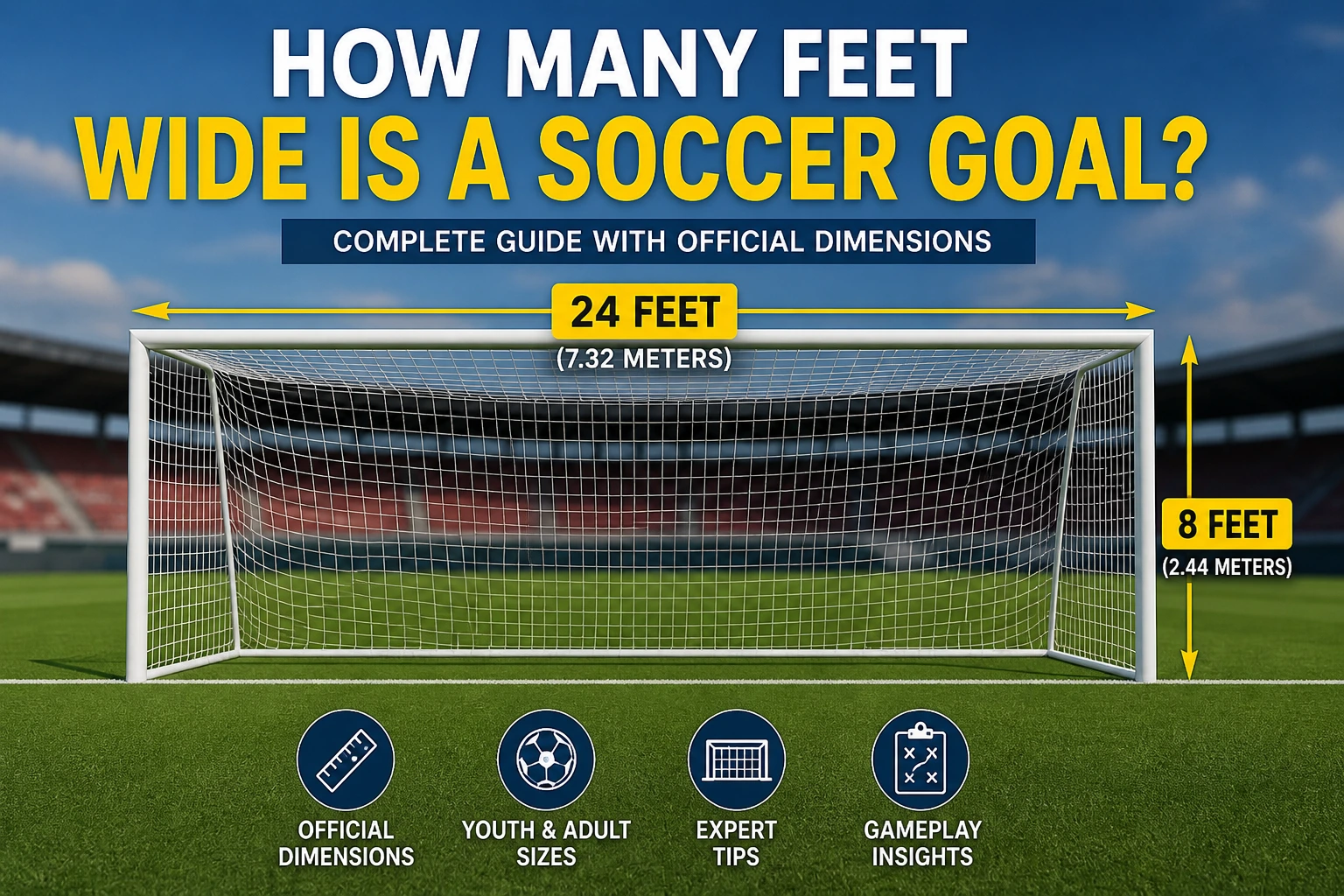
A standard soccer goal is 24 feet wide.
But there’s more to it than just one number. Soccer goals vary by age group, level of play, and purpose. Understanding these differences can help players improve performance, coaches train effectively, and organizers set up proper fields.
Let’s break everything down clearly so you fully understand soccer goal dimensions.
Official Soccer Goal Width (Exact Answer)
The standard width of a soccer goal used in professional matches is:
- 24 feet (7.32 meters) wide
This measurement is taken from the inside of one goalpost to the inside of the other.
It is the official size used in competitions governed by FIFA.
FIFA Standard Goal Dimensions
To fully understand goal size, you need to look at all dimensions—not just width.
Width
- 24 feet (7.32 meters)
Height
- 8 feet (2.44 meters)
Depth
- Typically 6 to 8 feet deep depending on net setup
These dimensions are used in professional leagues worldwide, including major tournaments like the FIFA World Cup.
Soccer Goal Sizes by Age Group
Not all players use full-size goals. Youth and amateur levels have smaller dimensions.
Youth Soccer Goals
Younger players use smaller goals to match their skill level and field size.
Typical sizes:
- Ages 6–8: 6–12 feet wide
- Ages 9–12: 18–21 feet wide
High School Goals
High school matches usually follow official standards:
- 24 feet wide
- 8 feet high
Professional Goals
Professional soccer always uses:
- 24 feet width
- 8 feet height
This ensures consistency across leagues worldwide.
Why Soccer Goal Width Matters
Goal width is not just a measurement—it directly affects how the game is played.
Gameplay Strategy
A wider goal:
- Increases scoring chances
- Requires better defensive organization
- Encourages attacking play
A smaller goal:
- Makes scoring harder
- Focuses on accuracy over power
Goalkeeper Positioning
Goalkeepers rely heavily on goal width.
- They must cover a 24-foot space
- Positioning and angles are crucial
- Reaction time becomes critical
Even a small misjudgment can lead to a goal.
Soccer Goal Dimensions Chart
Here’s a quick comparison for clarity:
| Level | Width (Feet) | Height (Feet) |
|---|---|---|
| Youth (Small) | 6–12 | 4–6 |
| Youth (Medium) | 18–21 | 6–7 |
| High School | 24 | 8 |
| Professional | 24 | 8 |
This table helps you quickly identify the right goal size.
Feet vs Meters Conversion Explained
Soccer is played globally, so measurements are often given in meters.
- 24 feet = 7.32 meters
- 8 feet = 2.44 meters
Quick tip:
Multiply feet by 0.3048 to convert to meters.
Understanding both units helps when reading international rules.
Real-World Examples of Soccer Goal Width
Let’s make this practical.
- A standard goal is about the width of two large cars parked side by side
- It’s wider than most living rooms
- Goalkeepers must cover this entire space in seconds
Watching players like Lionel Messi or Cristiano Ronaldo score goals shows how precision matters even with a large goal.
Common Mistakes About Goal Size
Many people misunderstand soccer goal dimensions.
Here are common mistakes:
- Thinking all goals are the same size
- Confusing width with height
- Ignoring youth size variations
- Measuring from outside posts instead of inside
Avoiding these mistakes ensures accurate setup.
Expert Tips for Choosing the Right Goal
If you’re buying or setting up a goal, consider this:
- Match the goal size to the player’s age
- Ensure sturdy materials for safety
- Check official guidelines if hosting matches
- Use proper net depth for stability
For training:
- Smaller goals improve accuracy
- Larger goals improve finishing under pressure
Comparison Table: Soccer vs Other Sports Goals
| Sport | Width |
|---|---|
| Soccer | 24 feet |
| Hockey | 6 feet |
| American Football | 18.5 feet |
| Handball | 9.8 feet |
Soccer has one of the widest goals, making scoring both easier and more dynamic.
FAQs
1. How many feet wide is a soccer goal?
A standard soccer goal is 24 feet wide.
2. Is every soccer goal 24 feet wide?
No. Youth goals are smaller, but professional goals are always 24 feet wide.
3. How tall is a soccer goal?
The official height is 8 feet.
4. Why are youth soccer goals smaller?
Smaller goals match player size and skill level, making the game fair and enjoyable.
5. Are soccer goals the same worldwide?
Yes, professional goals follow FIFA standards globally.
Conclusion
So, how many feet wide is a soccer goal? The answer is clear: 24 feet for standard professional play.
However, understanding the variations across age groups and levels gives you a deeper insight into the game. From youth training to professional matches, goal size plays a key role in shaping gameplay, strategy, and skill development.
Whether you’re a player, coach, or fan, knowing these dimensions helps you appreciate the precision and challenge involved in scoring goals.
Discover More: