

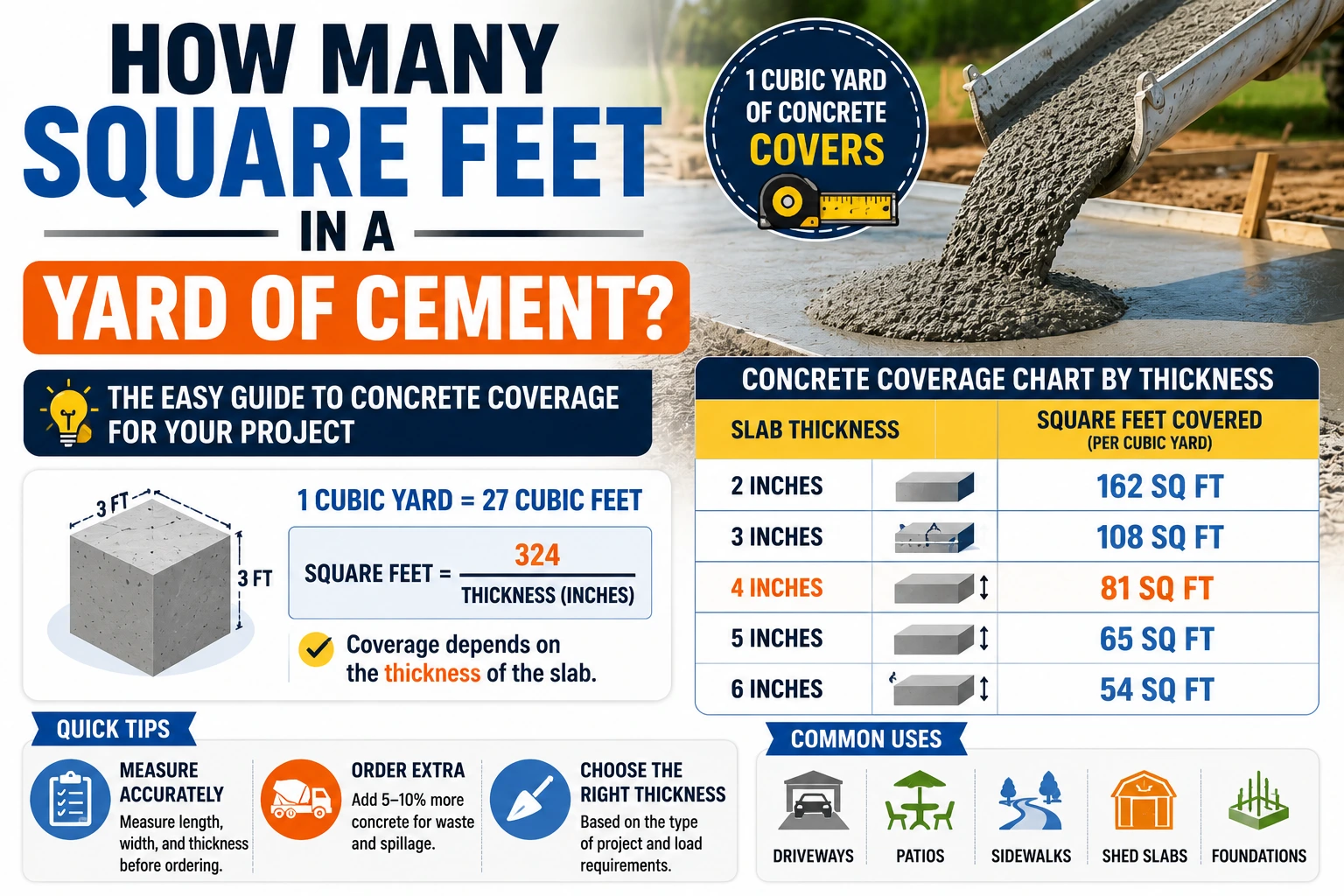
If you are wondering how many square feet in a yard of cement, the answer depends on the thickness of the concrete slab. One cubic yard of concrete covers about 81 square feet at 4 inches thick, which is one of the most common slab depths for patios, sidewalks, and residential concrete projects.
Many homeowners and contractors use the term “cement” when they actually mean concrete. While cement is an ingredient in concrete, most coverage calculations refer to ready-mix concrete used for slabs and construction work.
Understanding concrete coverage is important because ordering too little material can delay your project, while ordering too much can waste money. Whether you are pouring a driveway, patio, shed base, or walkway, knowing the correct coverage per cubic yard helps you estimate materials accurately.
In this guide, you will learn exactly how many square feet a yard of concrete covers, how slab thickness changes coverage, and how to calculate concrete needs for real-world projects.
Understanding Concrete Measurements
Before calculating coverage, it helps to understand how concrete is measured.
What Is a Cubic Yard?
Concrete is usually sold by the cubic yard.
One cubic yard equals:
27 cubic feet
This comes from:
3 ft×3 ft×3 ft=27 cubic feet
Because concrete is measured by volume, thickness plays a major role in determining square-foot coverage.
Difference Between Cement and Concrete
People often confuse these terms.
- Cement is a powder ingredient
- Concrete is the finished mixture of cement, sand, gravel, and water
When discussing slab coverage, builders are usually referring to concrete rather than pure cement.
How Many Square Feet in a Yard of Cement?
The square footage covered by one cubic yard depends on slab thickness.
Coverage Based on Thickness
Here is the most common coverage chart:
| Thickness | Square Feet Covered by 1 Yard |
|---|---|
| 2 inches | 162 sq ft |
| 3 inches | 108 sq ft |
| 4 inches | 81 sq ft |
| 5 inches | 65 sq ft |
| 6 inches | 54 sq ft |
As slab thickness increases, coverage decreases.
Quick Formula Explained
The basic formula for concrete coverage is:
Square Feet=Thickness in Inches324
Why 324?
Because:
- One cubic yard = 27 cubic feet
- One square foot at 1-inch depth equals 1/12 cubic foot
This simplifies into the common construction formula.
For a 4-inch slab:
4324=81 square feet
Concrete Coverage Chart by Thickness
Thickness affects durability and coverage.
2-Inch Slab Coverage
A 2-inch slab covers:
162 square feet
This thickness is commonly used for:
- Decorative overlays
- Thin walkways
- Light-use surfaces
It is usually not strong enough for vehicles.
4-Inch Slab Coverage
A 4-inch slab covers:
81 square feet
This is the standard thickness for:
- Patios
- Sidewalks
- Residential slabs
- Small shed foundations
Most homeowners use this depth for general projects.
6-Inch Slab Coverage
A 6-inch slab covers:
54 square feet
This thickness is often used for:
- Driveways
- Heavy equipment pads
- Garage floors
- Commercial surfaces
Thicker slabs improve load-bearing strength.
How to Calculate Concrete Coverage
Simple calculations help estimate material needs accurately.
Step-by-Step Formula
Use this formula:
Length×Width×Thickness=Volume
Convert thickness into feet first.
Real Project Example
Suppose you are pouring a patio:
- Length = 12 feet
- Width = 10 feet
- Thickness = 4 inches
Convert thickness:
4 inches=0.333 feet
Now calculate volume:
12×10×0.333≈39.96 cubic feet
Convert cubic feet into cubic yards:
2739.96≈1.48 cubic yards
You would need approximately 1.5 cubic yards of concrete.
Common Concrete Project Examples
Different projects require different slab thicknesses and coverage estimates.
Driveways
Residential driveways often use:
- 4 to 6 inches thickness
One yard covers:
- About 54–81 square feet
Heavier vehicles may require thicker concrete.
Sidewalks
Most sidewalks use:
- 4-inch slabs
Coverage is usually:
- About 81 square feet per cubic yard
Sidewalk projects are among the most common DIY pours.
Patios
Backyard patios commonly use:
- 4-inch thickness
One yard generally covers:
- Around 81 square feet
Decorative stamped patios may use slightly different depths.
Shed Slabs
Small sheds often require:
- 4 to 5 inches thickness
Larger storage buildings may need reinforcement and additional depth.
Factors That Affect Concrete Coverage
Coverage estimates are not always exact.
Waste and Spillage
Concrete projects usually involve some material loss from:
- Spills
- Overfilling
- Uneven forms
- Mixing waste
Most contractors recommend ordering:
- 5% to 10% extra concrete
Uneven Ground
Sloped or rough ground may require:
- Extra leveling
- Additional concrete thickness
This increases material needs.
Reinforcement Thickness
Projects using:
- Rebar
- Gravel bases
- Wire mesh
May require slightly different slab depths for structural strength.
Common Mistakes When Ordering Concrete
Many DIY projects run into problems because of inaccurate calculations.
Ordering Too Little
Running short can:
- Delay finishing
- Create weak cold joints
- Increase delivery costs
Always order slightly more than your estimate.
Ignoring Thickness Requirements
Thin slabs crack more easily.
For example:
- Driveways need thicker slabs than patios
- Garage floors require more strength than walkways
Using incorrect thickness can shorten slab lifespan.
Confusing Cubic Feet and Cubic Yards
This is one of the biggest beginner mistakes.
Remember:
1 cubic yard=27 cubic feet
Confusing these units causes major estimation errors.
Expert Tips for Accurate Concrete Estimation
Professionals use several strategies for better calculations.
Add Extra Material
Most experts recommend adding:
- 5% for small projects
- 10% for uneven surfaces
Extra material prevents shortages.
Measure Twice
Accurate measurements reduce:
- Waste
- Delays
- Extra expenses
Double-check:
- Length
- Width
- Thickness
Before placing your order.
Use Proper Thickness
Different projects require different slab strengths.
Typical recommendations:
- Sidewalks: 4 inches
- Patios: 4 inches
- Driveways: 5–6 inches
- Heavy equipment pads: 6+ inches
Correct thickness improves durability.
Why Concrete Thickness Matters
Thickness directly affects:
- Strength
- Durability
- Weight support
- Crack resistance
Thicker slabs last longer under heavy use.
Thin Slabs
Thin slabs:
- Use less concrete
- Cost less initially
- Work for light foot traffic
But they may crack more easily.
Thick Slabs
Thicker slabs:
- Handle heavier loads
- Resist cracking
- Last longer
However, they require more material and higher costs.
Benefits of Accurate Concrete Planning
Good planning improves project quality and reduces expenses.
Better Budget Control
Accurate estimates prevent:
- Overbuying
- Multiple deliveries
- Emergency supply runs
This helps keep projects on budget.
Faster Project Completion
Having enough concrete on-site allows continuous pouring without interruptions.
Improved Structural Strength
Correct slab thickness ensures:
- Proper support
- Better durability
- Longer lifespan
This is especially important for driveways and foundations.
Frequently Asked Questions
How many square feet in a yard of cement?
One cubic yard of concrete covers about 81 square feet at 4 inches thick.
How much area does 1 yard of concrete cover?
Coverage depends on slab thickness. Thinner slabs cover more area.
How many square feet does a yard of concrete cover at 2 inches thick?
At 2 inches thick, one yard covers approximately 162 square feet.
How many cubic feet are in a yard of concrete?
One cubic yard contains:
27 cubic feet
How much concrete do I need for a 10×10 slab?
A 10×10 slab at 4 inches thick requires about 1.23 cubic yards of concrete.
10. Conclusion
Understanding how many square feet in a yard of cement helps homeowners, builders, and contractors estimate concrete needs accurately for patios, driveways, sidewalks, and slabs. One cubic yard of concrete typically covers about 81 square feet at 4 inches thick, but coverage changes based on slab depth.
By using proper formulas, measuring carefully, and accounting for waste, you can avoid costly mistakes and complete your project more efficiently. Whether you are pouring a small backyard patio or a larger driveway, accurate concrete planning leads to stronger, longer-lasting results.
Discover more