

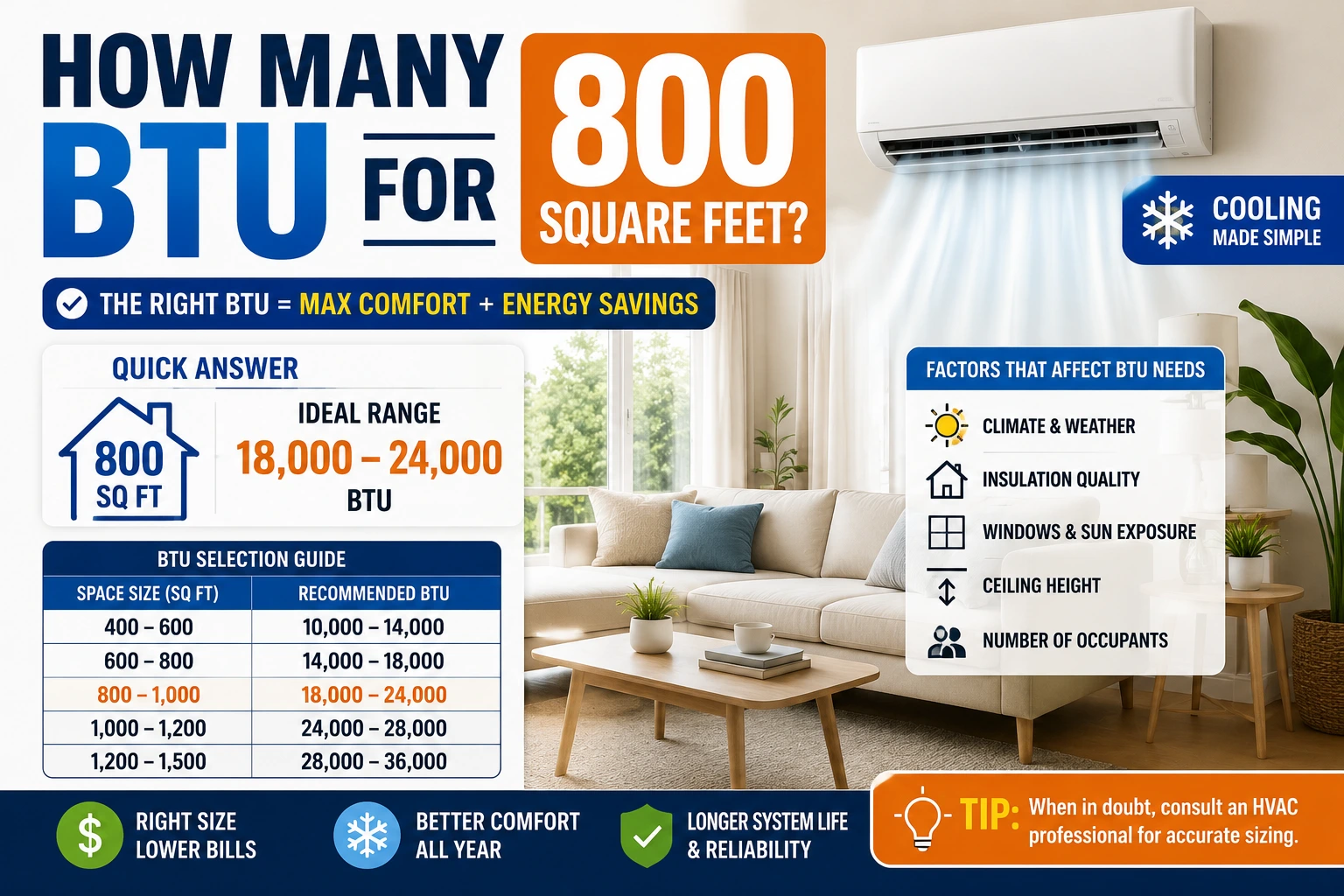
If you are wondering how many BTU for 800 square feet, the general recommendation is between 18,000 and 24,000 BTU depending on insulation, climate, ceiling height, and sunlight exposure. Choosing the correct BTU size is important because an air conditioner or heating system that is too small will struggle to maintain comfort, while an oversized system can waste energy and increase utility costs.
BTU sizing plays a major role in home comfort and energy efficiency. Whether you are shopping for a window AC, portable air conditioner, mini split, or central HVAC system, understanding the proper BTU range helps you make smarter decisions.
In this guide, you will learn exactly how many BTU are needed for 800 square feet, how to calculate HVAC sizing, what factors affect cooling power, and how to choose the best system for your space.
What Does BTU Mean?
Before selecting an HVAC system, it helps to understand the meaning of BTU.
Definition of BTU
BTU stands for British Thermal Unit. It measures the amount of heat required to raise the temperature of one pound of water by one degree Fahrenheit.
In HVAC systems, BTU measures:
- Cooling power
- Heating output
- Energy capacity
Higher BTU ratings mean stronger cooling or heating performance.
Why BTU Matters in HVAC
Correct BTU sizing helps:
- Maintain comfortable temperatures
- Reduce energy bills
- Improve system lifespan
- Prevent uneven cooling
An improperly sized unit can create ongoing comfort problems.
How Many BTU for 800 Square Feet?
The standard estimate for cooling 800 square feet is:
18,000 to 24,000 BTU
The exact number depends on several conditions.
Standard BTU Recommendation
Here is a quick estimate:
| Square Feet | Recommended BTU |
|---|---|
| 600 sq ft | 14,000 BTU |
| 700 sq ft | 16,000–18,000 BTU |
| 800 sq ft | 18,000–24,000 BTU |
| 1,000 sq ft | 24,000 BTU |
Larger or hotter rooms usually need higher BTU ratings.
Quick Sizing Formula
A basic HVAC formula is:
Square Feet×20=Approximate BTU
For 800 square feet:
800×20=16,000 BTU
However, many experts increase this estimate for:
- Hot climates
- Poor insulation
- High ceilings
- Multiple occupants
This is why 18,000–24,000 BTU is often recommended.
BTU Chart by Room Size
BTU charts simplify HVAC sizing for different room dimensions.
Small Spaces
| Room Size | Recommended BTU |
|---|---|
| 150 sq ft | 5,000 BTU |
| 250 sq ft | 6,000 BTU |
| 350 sq ft | 8,000 BTU |
These sizes work well for bedrooms and offices.
Medium Spaces
| Room Size | Recommended BTU |
|---|---|
| 450 sq ft | 10,000 BTU |
| 550 sq ft | 12,000 BTU |
| 700 sq ft | 16,000–18,000 BTU |
Medium-sized apartments and living rooms fall into this range.
Large Spaces
| Room Size | Recommended BTU |
|---|---|
| 800 sq ft | 18,000–24,000 BTU |
| 1,200 sq ft | 24,000–30,000 BTU |
| 1,500 sq ft | 30,000+ BTU |
Large open spaces often require stronger systems.
Factors That Affect BTU Requirements
Square footage alone does not determine HVAC sizing.
Climate and Weather
Hot climates increase cooling demands significantly.
Homes in:
- Texas
- Florida
- Arizona
- Southern regions
Usually require higher BTU capacity than cooler northern areas.
Ceiling Height
Standard BTU calculations assume:
- 8-foot ceilings
If ceilings are higher:
- More air volume must be cooled
- Additional BTU may be required
Vaulted ceilings often increase cooling needs.
Insulation Quality
Good insulation reduces heat transfer.
Poor insulation causes:
- Faster temperature changes
- Increased HVAC workload
- Higher electricity costs
Well-insulated homes may use smaller systems efficiently.
Sunlight Exposure
Rooms with:
- Large windows
- Direct afternoon sunlight
- West-facing exposure
Usually require additional cooling power.
Sunlight significantly increases indoor temperatures.
Cooling vs Heating BTU Needs
Cooling and heating calculations are not always identical.
Air Conditioning BTU
For cooling, HVAC professionals commonly use:
- 20–25 BTU per square foot
For 800 square feet, this equals:
800×25=20,000 BTU
This estimate works well in warmer climates.
Heating BTU Estimates
Heating calculations depend heavily on:
- Climate zone
- Insulation
- Window quality
General heating estimates range between:
- 30–60 BTU per square foot
Cold regions require significantly more heating power.
Best AC Types for 800 Square Feet
Several HVAC options work well for 800-square-foot spaces.
Window Units
Window air conditioners are:
- Affordable
- Easy to install
- Good for single rooms
However, cooling an entire 800-square-foot area may require multiple units.
Portable ACs
Portable air conditioners offer:
- Mobility
- Easy setup
- Flexible placement
But they are usually less efficient than other systems.
Mini Split Systems
Mini splits are highly recommended for 800 square feet because they provide:
- Efficient cooling
- Quiet operation
- Zoned temperature control
- Lower energy use
Many homeowners choose 18,000–24,000 BTU mini split systems for this size.
Central HVAC Systems
Central air systems are ideal for:
- Whole-home comfort
- Multiple rooms
- Consistent airflow
These systems require professional installation but offer excellent performance.
How to Calculate BTU for 800 Square Feet
Simple formulas provide quick estimates.
Step-by-Step Formula
Use this formula:
Room Area×BTU Per Square Foot
Example:
800×25=20,000 BTU
This is a common estimate for warmer spaces.
Real World Example
Suppose you have:
- 800 square feet
- High ceilings
- Large windows
- Warm climate
You may need:
- 22,000–24,000 BTU
If the space is shaded and insulated well, 18,000 BTU could be enough.
Common Mistakes When Choosing BTU Size
Incorrect sizing causes many HVAC problems.
Oversized Units
An oversized air conditioner may:
- Cool too quickly
- Shut off frequently
- Increase humidity
- Waste energy
Short cycling reduces efficiency and comfort.
Undersized Units
Undersized systems struggle to:
- Maintain temperature
- Handle heat waves
- Cool large spaces evenly
This increases wear and electricity costs.
Ignoring Insulation
Many buyers focus only on square footage while ignoring:
- Drafts
- Window quality
- Roof insulation
- Air leaks
These factors dramatically affect HVAC performance.
Expert Tips for Better Cooling Efficiency
Proper setup improves comfort and reduces energy usage.
Energy Saving Tips
Lower utility costs by:
- Using ceiling fans
- Closing blinds during hot afternoons
- Sealing air leaks
- Installing smart thermostats
Small changes can improve efficiency significantly.
Proper AC Placement
For best airflow:
- Avoid blocking vents
- Keep units away from heat sources
- Ensure open circulation
Poor placement reduces cooling effectiveness.
Maintenance Advice
Regular maintenance includes:
- Cleaning filters
- Checking refrigerant levels
- Inspecting ducts
- Removing dust buildup
Well-maintained systems last longer and perform better.
Signs Your AC BTU Size Is Wrong
Your system may be improperly sized if you notice:
- Uneven room temperatures
- Constant cycling
- Excess humidity
- High electricity bills
- Poor cooling performance
Professional HVAC inspections can confirm proper sizing.
Benefits of Correct BTU Sizing
Choosing the correct BTU range provides several advantages.
Better Comfort
Properly sized systems:
- Maintain stable temperatures
- Reduce humidity
- Improve airflow
Comfort improves throughout the home.
Lower Energy Bills
Efficient systems consume less power and reduce monthly utility costs.
Longer Equipment Lifespan
Correct sizing reduces strain on HVAC components, helping systems last longer.
Frequently Asked Questions
How many BTU for 800 square feet?
Most 800-square-foot spaces need between 18,000 and 24,000 BTU depending on insulation and climate.
Is 18,000 BTU enough for 800 square feet?
Yes, in many well-insulated homes. Hot climates or high ceilings may require more capacity.
What size mini split for 800 sq ft?
An 18,000–24,000 BTU mini split is commonly recommended.
Can a portable AC cool 800 square feet?
Some high-capacity portable units can, but mini splits or central systems are usually more effective.
Does ceiling height affect BTU requirements?
Yes. Higher ceilings increase room volume and require additional cooling power.
10. Conclusion
Understanding how many BTU for 800 square feet helps you choose the right HVAC system for comfort, efficiency, and energy savings. In most cases, 18,000 to 24,000 BTU is the ideal range depending on room conditions, insulation, ceiling height, and local climate.
Correct BTU sizing prevents energy waste, improves indoor comfort, and extends HVAC system lifespan. By considering real-world factors and using proper calculations, homeowners can confidently select the best cooling or heating solution for their 800-square-foot space.
Discover more