

If you are planning a driveway, patio, sidewalk, or foundation project, you may wonder: “How many square feet in a concrete yard?”
The answer depends on the thickness of the concrete slab because concrete is measured in cubic yards, not square feet alone.
In general:
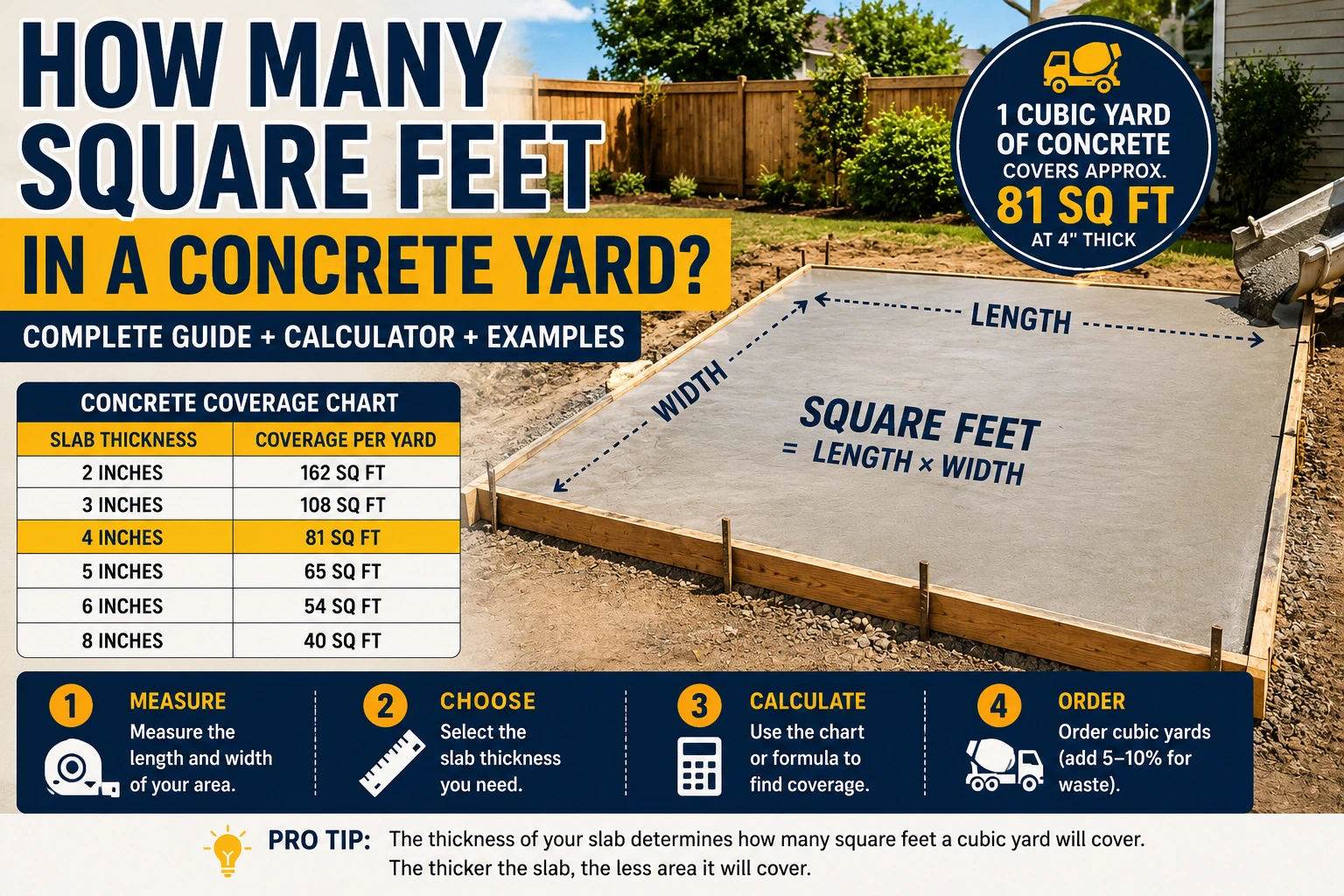
- 1 cubic yard of concrete covers about 81 square feet at 4 inches thick.
However, the total coverage changes depending on slab depth. A thinner slab covers more square feet, while a thicker slab covers less.
Understanding this calculation is essential for:
- Ordering the correct amount of concrete
- Avoiding waste
- Preventing project delays
- Saving money
In this complete guide, you will learn how concrete yard coverage works, formulas, charts, real-world examples, and expert tips for accurate concrete estimation.
Understanding Concrete Measurements
Before calculating coverage, it is important to understand how concrete is measured.
What Is a Cubic Yard?
Concrete suppliers sell concrete by:
- Cubic yard
- Not square foot
A cubic yard equals:
3 ft×3 ft×3 ft=27 cubic feet
So:
- 1 cubic yard = 27 cubic feet
This measurement represents volume, not surface area.
Why Thickness Matters
Square foot coverage depends entirely on slab thickness.
For example:
- Thin patios require less concrete
- Thick driveways require more concrete
The thicker the slab:
- The fewer square feet one yard covers
This is why concrete estimates always include depth measurements.
How Many Square Feet in a Concrete Yard?
Here are the most common coverage estimates for 1 cubic yard of concrete.
| Slab Thickness | Coverage Per Cubic Yard |
|---|---|
| 2 inches | 162 sq ft |
| 3 inches | 108 sq ft |
| 4 inches | 81 sq ft |
| 5 inches | 65 sq ft |
| 6 inches | 54 sq ft |
The most common residential slab thickness is:
- 4 inches
At that depth:
1 cubic yard≈81 square feet at 4 inches thick
Concrete Yard Formula Explained
Concrete calculations become simple once you know the formula.
Cubic Yard Formula
Use this formula:
Cubic Yards=27Length×Width×Depth
Remember:
- Length and width are measured in feet
- Depth must also be converted into feet
Converting Inches Into Feet
Since slab thickness is usually measured in inches:
4 inches=124 feet
Which equals:
- 0.333 feet
Step-by-Step Concrete Calculation Example
Suppose you want to pour a patio measuring:
- 18 feet long
- 12 feet wide
- 4 inches thick
Step 1: Calculate Square Footage
18×12=216
Total area:
- 216 square feet
Step 2: Convert Thickness to Feet
4÷12=0.333
Thickness:
- 0.333 feet
Step 3: Calculate Cubic Feet
216×0.333=71.9
Concrete needed:
- 71.9 cubic feet
Step 4: Convert to Cubic Yards
71.9÷27=2.66
You need:
- About 2.7 cubic yards of concrete
Professionals usually round up slightly.
Concrete Coverage Chart by Thickness
This chart helps estimate concrete needs quickly.
| Concrete Thickness | Square Feet Per Yard |
|---|---|
| 2-inch slab | 162 sq ft |
| 3-inch slab | 108 sq ft |
| 4-inch slab | 81 sq ft |
| 5-inch slab | 65 sq ft |
| 6-inch slab | 54 sq ft |
| 8-inch slab | 40 sq ft |
Common Concrete Project Thicknesses
Different projects require different slab depths.
| Project Type | Recommended Thickness |
|---|---|
| Sidewalk | 4 inches |
| Patio | 4 inches |
| Shed slab | 4–5 inches |
| Driveway | 5–6 inches |
| Garage floor | 6 inches |
| Foundation | 8 inches or more |
Thicker slabs provide:
- Better durability
- Higher load capacity
- Longer lifespan
How to Calculate Concrete for Your Project
Here are practical examples for common projects.
Patio Example
Patio size:
- 10 × 10 feet
- 4 inches thick
Coverage:
- 100 square feet
Since one yard covers 81 square feet at 4 inches:
- You need about 1.25 cubic yards
Driveway Example
Driveway dimensions:
- 20 × 30 feet
- 5 inches thick
Total area:
20×30=600
At 5 inches thick:
- One yard covers about 65 sq ft
Calculation:
600÷65≈9.2
You need:
- About 9.5 cubic yards
Sidewalk Example
Sidewalk dimensions:
- 4 × 50 feet
- 4 inches thick
Area:
4×50=200
Concrete needed:
- About 2.5 cubic yards
Factors That Affect Concrete Coverage
Several variables can change concrete requirements.
Slab Depth
The biggest factor is thickness.
A thicker slab:
- Uses more concrete
- Covers less area
Waste and Spillage
Concrete projects rarely use exactly the estimated amount.
Losses happen due to:
- Spillage
- Uneven ground
- Form leakage
- Over-excavation
Professionals usually order:
- 5–10% extra
Surface Preparation
Poor ground preparation may increase concrete usage.
Uneven surfaces can require:
- Additional filling
- Deeper pours
Common Concrete Estimating Mistakes
Concrete ordering mistakes can be expensive.
Incorrect Measurements
Even small measurement errors affect:
- Total cost
- Material needs
- Project timing
Always double-check:
- Length
- Width
- Depth
Forgetting Thickness Conversion
One common error is failing to convert inches into feet.
Always divide inches by 12 before calculations.
Ordering Too Little Concrete
Running short can create:
- Cold joints
- Uneven surfaces
- Delays
Ordering slightly extra is safer.
Expert Tips for Ordering Concrete
Professional contractors follow several best practices.
Measure Twice
Accurate measurements prevent:
- Waste
- Extra delivery charges
- Project interruptions
Add Extra Material
Experts recommend:
- Adding 5–10% more concrete
This accounts for:
- Waste
- Spillage
- Ground variation
Talk to Your Supplier
Concrete suppliers can help verify:
- Slab thickness
- Yard estimates
- Delivery timing
Concrete Yard vs Square Foot Comparison Table
| Cubic Yards | Coverage at 4 Inches |
|---|---|
| 1 yard | 81 sq ft |
| 2 yards | 162 sq ft |
| 3 yards | 243 sq ft |
| 5 yards | 405 sq ft |
| 10 yards | 810 sq ft |
This table is useful for larger projects.
Why Accurate Concrete Estimates Matter
Good estimates help:
- Control project costs
- Reduce waste
- Prevent delays
- Improve finishing quality
Accurate calculations also reduce environmental waste from excess concrete production.
Benefits of Proper Concrete Planning
Careful planning creates:
- Stronger slabs
- Better durability
- Cleaner finishes
- Lower costs
It also improves project efficiency for contractors and DIY homeowners alike.
FAQs
1. How many square feet does 1 yard of concrete cover?
At 4 inches thick, 1 cubic yard covers approximately 81 square feet.
2. Why does slab thickness affect concrete coverage?
Concrete is measured by volume. Thicker slabs use more concrete, reducing total coverage area.
3. How many cubic feet are in a cubic yard?
One cubic yard equals 27 cubic feet.
4. How much concrete do I need for a 20×20 slab?
For a 4-inch slab:
20×20=400 square feet
You would need about 5 cubic yards of concrete.
5. Should I order extra concrete?
Yes. Most professionals recommend ordering 5–10% extra for waste and uneven surfaces.
Conclusion
If you are asking “how many square feet in a concrete yard,” the answer depends on slab thickness. In the most common residential applications:
1 cubic yard covers approximately 81 square feet at 4-inch thickness
Thinner slabs cover more area, while thicker slabs require additional concrete. By understanding cubic yard calculations, slab depth, and coverage charts, you can estimate concrete accurately and avoid costly mistakes.
Whether you are pouring a patio, driveway, sidewalk, or garage floor, proper planning ensures smoother construction, lower costs, and better long-term durability.
Discover more
how many square feet in a 10×16 shed