

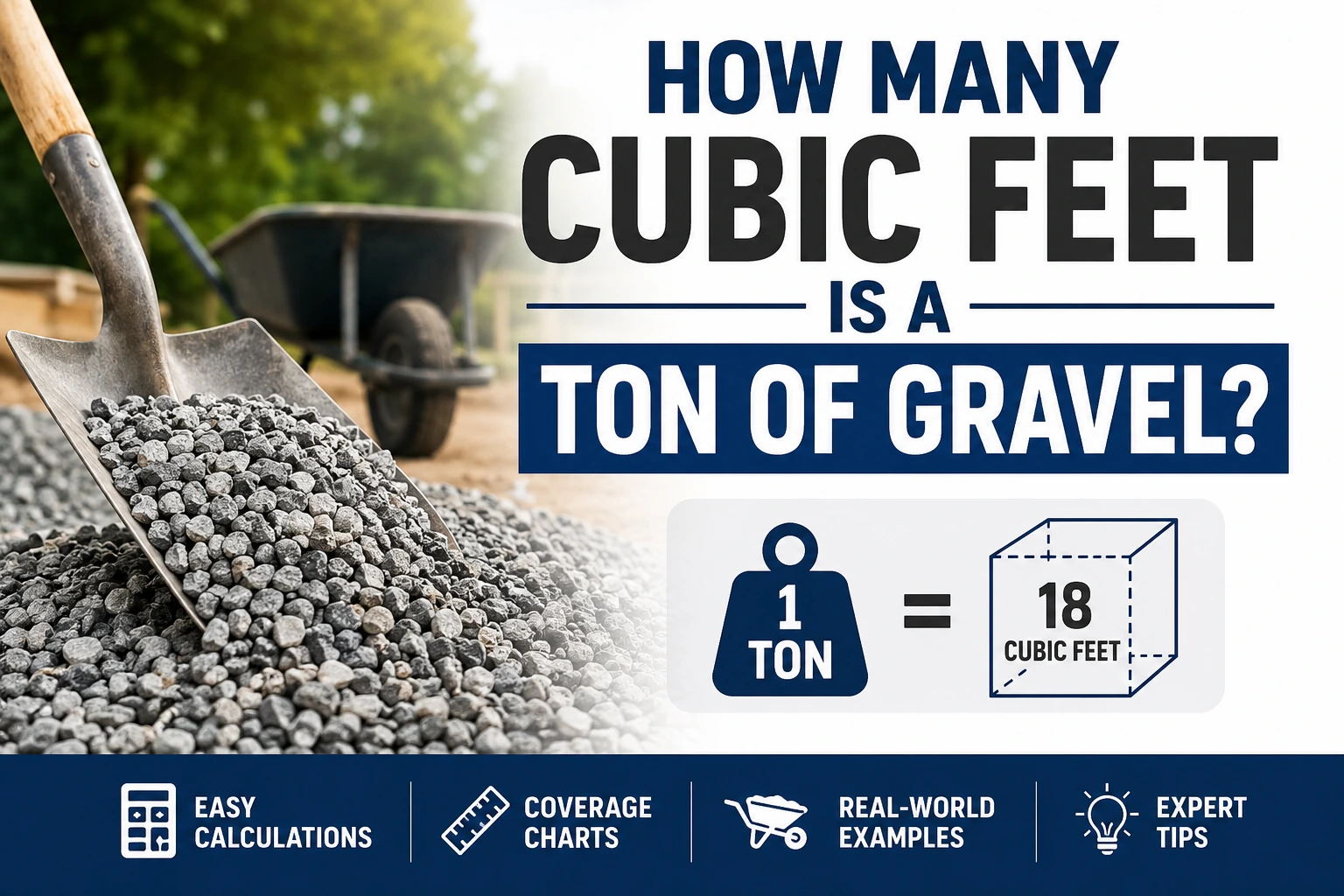
If you are planning a landscaping, driveway, patio, or construction project, you may wonder: how many cubic feet is a ton of gravel?
This is one of the most common questions people ask when buying bulk gravel. Gravel is usually sold by weight in tons, but project measurements are often calculated in cubic feet or cubic yards. Understanding the conversion helps you avoid ordering too little or paying for extra material you do not need.
On average, one ton of gravel equals about 18 cubic feet. However, the exact amount depends on the gravel type, moisture content, and density.
In this guide, you will learn:
- How gravel weight and volume work
- The average cubic feet in a ton of gravel
- Conversion formulas
- Gravel coverage charts
- Real project examples
- Expert tips for accurate ordering
Understanding Gravel Weight and Volume
Before calculating gravel quantities, it helps to understand the difference between weight and volume.
Weight vs. Volume
- Weight measures how heavy the gravel is
- Volume measures how much space it occupies
Gravel suppliers usually sell material by:
- Tons
- Pounds
- Cubic yards
Homeowners often measure project areas using:
- Cubic feet
- Square feet
That is why conversion matters.
Why Gravel Density Matters
Different gravel types have different densities. Some gravel pieces are tightly packed and heavy, while others are lighter and airier.
For example:
- Crushed stone is usually denser
- Pea gravel contains more air gaps
- Wet gravel weighs more than dry gravel
Because of this, the cubic feet per ton can vary slightly.
How Many Cubic Feet Is a Ton of Gravel on Average?
The standard estimate used in landscaping and construction is:
1 ton of gravel≈18 cubic feet
This estimate works for most common gravel types.
However, actual values usually range between:
| Gravel Type | Approx. Cubic Feet per Ton |
|---|---|
| Crushed Stone | 16–18 cubic feet |
| Pea Gravel | 18–20 cubic feet |
| River Rock | 19–21 cubic feet |
| Limestone Gravel | 17–18 cubic feet |
These numbers are averages used by contractors and suppliers.
Gravel Types and Their Cubic Feet Per Ton
Different gravel materials change the final volume calculation.
Pea Gravel
Pea gravel is small, smooth, and rounded. Because the stones do not compact tightly, one ton often covers more space.
Typical conversion:
- 1 ton = 18 to 20 cubic feet
Common uses:
- Garden paths
- Decorative landscaping
- Playgrounds
Crushed Stone
Crushed stone is angular and compact. It usually weighs more per cubic foot.
Typical conversion:
- 1 ton = 16 to 18 cubic feet
Common uses:
- Driveways
- Foundations
- Base layers
River Rock
River rock is smoother and larger than standard gravel.
Typical conversion:
- 1 ton = 19 to 21 cubic feet
Common uses:
- Drainage systems
- Decorative borders
- Water features
Limestone Gravel
Limestone is dense and commonly used in construction.
Typical conversion:
- 1 ton = 17 to 18 cubic feet
Common uses:
- Road bases
- Parking areas
- Structural fill
Formula to Convert Tons of Gravel to Cubic Feet
You can estimate gravel volume using a simple formula.
Cubic Feet=Tons×18
This formula uses the average density of standard gravel.
Step-by-Step Example
Suppose you bought 3 tons of gravel.
Calculation:
3×18=54 cubic feet
So:
- 3 tons of gravel ≈ 54 cubic feet
Gravel Coverage Chart by Ton
This quick-reference chart helps estimate gravel volume.
| Tons of Gravel | Approx. Cubic Feet |
|---|---|
| 0.5 ton | 9 cubic feet |
| 1 ton | 18 cubic feet |
| 2 tons | 36 cubic feet |
| 3 tons | 54 cubic feet |
| 4 tons | 72 cubic feet |
| 5 tons | 90 cubic feet |
| 10 tons | 180 cubic feet |
This chart uses average gravel density.
How Much Area Does One Ton of Gravel Cover?
Coverage depends on gravel depth.
The deeper the gravel layer, the smaller the area covered.
Coverage at 1 Inch Depth
One ton of gravel typically covers:
- About 216 square feet
Good for:
- Decorative landscaping
- Walkways
Coverage at 2 Inches Depth
One ton covers approximately:
- 108 square feet
Good for:
- Patios
- Garden paths
Coverage at 4 Inches Depth
One ton covers around:
- 54 square feet
Good for:
- Driveways
- Heavy traffic areas
Real-World Examples of Gravel Calculations
Practical examples make gravel estimation easier.
Driveway Example
Suppose your driveway measures:
- 20 feet long
- 10 feet wide
- 4 inches deep
Step 1: Calculate Area
20×10=200 square feet
Step 2: Convert Depth to Feet
4 inches = 0.33 feet
Step 3: Calculate Volume
200×0.33≈66 cubic feet
Step 4: Convert to Tons
Using 18 cubic feet per ton:
66÷18≈3.7 tons
You would need about:
- 4 tons of gravel
Garden Landscaping Example
You want decorative gravel around flower beds measuring:
- 15 feet × 8 feet
- 2 inches deep
Area
15×8=120 square feet
Depth Conversion
2 inches = 0.167 feet
Volume
120×0.167≈20 cubic feet
Tons Needed
20÷18≈1.1 tons
Order about:
- 1.25 tons for safety
Drainage Trench Example
Suppose a trench measures:
- 30 feet long
- 1 foot wide
- 1 foot deep
Volume
30×1×1=30 cubic feet
Gravel Needed
30÷18≈1.67 tons
You would likely order:
- 1.75 to 2 tons
Common Mistakes When Estimating Gravel
Many people underestimate gravel needs. Here are common errors to avoid.
Ignoring Gravel Depth
Depth changes everything.
A shallow decorative layer may need only one ton, while a driveway base may require several tons.
Always calculate:
- Length
- Width
- Depth
Forgetting Compaction
Compacted gravel settles over time.
Crushed stone especially compresses after installation.
Experts often recommend ordering:
- 5–10% extra material
Using the Wrong Density
Not all gravel types weigh the same.
Supplier estimates can differ depending on:
- Stone size
- Moisture level
- Material composition
Always ask your supplier for:
- Weight-per-cubic-yard information
Expert Tips for Ordering Gravel
Professional contractors follow a few smart practices.
Order Slightly More Than Calculated
Running short creates delays and additional delivery costs.
A good rule:
- Add 5–10% extra
Choose the Right Gravel Size
Different projects need different gravel sizes.
Small Gravel
Best for:
- Walkways
- Landscaping
Medium Gravel
Best for:
- Drainage
- Decorative uses
Large Gravel
Best for:
- Driveways
- Structural support
Measure Carefully
Even small measurement errors can change total tonnage significantly.
Double-check:
- Width
- Length
- Depth
Gravel vs. Cubic Yards
People often confuse cubic feet and cubic yards.
Here is the relationship:
1 cubic yard=27 cubic feet
Since one ton of gravel averages 18 cubic feet:
18÷27≈0.67 cubic yards
So:
- 1 ton of gravel ≈ 0.67 cubic yards
This conversion is useful when suppliers price gravel by cubic yard instead of ton.
Why Gravel Calculations Matter
Accurate gravel estimation saves:
- Money
- Time
- Labor
- Delivery costs
It also prevents:
- Uneven surfaces
- Thin coverage
- Drainage issues
- Structural weakness
Whether you are building a driveway or improving landscaping, proper measurements help your project succeed.
FAQs
How many cubic feet are in one ton of gravel?
On average, one ton of gravel equals about 18 cubic feet. The exact amount depends on gravel type and density.
How much area does 1 ton of gravel cover?
One ton can cover:
- About 216 sq ft at 1 inch depth
- About 108 sq ft at 2 inches depth
- About 54 sq ft at 4 inches depth
Does gravel type affect cubic feet per ton?
Yes. Pea gravel, crushed stone, river rock, and limestone all have different densities, which changes volume calculations.
How do I calculate gravel needed for my project?
Multiply:
- Length × width × depth
This gives cubic feet. Then divide by 18 to estimate tons.
Is wet gravel heavier than dry gravel?
Yes. Moisture increases weight, so wet gravel may contain fewer cubic feet per ton than dry gravel.
Conclusion
Understanding how many cubic feet is a ton of gravel helps you plan landscaping and construction projects more accurately.
For most projects, the standard estimate is:
- 1 ton of gravel ≈ 18 cubic feet
However, the exact amount depends on:
- Gravel type
- Stone size
- Moisture content
- Compaction
Using the right formulas, coverage charts, and depth calculations can help you avoid costly mistakes and order the correct amount of material the first time.
Whether you are building a driveway, filling a drainage trench, or upgrading your landscaping, accurate gravel calculations make every project smoother and more cost-effective.
Discover more