

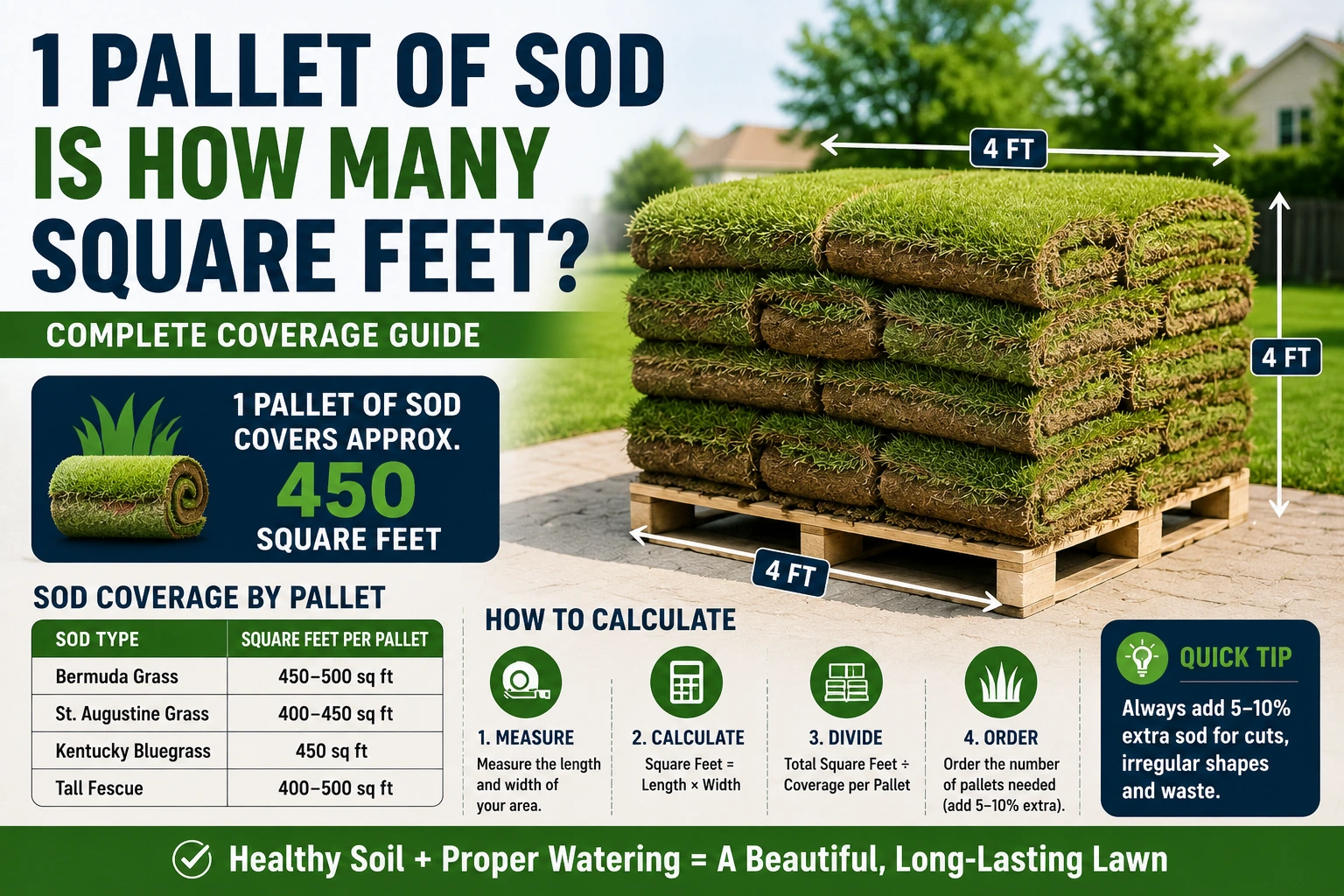
If you are planning a new lawn or landscaping project, one of the first questions you may ask is: “1 pallet of sod is how many square feet?”
In most cases:
- One pallet of sod covers approximately 400 to 500 square feet.
However, the exact amount depends on:
- The sod supplier
- Grass type
- Roll size
- Pallet stacking method
Understanding sod coverage helps you:
- Avoid overbuying
- Prevent shortages
- Estimate project costs accurately
- Plan lawn installation more efficiently
In this complete guide, you will learn how sod coverage works, formulas, coverage charts, installation examples, common mistakes, and expert landscaping tips.
Understanding Sod Pallets
Before calculating coverage, it helps to understand what sod actually is.
What Is Sod?
Sod is pre-grown grass with soil attached to the roots. It is harvested in strips or rolls and delivered ready for installation.
Sod is commonly used for:
- New lawns
- Backyard renovations
- Sports fields
- Commercial landscaping
- Erosion control
Unlike grass seed, sod creates an almost instant lawn.
What Comes on a Sod Pallet?
A pallet of sod typically contains:
- Multiple sod rolls or slabs
- Stacked layers of turf
- Around 400–500 sq ft of coverage
The pallet weight can range from:
- 2,000 to 3,000 pounds depending on moisture levels
That is why sod delivery usually requires trucks or forklifts.
1 Pallet of Sod Is How Many Square Feet?
The standard answer is:
1 pallet of sod≈400 to 500 square feet
Most suppliers sell pallets designed to cover:
- About 450 square feet on average
However, pallet sizes vary slightly by region and grass variety.
Standard Sod Coverage by Type
Here is a general sod coverage chart.
| Sod Type | Average Coverage Per Pallet |
|---|---|
| Bermuda sod | 450–500 sq ft |
| St. Augustine sod | 400–450 sq ft |
| Kentucky bluegrass | 450 sq ft |
| Fescue sod | 400–500 sq ft |
Always verify coverage with your supplier before ordering.
Why Sod Coverage Varies
Several factors affect how much area a pallet covers.
Roll Size Differences
Sod may come as:
- Large rolls
- Small rolls
- Rectangular slabs
Different dimensions affect pallet totals.
Grass Variety
Certain grasses are:
- Thicker
- Heavier
- More moisture-retentive
This changes stacking and pallet size.
Supplier Packaging
Each supplier may use slightly different pallet configurations.
For example:
- One company may package 450 sq ft
- Another may package 500 sq ft
Sod Coverage Formula Explained
Measuring your lawn correctly is essential before ordering sod.
Square Foot Formula
Use this formula:
Square Feet=Length×Width
This works for square or rectangular lawns.
Example Calculation
Suppose your lawn measures:
- 20 feet wide
- 25 feet long
Calculation:
20×25=500
Your lawn size is:
- 500 square feet
Since one pallet covers around 450–500 sq ft:
- You need approximately one pallet.
How to Calculate Number of Sod Pallets Needed
Once you know your lawn size, divide by pallet coverage.
Formula
Number of Pallets=Coverage Per PalletTotal Lawn Area
Example
Suppose your yard is:
- 1,200 square feet
Each pallet covers:
- 450 sq ft
Calculation:
1200÷450≈2.67
You would need:
- About 3 pallets of sod
Always round up slightly.
Sod Coverage Chart
This quick-reference chart helps estimate sod needs.
| Lawn Size | Approximate Pallets Needed |
|---|---|
| 400 sq ft | 1 pallet |
| 800 sq ft | 2 pallets |
| 1,200 sq ft | 3 pallets |
| 2,000 sq ft | 4–5 pallets |
| 5,000 sq ft | 10–12 pallets |
How to Measure Irregular Lawn Shapes
Many lawns are not perfect rectangles.
Divide Into Sections
Break the lawn into:
- Squares
- Rectangles
- Circles
Measure each section separately.
Add the Areas Together
For example:
- Front yard = 600 sq ft
- Side yard = 300 sq ft
- Backyard = 900 sq ft
Total:
600+300+900=1800
Total lawn:
- 1,800 square feet
Common Types of Sod
Different grass varieties suit different climates.
Bermuda Grass
Best For
- Warm climates
- High traffic lawns
Pros
- Durable
- Fast growth
- Drought resistant
Cons
- Turns brown in cold weather
St. Augustine Grass
Best For
- Southern regions
- Humid climates
Pros
- Thick appearance
- Good shade tolerance
Cons
- Requires regular watering
Kentucky Bluegrass
Best For
- Cooler climates
Pros
- Soft texture
- Rich green color
Cons
- Higher maintenance
Fescue Grass
Best For
- Moderate climates
Pros
- Shade tolerant
- Deep roots
Cons
- May require overseeding
Factors That Affect Sod Installation
Proper installation improves lawn success.
Soil Preparation
Healthy soil is critical.
Before laying sod:
- Remove weeds
- Level the surface
- Add topsoil if needed
- Loosen compacted soil
Watering
New sod needs frequent watering.
Typical schedule:
- Daily watering for the first 2 weeks
- Gradually reduce frequency afterward
Installation Timing
The best seasons are usually:
- Spring
- Early fall
Extreme heat makes sod establishment harder.
Common Sod Installation Mistakes
Avoiding mistakes saves time and money.
Incorrect Measurements
Underestimating lawn size can delay projects.
Always:
- Measure carefully
- Double-check dimensions
Leaving Gaps Between Sod Pieces
Gaps can cause:
- Dry spots
- Weed growth
- Uneven appearance
Install pieces tightly together.
Delaying Installation
Sod should be installed quickly after delivery.
Waiting too long can:
- Dry out roots
- Damage grass health
Expert Tips for Successful Sod Installation
Professional landscapers use several best practices.
Order Slightly Extra Sod
Experts recommend:
- Ordering 5–10% extra
This covers:
- Trimming waste
- Irregular edges
- Repairs
Stagger Sod Seams
Lay sod like bricks rather than straight rows.
This improves:
- Appearance
- Root establishment
Roll the Sod After Installation
Using a lawn roller:
- Improves soil contact
- Removes air pockets
- Helps roots establish faster
Sod vs Grass Seed Comparison
| Feature | Sod | Grass Seed |
|---|---|---|
| Appearance | Instant lawn | Slow growth |
| Installation Speed | Fast | Slow |
| Cost | Higher | Lower |
| Erosion Control | Excellent | Limited |
| Maintenance | Moderate | High initially |
Sod costs more but delivers immediate results.
Benefits of Sod Installation
Sod offers many advantages.
Instant Curb Appeal
A new lawn improves:
- Home appearance
- Property value
- Outdoor enjoyment
Faster Lawn Establishment
Unlike seed, sod becomes usable relatively quickly.
Better Erosion Control
Sod helps stabilize:
- Slopes
- Bare soil
- Drainage areas
FAQs
1. 1 pallet of sod is how many square feet?
Most pallets cover approximately 400–500 square feet.
2. How much does a pallet of sod weigh?
A pallet typically weighs between 2,000 and 3,000 pounds depending on moisture content.
3. How do I calculate sod needed for my yard?
Measure lawn square footage and divide by the coverage per pallet.
4. Should I order extra sod?
Yes. Most landscapers recommend ordering 5–10% extra for waste and trimming.
5. How quickly should sod be installed?
Ideally within 24 hours after delivery to prevent drying and root damage.
Conclusion
If you are wondering “1 pallet of sod is how many square feet,” the typical answer is:
1 pallet of sod covers approximately 400 to 500 square feet
The exact coverage depends on sod type, supplier packaging, and roll dimensions. By measuring your lawn accurately, using coverage formulas, and ordering slightly extra material, you can complete your landscaping project smoothly and efficiently.
Whether you are installing a small backyard lawn or a large commercial landscape, understanding sod coverage helps save money, reduce waste, and achieve a healthy, beautiful lawn quickly.
Discover more
how many square feet in a concrete yard