

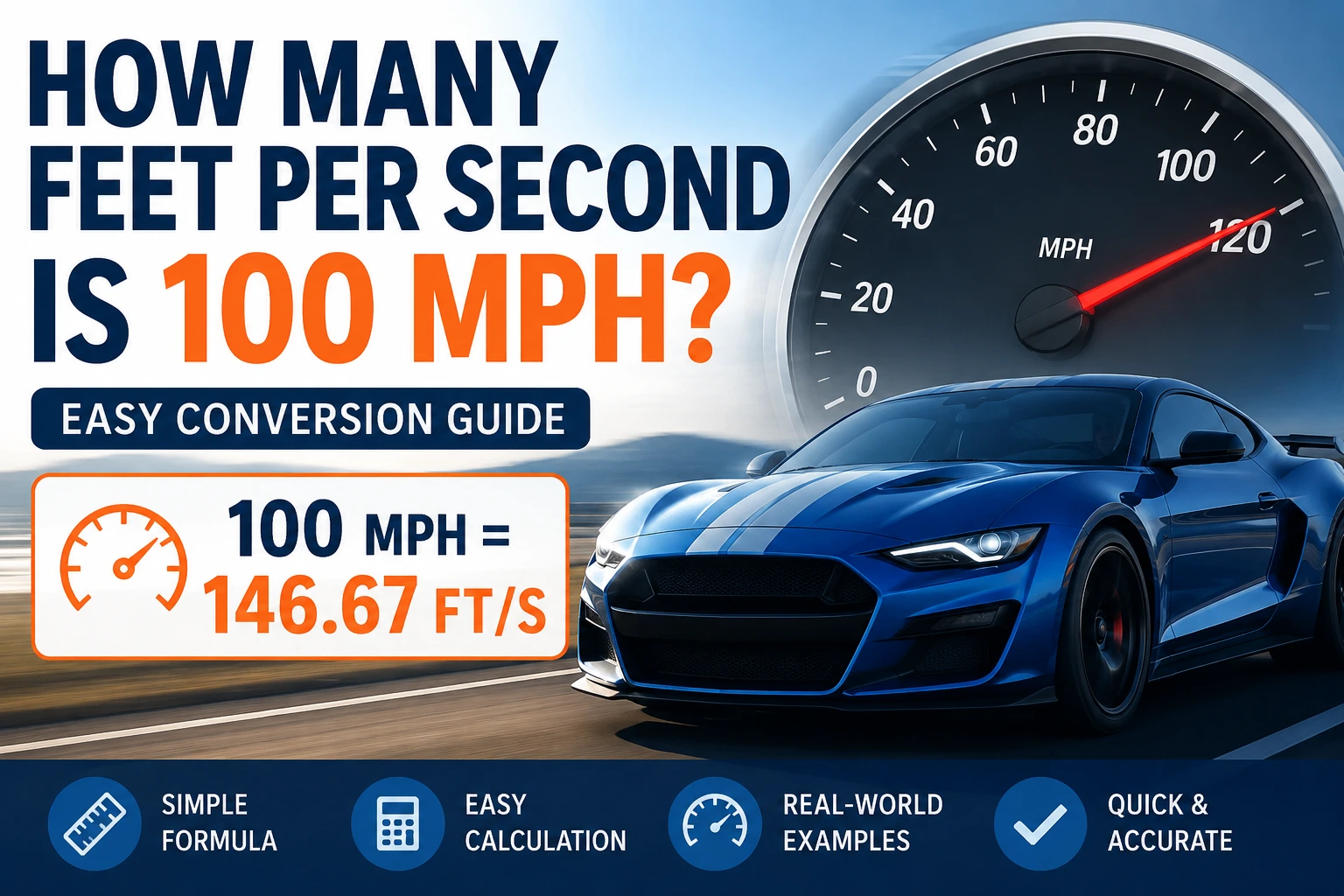
If you’ve ever wondered how many feet per second is 100 mph, you’re not alone. This conversion is common in physics, engineering, transportation, sports analysis, and even driving education.
While miles per hour (mph) is one of the most commonly used speed measurements in the United States, feet per second (ft/s) often provides a more precise understanding of how quickly an object is moving over short distances.
The short answer is:
100 mph = 146.67 feet per second (ft/s)
That means an object traveling at 100 miles per hour moves nearly 147 feet every second.
To put that into perspective, that’s almost half the length of a football field in just one second.
In this guide, you’ll learn exactly how the conversion works, why it’s useful, and how to convert any speed from mph to feet per second.
Quick Answer
If you’re looking for the fastest possible answer:
100 mph=146.67 ft/s
100 miles per hour equals approximately 146.67 feet per second.
This value is obtained using a standard speed conversion formula that converts miles into feet and hours into seconds.
Understanding MPH and Feet Per Second
Before performing the calculation, it helps to understand what each unit measures.
What Is Miles Per Hour?
Miles per hour (mph) measures how many miles an object travels in one hour.
For example:
- A car traveling at 60 mph covers 60 miles in one hour.
- A race car traveling at 100 mph covers 100 miles in one hour.
- An aircraft may travel several hundred miles per hour.
MPH is commonly used in:
- Road transportation
- Speed limits
- Vehicle performance
- Aviation in some contexts
What Is Feet Per Second?
Feet per second (ft/s) measures how many feet an object travels in one second.
This unit is frequently used in:
- Physics
- Engineering
- Ballistics
- Sports science
- Motion analysis
Because a second is a much smaller unit of time than an hour, ft/s provides a clearer picture of rapid movement.
How Many Feet Per Second Is 100 MPH? Step-by-Step Calculation
Let’s calculate it manually.
The Conversion Formula
The standard conversion formula is:
ft/s=mph×36005280
Where:
- 1 mile = 5,280 feet
- 1 hour = 3,600 seconds
When simplified:
ft/s=mph×1.46667
Solving the Equation
Insert 100 mph into the formula:
146.67 = 100 × 1.46667
Therefore:
100 mph = 146.67 ft/s
This is the exact conversion used by engineers, scientists, and transportation professionals.
MPH to Feet Per Second Conversion Chart
The following chart makes speed conversions quick and easy.
| Speed (MPH) | Feet Per Second (FT/S) |
|---|---|
| 10 mph | 14.67 ft/s |
| 20 mph | 29.33 ft/s |
| 30 mph | 44.00 ft/s |
| 40 mph | 58.67 ft/s |
| 50 mph | 73.33 ft/s |
| 60 mph | 88.00 ft/s |
| 70 mph | 102.67 ft/s |
| 80 mph | 117.33 ft/s |
| 90 mph | 132.00 ft/s |
| 100 mph | 146.67 ft/s |
| 110 mph | 161.33 ft/s |
| 120 mph | 176.00 ft/s |
| 150 mph | 220.00 ft/s |
| 200 mph | 293.33 ft/s |
This chart shows how rapidly speed increases when measured in feet traveled every second.
Why Convert MPH to Feet Per Second?
Many people ask why they should convert speeds at all.
The answer depends on the situation.
Physics and Engineering
Physics equations often require feet per second rather than miles per hour.
Examples include:
- Projectile motion
- Velocity calculations
- Acceleration formulas
- Motion analysis
Using ft/s makes equations easier because the time unit is seconds.
Driving and Road Safety
Understanding feet per second can improve awareness of stopping distances.
At 100 mph:
- You travel 146.67 feet every second.
- In 2 seconds, you travel nearly 293 feet.
- In 3 seconds, you travel more than 440 feet.
This demonstrates why reaction time is critical at high speeds.
Sports Performance
Sports analysts frequently measure speed using feet per second.
Examples include:
- Baseball pitches
- Sprinting athletes
- Hockey pucks
- Racing vehicles
The unit allows accurate short-distance analysis.
Aviation and Transportation
Engineers and transportation planners often convert speed units to perform calculations involving:
- Runway lengths
- Vehicle braking distances
- Aircraft performance
- Transportation safety systems
Real-World Examples of 100 MPH in Feet Per Second
Numbers become easier to understand when connected to real situations.
Sports Cars
Many modern performance cars can reach 100 mph in seconds.
At that speed:
- The car moves 146.67 feet every second.
- That’s nearly the length of a large commercial airplane every second.
Drivers often underestimate how much ground is covered at this speed.
Racing Events
In professional racing, even small reaction delays matter.
A driver reacting just one second late at 100 mph has already traveled:
146.67 feet
That’s enough distance to dramatically affect race outcomes or safety.
High-Speed Trains
Some rail systems operate at speeds exceeding 100 mph.
Engineers use feet per second calculations to determine:
- Safe braking distances
- Signal timing
- Track design requirements
Comparing 100 MPH to Other Common Speeds
Let’s compare 100 mph with familiar speeds.
| Speed | Feet Per Second |
|---|---|
| Walking (3 mph) | 4.4 ft/s |
| Running (10 mph) | 14.7 ft/s |
| City Driving (30 mph) | 44 ft/s |
| Highway Driving (65 mph) | 95.3 ft/s |
| Fast Highway Speed (80 mph) | 117.3 ft/s |
| 100 mph | 146.67 ft/s |
| 200 mph | 293.33 ft/s |
These comparisons show how quickly speed increases as mph rises.
A vehicle moving at 100 mph travels more than:
- 33 times faster than a typical walking speed.
- 10 times faster than a recreational runner.
Common Mistakes When Converting MPH to Feet Per Second
Many people make errors during speed conversions.
Here are the most common ones.
Forgetting the Time Conversion
Some people convert miles to feet but forget to convert hours into seconds.
This creates results that are thousands of times too large.
Using Incorrect Conversion Factors
Remember:
- 1 mile = 5,280 feet
- 1 hour = 3,600 seconds
Using inaccurate values leads to incorrect answers.
Confusing Feet Per Second with Miles Per Minute
These units measure speed differently.
Always check the target unit before calculating.
Rounding Too Early
Keep several decimal places during calculations and round only at the end.
For example:
- Correct: 146.67 ft/s
- Over-rounded: 147 ft/s
While both are acceptable in casual situations, technical work requires greater precision.
Expert Tips for Quick Speed Conversions
Need a fast estimate?
Use this shortcut:
Multiply mph by 1.47
Examples:
- 50 mph × 1.47 ≈ 73.5 ft/s
- 75 mph × 1.47 ≈ 110.25 ft/s
- 100 mph × 1.47 ≈ 147 ft/s
This method is accurate enough for most everyday calculations.
For scientific or engineering purposes, use the exact factor:
1.46667
Frequently Asked Questions
Is 100 mph equal to 146.67 feet per second?
Yes. Using the standard conversion formula, 100 miles per hour equals approximately 146.67 feet per second.
How do you convert mph to feet per second?
Multiply the mph value by 1.46667. This converts miles into feet and hours into seconds.
Why do engineers use feet per second?
Feet per second is often more useful for calculations involving motion, acceleration, reaction times, and short-distance measurements.
How many feet does a car travel in one second at 100 mph?
A car traveling at 100 mph covers approximately 146.67 feet every second.
What is 60 mph in feet per second?
60 mph equals approximately 88 feet per second.
10. Conclusion
Final Answer: How Many Feet Per Second Is 100 MPH?
If you’re asking how many feet per second is 100 mph, the answer is simple:
100 mph = 146.67 feet per second (ft/s).
This means an object moving at 100 miles per hour travels nearly 147 feet every second. Understanding this conversion is useful for physics, engineering, transportation planning, driving safety, racing, and many other real-world applications.
By remembering the quick conversion factor of 1.46667, you can easily convert any speed from miles per hour to feet per second whenever needed. Whether you’re solving a physics problem, analyzing vehicle performance, or simply satisfying your curiosity, knowing that 100 mph equals 146.67 ft/s gives you a clearer understanding of just how fast that speed really is.
discover more