
If you’re shopping for a new air conditioner, one of the most common questions is: how many square feet for a 5 ton AC unit?
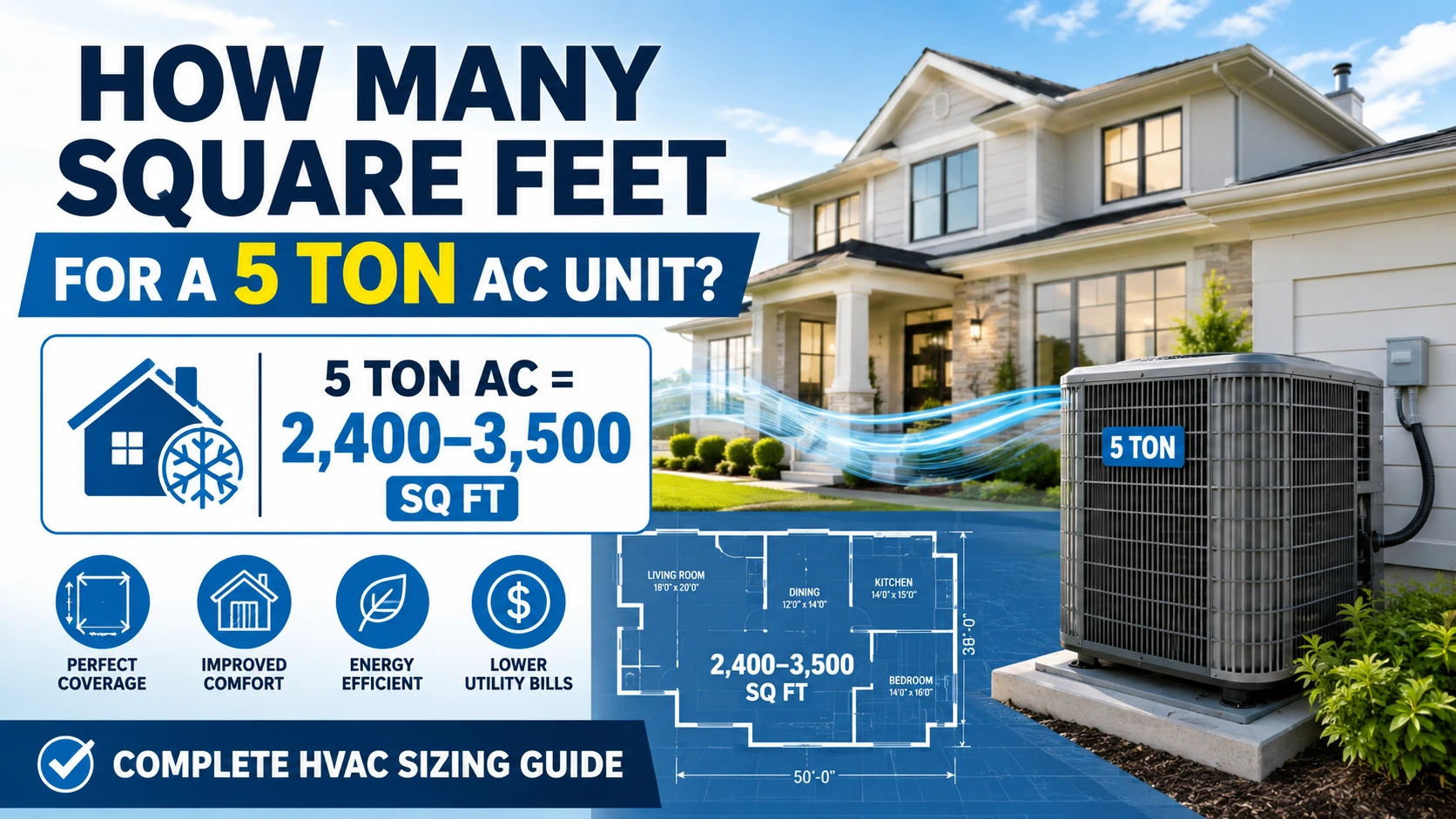
The short answer is that a 5-ton AC unit typically cools between 2,400 and 3,500 square feet under normal conditions. However, the actual coverage depends on several factors, including climate, insulation, ceiling height, window placement, and overall home efficiency.
Choosing the right AC size is extremely important. A system that is too large can waste energy and create humidity problems, while a system that is too small may struggle to keep your home comfortable during hot weather.
In this guide, you’ll learn exactly how much space a 5-ton AC can cool, what factors influence performance, and how professionals determine the correct HVAC size.
Understanding What a 5 Ton AC Unit Means
Many homeowners assume that “5 tons” refers to the physical weight of the air conditioner. In HVAC terminology, that’s not the case.
What Is HVAC Tonnage?
HVAC tonnage measures cooling capacity rather than weight.
One ton of air conditioning equals the amount of cooling needed to melt one ton of ice in 24 hours.
BTU Capacity of a 5 Ton AC
A standard air conditioner provides:
| AC Size | Cooling Capacity |
|---|---|
| 1 Ton | 12,000 BTUs |
| 2 Ton | 24,000 BTUs |
| 3 Ton | 36,000 BTUs |
| 4 Ton | 48,000 BTUs |
| 5 Ton | 60,000 BTUs |
A 5-ton AC unit delivers approximately 60,000 BTUs per hour, making it suitable for larger homes and commercial spaces.
How Many Square Feet for a 5 Ton AC Unit?
The average coverage range for a 5-ton AC unit is:
| Condition | Approximate Coverage |
|---|---|
| Hot climate, poor insulation | 2,400–2,700 sq ft |
| Average conditions | 2,700–3,000 sq ft |
| Excellent insulation | 3,000–3,500 sq ft |
Most HVAC contractors use general sizing guidelines that estimate roughly 20–25 BTUs per square foot.
Using this formula:
60,000 BTUs ÷ 20 BTUs = 3,000 sq ft
60,000 BTUs ÷ 25 BTUs = 2,400 sq ft
This explains why a 5-ton AC is commonly recommended for homes between 2,400 and 3,500 square feet.
Typical Home Size Examples
A 5-ton AC may work well for:
- Large single-family homes
- Two-story houses
- Open-concept floor plans
- Small office buildings
- Large retail spaces
However, square footage alone should never be the only factor considered.
Quick AC Sizing Chart by Square Footage
Use this chart as a general reference.
| Home Size (Sq Ft) | Recommended AC Size |
|---|---|
| 600–1,000 | 1.5–2 Tons |
| 1,000–1,300 | 2–2.5 Tons |
| 1,300–1,600 | 2.5–3 Tons |
| 1,600–2,000 | 3–3.5 Tons |
| 2,000–2,400 | 3.5–4 Tons |
| 2,400–3,000 | 4.5–5 Tons |
| 3,000–3,500 | 5 Tons+ |
Remember that these are estimates. Actual requirements can vary significantly.
Factors That Affect How Many Square Feet a 5 Ton AC Unit Can Cool
When determining how many square feet for a 5 ton AC unit, several factors influence cooling performance.
Climate Zone
Homes in hotter regions require more cooling power.
For example:
- Arizona and Texas homes often need larger systems.
- Northern states may require less cooling capacity.
A 5-ton AC may cool fewer square feet in a very hot climate than in a mild one.
Insulation Quality
Good insulation reduces heat transfer.
Well-insulated homes:
- Stay cooler longer
- Reduce AC workload
- Improve energy efficiency
A highly insulated home can often cool a larger area with the same AC size.
Ceiling Height
Most sizing guidelines assume 8-foot ceilings.
If your home has:
- Vaulted ceilings
- Cathedral ceilings
- Open atriums
You may need additional cooling capacity because there is more air volume to cool.
Sun Exposure
Homes with extensive southern or western sun exposure often absorb more heat.
Factors include:
- Large windows
- Skylights
- Minimal shade
These can increase cooling requirements substantially.
Occupancy Levels
More people generate more heat.
A household with:
- Multiple family members
- Frequent gatherings
- Home offices
May require additional cooling compared to a lightly occupied home.
Window Size and Placement
Windows are a major source of heat gain.
Large glass areas can dramatically increase cooling demand, especially if they are not energy efficient.
Is a 5 Ton AC Unit Right for Your Home?
A 5-ton AC is generally appropriate for:
- Homes around 2,500–3,500 square feet
- Large residential properties
- Buildings in warm climates
- Homes with open floor plans
It may not be the best choice for:
- Small homes
- Apartments
- Condominiums under 2,000 square feet
Installing a larger system than necessary can create performance issues.
Examples of Homes That May Need a 5 Ton AC
Here are some realistic examples.
Example 1: Large Suburban Home
- Size: 2,900 sq ft
- Average insulation
- Hot climate
A 5-ton system may be appropriate.
Example 2: Energy-Efficient Home
- Size: 3,300 sq ft
- High-efficiency windows
- Excellent insulation
A 5-ton unit could still provide adequate cooling.
Example 3: Older Home
- Size: 2,500 sq ft
- Poor insulation
- Drafty windows
A 5-ton AC may be necessary due to increased heat gain.
Benefits of Proper AC Sizing
Correct sizing provides numerous advantages.
Improved Comfort
Rooms maintain consistent temperatures.
Lower Energy Bills
The system runs efficiently without excessive cycling.
Better Humidity Control
Properly sized AC systems remove moisture effectively.
Longer Equipment Life
Reduced strain helps extend system lifespan.
Better Indoor Air Quality
Balanced airflow improves overall comfort and health.
Problems Caused by Oversized AC Units
Many homeowners mistakenly believe bigger is always better.
Unfortunately, oversized systems create several issues.
Short Cycling
The AC cools too quickly and shuts off repeatedly.
Poor Humidity Removal
Because cycles are short, the unit doesn’t remove enough moisture.
Increased Wear and Tear
Frequent starts and stops stress components.
Higher Energy Costs
Oversized systems often consume more electricity than necessary.
Uneven Cooling
Some rooms become too cold while others remain warm.
Problems Caused by Undersized AC Units
An undersized unit has its own set of problems.
Constant Operation
The system runs continuously trying to reach the thermostat setting.
Reduced Comfort
Indoor temperatures remain higher than desired.
Excessive Utility Bills
Continuous operation increases energy consumption.
Premature Equipment Failure
Constant workload can shorten system life.
How HVAC Professionals Determine the Correct AC Size
Professional HVAC contractors rely on more than square footage.
Manual J Load Calculation
The industry-standard method is called a Manual J calculation.
It evaluates:
- Home size
- Insulation levels
- Window efficiency
- Occupancy
- Local climate
- Building orientation
- Ceiling height
- Air leakage
This process provides a much more accurate recommendation than a simple square-foot estimate.
Why Square Footage Alone Is Not Enough
Two homes with identical square footage can have very different cooling needs.
For example:
- One may have excellent insulation.
- Another may have older windows and poor air sealing.
As a result, they could require completely different AC sizes.
Expert Tips for Choosing the Right AC Size
Before purchasing a new system, consider these professional recommendations:
Get a Load Calculation
Never rely solely on online calculators.
Improve Insulation First
Upgrading insulation may allow you to install a smaller, more efficient system.
Seal Air Leaks
Prevent conditioned air from escaping.
Consider Energy-Efficient Windows
Modern windows reduce heat gain significantly.
Evaluate Ductwork
Poor duct design can reduce cooling performance regardless of AC size.
Think About Future Needs
Home additions and renovations may affect cooling requirements.
Common Mistakes When Buying a 5 Ton AC Unit
Avoid these costly errors.
Choosing Based Only on Square Footage
Many factors affect cooling needs beyond floor area.
Ignoring Climate Conditions
Hot regions often require more cooling capacity.
Skipping Professional Assessment
Load calculations provide far greater accuracy.
Buying the Cheapest Unit
Efficiency ratings and reliability matter.
Overlooking Ductwork Issues
Even the best AC system cannot compensate for poorly designed ducts.
FAQs
1. How many square feet can a 5 ton AC cool?
A 5-ton AC unit typically cools between 2,400 and 3,500 square feet, depending on insulation, climate, ceiling height, and home efficiency.
2. Is a 5 ton AC too large for a 2,000-square-foot home?
In many cases, yes. A 5-ton system may be oversized for a 2,000-square-foot home unless the property has unusually high cooling demands.
3. How many BTUs does a 5 ton AC unit provide?
A 5-ton air conditioner provides approximately 60,000 BTUs per hour of cooling capacity.
4. Can a 5 ton AC cool a 3,500-square-foot house?
Yes, under favorable conditions such as good insulation, energy-efficient windows, and moderate climate conditions.
5. What is the best way to determine AC size?
A professional Manual J load calculation is the most accurate method for determining the correct air conditioner size.
Conclusion
If you’re wondering how many square feet for a 5 ton AC unit, the general answer is 2,400 to 3,500 square feet, with most installations targeting homes around 2,700 to 3,000 square feet. However, factors such as climate, insulation, ceiling height, window efficiency, and occupancy can significantly affect cooling requirements.
While square-foot estimates provide a useful starting point, the best approach is to have an HVAC professional perform a detailed load calculation. This ensures your system is properly sized, energy efficient, and capable of keeping your home comfortable for years to come. A correctly sized 5-ton AC unit delivers better comfort, lower utility bills, improved humidity control, and longer equipment life.
Discover more
how many square feet in 30 acres