
Cornhole is one of the most popular lawn games in North America. Whether you’re playing in your backyard, at a tailgate party, a family barbecue, or a competitive tournament, one question always comes up: how many feet apart are cornhole boards?
Getting the distance right is important because it affects fairness, scoring, and overall gameplay. Boards placed too close make scoring easy, while boards placed too far apart can make the game frustrating, especially for beginners.
The official distance used by professional organizations is straightforward, but there are also recommended distances for children and casual players.
This guide covers everything you need to know about cornhole board spacing, court dimensions, setup instructions, common mistakes, and expert tips.
Quick Answer: Official Cornhole Distance
If you’re wondering how many feet apart are cornhole boards, the official answer is:
| Measurement | Distance |
|---|---|
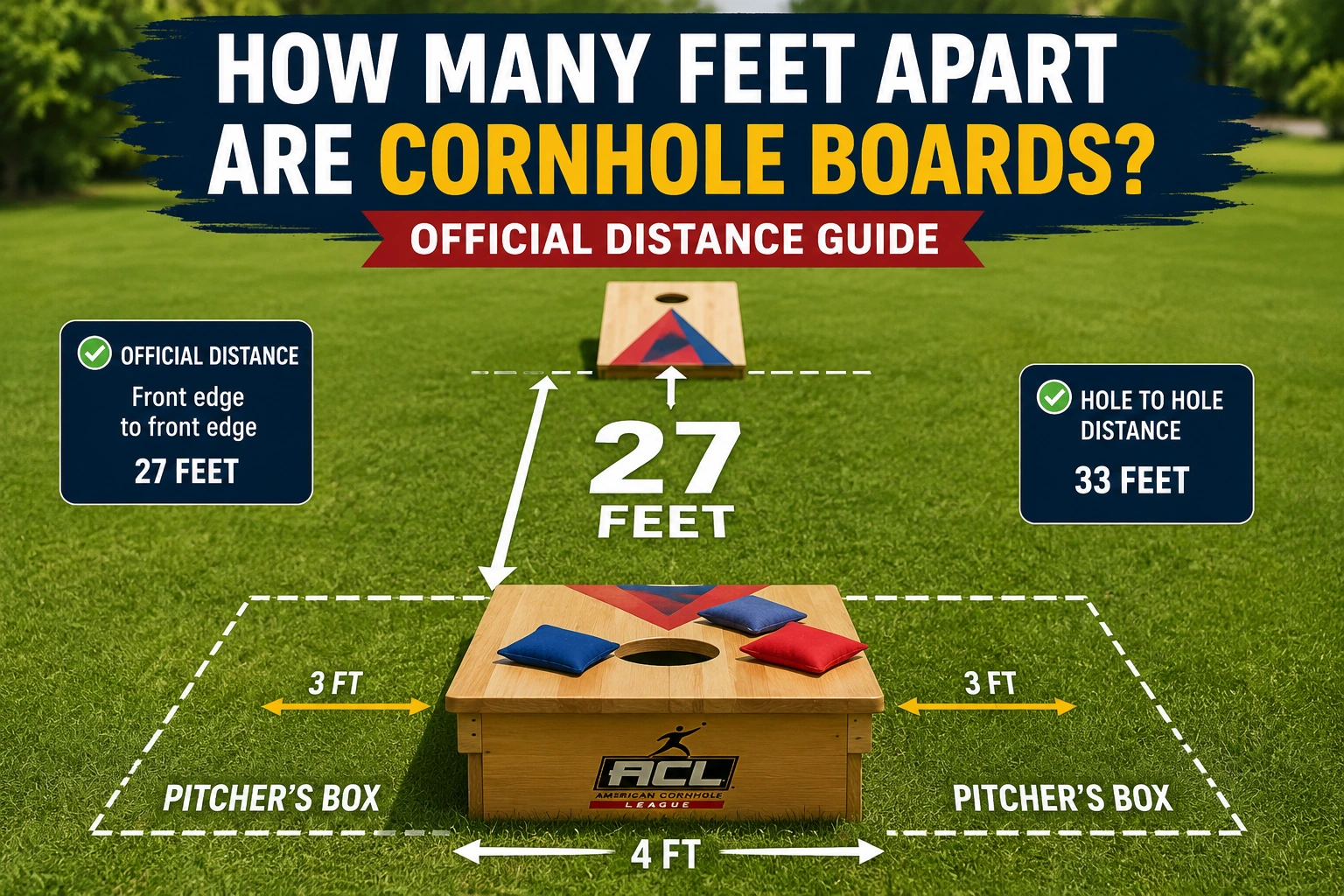
| Front edge to front edge | 27 feet |
| Hole center to hole center | 33 feet |
| Adult tournament distance | 27 feet |
| Youth distance | 12–21 feet |
| Beginner recreational distance | 21–24 feet |
The official regulation measurement is 27 feet from the front edge of one board to the front edge of the opposite board.
This standard is used by professional leagues and major tournaments.
Understanding Cornhole Court Measurements
Many players assume the game only requires placing two boards on the ground. However, official cornhole courts include several measurements.
Front Edge to Front Edge Measurement
The most important measurement is the distance between the front edges of both boards.
Official regulation:
27 feet
When someone asks, “How far apart should cornhole boards be?” this is usually the measurement being referenced.
Hole-to-Hole Measurement
Since the holes are positioned toward the upper portion of each board, the distance from one hole center to the other is longer.
Official hole-to-hole distance:
33 feet
Many competitive players use this measurement to double-check proper board placement.
Pitcher’s Box Dimensions
Each side of a cornhole court includes a designated pitching area.
Standard pitcher boxes are:
- 4 feet wide
- 3 feet beside each board
- Extend along both sides
These areas help keep gameplay organized during competition.
How Many Feet Apart Are Cornhole Boards for Adults?
For adults, the official regulation remains:
27 feet from front edge to front edge.
This distance is recognized by major cornhole organizations and tournament directors.
The 27-foot spacing creates a balance between:
- Skill
- Accuracy
- Strategy
- Consistency
At this distance, players must carefully control arc, speed, and landing position.
Competitive players spend countless hours practicing from the official distance because even a few feet can significantly affect performance.
Cornhole Distance for Kids and Beginners
Not everyone needs to play at regulation distance.
Children and beginners often struggle when boards are placed 27 feet apart.
Recommended distances include:
| Player Type | Recommended Distance |
|---|---|
| Young children | 12–15 feet |
| Older children | 15–21 feet |
| Beginners | 21 feet |
| Casual backyard play | 21–24 feet |
| Competitive adults | 27 feet |
Reducing the distance allows players to:
- Build confidence
- Improve throwing mechanics
- Enjoy the game more
- Increase scoring opportunities
As skills improve, the boards can gradually be moved farther apart.
Official Cornhole Court Dimensions Table
A complete cornhole court consists of more than just two boards.
| Component | Official Measurement |
|---|---|
| Board length | 48 inches |
| Board width | 24 inches |
| Board height (rear) | 12 inches |
| Hole diameter | 6 inches |
| Hole position from top | 9 inches |
| Hole center from side edges | 12 inches |
| Front board to front board | 27 feet |
| Hole center to hole center | 33 feet |
Knowing these dimensions helps create a court that closely matches tournament conditions.
Step-by-Step Guide to Setting Up Cornhole Boards
A proper setup ensures fair play and a better overall experience.
Gather Equipment
You’ll need:
- Two cornhole boards
- Measuring tape
- Eight bean bags
- Flat playing surface
A level surface produces the most accurate gameplay.
Measure the Distance
Place one board first.
From the front edge, measure exactly:
27 feet
Mark the location where the second board should be positioned.
Position the Boards
Align the second board so that:
- It faces the first board directly
- Front edges are parallel
- Distance remains 27 feet
Misalignment can affect shot accuracy.
Verify Measurements
Before starting the game:
- Recheck spacing
- Ensure boards are level
- Confirm both boards face each other evenly
Small adjustments can improve gameplay significantly.
Why the Official Cornhole Distance Matters
Many people casually place boards wherever they fit.
While this may be acceptable for recreational play, official spacing offers several advantages.
Consistent Competition
Everyone plays under the same conditions.
Better Skill Development
Practicing at regulation distance prepares players for tournaments.
Fair Gameplay
Equal board spacing removes unnecessary advantages.
Accurate Scoring
Proper setup ensures scoring reflects player skill rather than an easy or difficult court.
Common Cornhole Setup Mistakes
Even experienced players sometimes make setup errors.
Measuring Hole-to-Hole Instead of Front-to-Front
The official measurement is:
27 feet front edge to front edge
Not hole-to-hole.
Uneven Ground
Sloped surfaces can:
- Alter bag movement
- Create unfair conditions
- Affect scoring
Boards Not Facing Straight
Crooked boards change throwing angles and make the game inconsistent.
Using Incorrect Distances
Many casual players estimate spacing rather than measuring it accurately.
Even a difference of 2–3 feet can noticeably affect gameplay.
Ignoring Wind Conditions
Outdoor games should account for strong winds that may influence bag flight.
Recreational vs Tournament Cornhole Distances
Not every game needs professional standards.
Here’s a comparison:
| Feature | Recreational Play | Tournament Play |
|---|---|---|
| Distance | 21–24 feet | 27 feet |
| Surface | Any flat area | Regulation court |
| Equipment | Standard boards | Approved boards |
| Skill Level | Beginner to casual | Advanced |
| Rules | Flexible | Strict |
Recreational games prioritize fun.
Tournament games prioritize consistency and competition.
Indoor vs Outdoor Cornhole Setup Considerations
The official distance remains the same indoors and outdoors.
However, environmental factors can influence setup.
Indoor Setup
Benefits:
- No wind interference
- Stable playing conditions
- Consistent bag flight
Challenges:
- Limited space
- Ceiling height restrictions
Outdoor Setup
Benefits:
- More space
- Better for larger gatherings
Challenges:
- Wind
- Uneven terrain
- Weather conditions
Regardless of location, maintaining proper board spacing remains essential.
Expert Tips for Better Cornhole Gameplay
Once you’ve mastered the correct board distance, these tips can improve your game.
Develop a Consistent Throw
Consistency matters more than power.
Use the same stance and release every time.
Focus on Arc
A higher arc often produces softer landings and better board control.
Practice at Regulation Distance
If you plan to compete, practice at 27 feet regularly.
Aim for Board Contact
Bags landing on the board still score points and create opportunities for future shots.
Learn Strategic Blocking
Advanced players often place bags intentionally to block opponents from reaching the hole.
Use Quality Equipment
Regulation-sized boards and bags provide more realistic practice conditions.
The History Behind the Official Cornhole Distance
The 27-foot distance wasn’t chosen randomly.
Over time, players and organizations tested different court sizes to determine the most balanced setup.
The result was a distance that:
- Rewards accuracy
- Requires skill
- Keeps games competitive
- Works well for most adults
Today, professional tournaments across the United States use this standard, making it the accepted benchmark for competitive play.
FAQs
1. How many feet apart are cornhole boards officially?
Official cornhole boards are placed 27 feet apart from front edge to front edge.
2. What is the hole-to-hole distance in cornhole?
The center of one hole to the center of the opposite hole measures approximately 33 feet.
3. Can kids play at a shorter cornhole distance?
Yes. Children commonly play between 12 and 21 feet, depending on age and skill level.
4. Is the cornhole distance different indoors?
No. Official indoor and outdoor cornhole games use the same 27-foot board spacing.
5. What happens if boards are placed too close together?
Games become easier, scoring increases, and players may develop habits that don’t translate well to regulation play.
Conclusion
If you’ve been asking how many feet apart are cornhole boards, the official answer is simple: 27 feet from the front edge of one board to the front edge of the other. This regulation distance creates a fair, challenging, and enjoyable playing experience for adults and competitive players.
For children, beginners, and casual backyard games, shorter distances can make the game more accessible and fun. However, if your goal is to improve your skills or participate in tournaments, practicing at the official cornhole board distance is the best approach.
By following proper court dimensions, avoiding common setup mistakes, and using quality equipment, you’ll enjoy a more authentic cornhole experience every time you play
discover more
how many square feet will a barrel stove heat