
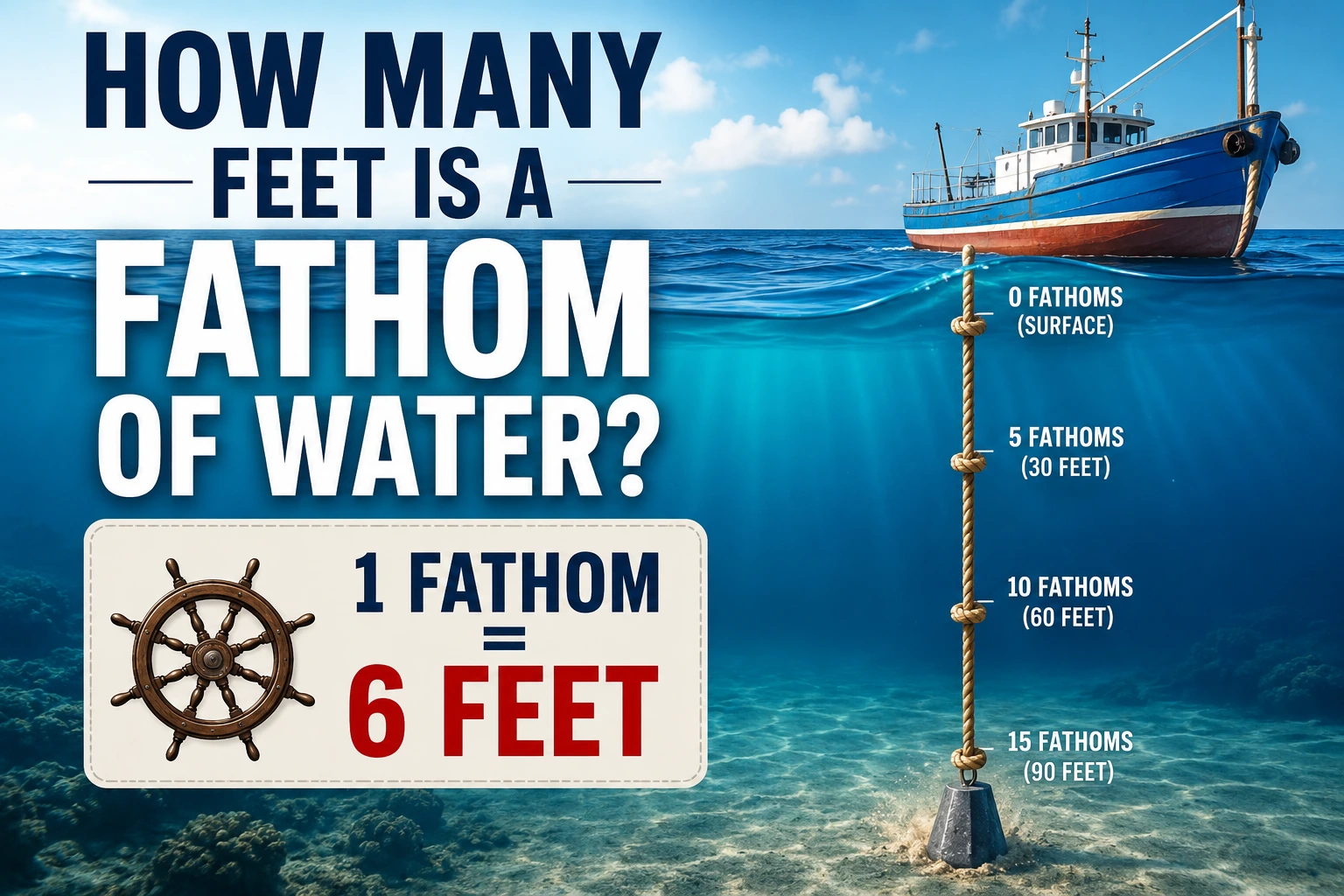
If you have ever watched a sailing movie, gone fishing, or read about ocean exploration, you may have heard the word “fathom.” Many people wonder, how many feet is a fathom of water?
The simple answer is:
1 fathom=6 feet
A fathom is a traditional nautical unit used to measure water depth. Even though modern technology now uses meters and digital sonar systems, fathoms are still commonly mentioned in boating, fishing, and maritime history.
In this guide, you will learn:
- What a fathom means
- Why sailors used fathoms
- Easy fathom-to-feet conversions
- Real-world examples
- Historical uses
- Common mistakes to avoid
By the end, you will fully understand how fathoms work and why this old measurement is still important today.
What Is a Fathom?
A fathom is a unit of length mainly used for measuring the depth of water.
Historically, the word “fathom” came from an Old English word meaning “outstretched arms.” The original measurement was based on the distance between a person’s fingertips when both arms were stretched wide.
Sailors found this measurement practical because:
- It was simple
- It required no tools
- It worked well on ships
Over time, the measurement became standardized.
Today, one fathom always equals six feet.
Why Sailors Used Fathoms
Before modern sonar and GPS systems existed, sailors needed a reliable way to measure ocean depth.
Fathoms were useful because:
- They were easy to count
- Rope markings could show depth quickly
- The unit matched human body proportions
- It worked well for anchoring and navigation
Even today, some nautical charts still display water depth in fathoms.
How Many Feet Is a Fathom of Water?
The standard conversion is straightforward:
Feet=Fathoms×6
This means:
- 1 fathom = 6 feet
- 2 fathoms = 12 feet
- 5 fathoms = 30 feet
- 10 fathoms = 60 feet
Easy Example
If a harbor is 8 fathoms deep:
8×6=48 feet
The water depth is 48 feet.
This simple multiplication makes fathoms easy to convert.
Fathom to Feet Conversion Table
Here is a quick reference chart for common fathom measurements.
| Fathoms | Feet |
|---|---|
| 1 fathom | 6 feet |
| 2 fathoms | 12 feet |
| 3 fathoms | 18 feet |
| 5 fathoms | 30 feet |
| 10 fathoms | 60 feet |
| 20 fathoms | 120 feet |
| 50 fathoms | 300 feet |
| 100 fathoms | 600 feet |
Quick Trick
To convert fathoms into feet:
- Multiply by 6
To convert feet into fathoms:
- Divide by 6
For example:
72÷6=12 fathoms
So, 72 feet equals 12 fathoms.
Why Is the Fathom Important in Water Measurement?
Although modern measurements often use meters, fathoms still matter in many marine activities.
Navigation
Ships need accurate depth information to avoid underwater hazards.
Using fathoms allows sailors to:
- Understand safe water depth
- Avoid running aground
- Navigate harbors safely
Older nautical maps commonly used fathoms instead of feet.
Fishing
Commercial and recreational fishermen still use fathoms when discussing:
- Fish locations
- Net depths
- Ocean floor structures
For example:
- “The fish are swimming around 15 fathoms deep.”
That means the fish are about 90 feet below the surface.
Anchoring
Anchoring requires enough rope length based on water depth.
Sailors often estimate depth in fathoms because:
- Rope markings are traditionally spaced by fathoms
- It helps determine safe anchor placement
Diving and Marine Work
Divers, underwater engineers, and marine researchers sometimes use fathoms in historical documents or older charts.
Even though meters are more common internationally today, fathoms remain part of marine language.
How Sailors Measured Fathoms Historically
Long before electronic depth finders existed, sailors used a simple tool called a sounding line.
What Was a Sounding Line?
A sounding line was:
- A long rope
- Marked at intervals
- Attached to a heavy lead weight
The sailor lowered the line into the water until it touched the seabed.
The rope markings showed the depth in fathoms.
Why It Worked Well
This method was:
- Cheap
- Reliable
- Portable
- Easy to use during storms
It became one of the most important navigation tools in maritime history.
Lead Line Markings
Traditional ropes included knots or leather strips at certain intervals.
For example:
- 2 fathoms
- 5 fathoms
- 10 fathoms
Experienced sailors could identify depth quickly even at night.
Fathoms vs Other Water Measurement Units
Understanding how fathoms compare with other units helps avoid confusion.
Fathoms vs Feet
Feet are common for general measurements on land.
Fathoms are mainly used at sea.
Comparison:
- 1 fathom = 6 feet
- Feet are smaller units
- Fathoms simplify larger water depth readings
Instead of saying:
- “60 feet deep”
A sailor may say:
- “10 fathoms deep”
Fathoms vs Meters
Many countries now use meters for ocean depth.
Here is the conversion:
1 fathom≈1.8288 meters
Example:
- 10 fathoms ≈ 18.3 meters
Fathoms vs Nautical Miles
This is a common misunderstanding.
A fathom measures:
- Depth or length
A nautical mile measures:
- Distance traveled over water
They are completely different units.
Real-World Examples of Fathom Measurements
Understanding real examples makes fathoms easier to visualize.
Harbor Depths
Small harbors may have depths of:
- 5 to 10 fathoms
That equals:
- 30 to 60 feet
Larger ships require deeper ports.
Fishing Areas
Deep-sea fishing often happens at:
- 50 to 100 fathoms
That equals:
- 300 to 600 feet
Different fish species live at different depths.
Ocean Trenches
Major ocean trenches are incredibly deep.
For example:
- 1,000 fathoms = 6,000 feet
This shows how useful fathoms can be when discussing large underwater depths.
Common Mistakes When Understanding Fathoms
Many people confuse fathoms with other nautical terms.
Here are some common mistakes.
Confusing Fathoms With Nautical Miles
Remember:
- Fathoms measure depth
- Nautical miles measure travel distance
They are unrelated units.
Using Incorrect Conversions
Some people mistakenly think:
- 1 fathom = 3 feet
The correct conversion is always:
1 fathom=6 feet
Assuming Fathoms Are Obsolete
Although modern systems use meters and sonar:
- Fathoms are still used in boating
- Fishermen still reference them
- Older charts still contain fathom markings
Understanding them remains useful.
Quick Tips to Remember Fathom Conversions
Here are some easy memory tricks.
Multiply by Six
Always remember:
- 1 fathom = 6 feet
Then simply multiply.
Think of Human Arm Span
The original fathom represented:
- An outstretched arm span
That visual helps many people remember the term.
Use Common Benchmarks
Helpful examples:
- 5 fathoms = 30 feet
- 10 fathoms = 60 feet
- 20 fathoms = 120 feet
These are frequently used marine depths.
Why the Word “Fathom” Still Exists Today
Even in the age of technology, nautical traditions remain strong.
Marine professionals continue using the word because:
- It is deeply rooted in maritime history
- It simplifies communication at sea
- It remains familiar among sailors and fishermen
The term also appears in literature and everyday speech.
For example:
- “I can’t fathom it.”
This phrase means:
- “I cannot fully understand it.”
The word evolved from the idea of measuring depth to measuring understanding.
Practical Uses of Fathoms Today
Although less common outside marine industries, fathoms still appear in:
- Nautical charts
- Fishing discussions
- Sailing manuals
- Historical ship records
- Marine archaeology
Learning the term helps anyone interested in:
- Boating
- Ocean science
- Maritime history
- Navigation
FAQs
1. How many feet is one fathom of water?
One fathom equals 6 feet of water depth.
2. Why do sailors use fathoms instead of feet?
Fathoms simplify marine depth measurements and have been traditionally used in navigation for centuries.
3. How deep is 10 fathoms?
10 fathoms=60 feet
Ten fathoms equals 60 feet.
4. Are fathoms still used today?
Yes. Some sailors, fishermen, and nautical charts still use fathoms for water depth measurements.
5. What is the difference between a fathom and a nautical mile?
A fathom measures water depth or length, while a nautical mile measures travel distance over water.
Conclusion
So, how many feet is a fathom of water? The answer is simple:
1 fathom=6 feet
This traditional nautical measurement has helped sailors navigate oceans for centuries. Even though modern marine technology often uses meters and sonar systems, fathoms still play an important role in boating, fishing, navigation, and maritime history.
By understanding fathoms, you gain deeper insight into marine terminology and ocean measurements. Whether you are studying nautical history, preparing for boating activities, or simply curious about water depth measurements, knowing fathom conversions can be surprisingly useful.
Discover more