

How Many Steps Is 150 Feet?
If you’ve ever wondered how many steps is 150 feet, you’re not alone. Whether you’re tracking your daily activity, measuring walking distances, planning an exercise routine, or simply curious about conversions, understanding how feet translate into steps can be surprisingly useful.
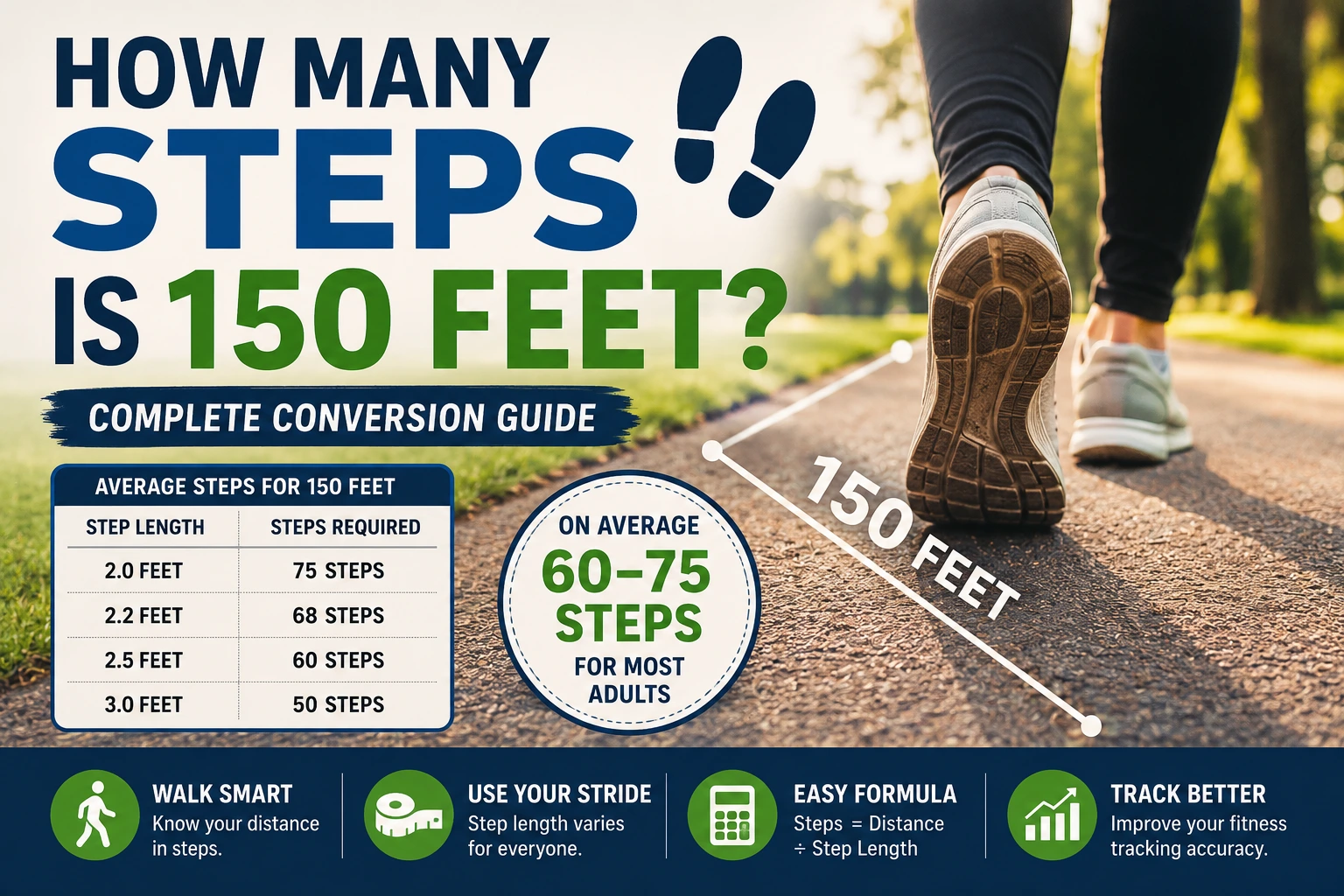
For most adults, 150 feet equals approximately 60 to 75 steps, depending on stride length. A person with a shorter stride will take more steps, while someone with a longer stride will take fewer.
However, there isn’t a single universal answer because step count depends on several personal factors, including height, walking speed, age, and natural gait.
In this guide, you’ll learn exactly how to calculate steps from feet, see practical examples, explore conversion charts, and discover the factors that affect your step count.
Quick Answer
The average adult step length ranges from 2 to 2.5 feet per step.
Using those averages:
| Step Length | Steps in 150 Feet |
|---|---|
| 2.0 feet | 75 steps |
| 2.2 feet | 68 steps |
| 2.5 feet | 60 steps |
| 3.0 feet | 50 steps |
For most people:
150 feet is approximately 60–75 walking steps.
Understanding Steps and Stride Length
Before converting feet into steps, it’s important to understand two key terms.
What Is a Step?
A step is the movement from one foot touching the ground to the other foot touching the ground.
Fitness trackers, smartwatches, and pedometers count each individual step.
What Is Stride Length?
Stride length refers to the distance covered in a single step.
People have different stride lengths based on:
- Height
- Leg length
- Walking speed
- Fitness level
- Age
Because stride length varies, the number of steps needed to walk 150 feet will vary as well.
How Many Steps Is 150 Feet for the Average Person?
Let’s look at average walking patterns.
Men
The average male step length is approximately:
- 2.5 feet per step
Calculation:
150 ÷ 2.5 = 60 steps
Average result:
About 60 steps
Women
The average female step length is approximately:
- 2.2 feet per step
Calculation:
150 ÷ 2.2 = 68 steps
Average result:
About 68 steps
Children
Children generally have shorter legs and shorter strides.
Average step length:
- 1.5–2 feet
Calculation:
150 ÷ 1.5 = 100 steps
150 ÷ 2 = 75 steps
Average result:
75–100 steps
Formula to Calculate Steps from Feet
You can calculate any feet-to-steps conversion using a simple formula.
Formula
Steps=Step Length in FeetDistance in Feet
Example Calculation
Suppose your average step length is 2.4 feet.
Calculation:
150 ÷ 2.4 = 62.5
Rounded result:
63 steps
This formula works for walking, jogging, and many fitness calculations.
Step Conversion Chart for 150 Feet
The following chart shows how step count changes based on stride length.
| Stride Length | Steps Required |
|---|---|
| 1.5 feet | 100 steps |
| 1.8 feet | 83 steps |
| 2.0 feet | 75 steps |
| 2.2 feet | 68 steps |
| 2.5 feet | 60 steps |
| 2.8 feet | 54 steps |
| 3.0 feet | 50 steps |
This table demonstrates why two people walking the same distance may record different step counts.
Real-World Examples of 150 Feet
Many people struggle to visualize 150 feet.
Here are some practical comparisons.
Half a Basketball Court
A regulation basketball court is approximately 94 feet long.
150 feet is roughly:
- One and a half basketball courts
Residential Property
Many suburban house lots are between 100 and 200 feet deep.
Walking from the street to the back of a large property may be close to 150 feet.
Office Buildings
Walking through a large warehouse, school hallway, or office corridor can easily cover 150 feet.
Parking Lots
Crossing a medium-sized parking lot often involves walking around 150 feet.
For most adults, these distances require approximately 60–75 steps.
Factors That Affect Step Count
The answer to how many steps is 150 feet changes depending on several factors.
Height
Taller people generally have:
- Longer legs
- Longer strides
- Fewer steps per distance
Shorter people typically take more steps.
Walking Speed
When walking faster:
- Strides naturally lengthen
- Step count decreases slightly
When walking slowly:
- Strides shorten
- More steps are required
Terrain
Walking on:
- Grass
- Sand
- Gravel
- Hiking trails
often shortens stride length.
As a result, you’ll take more steps over the same distance.
Age
Children and older adults may have shorter step lengths than healthy adults in their prime years.
How to Measure Your Own Stride Length
The best way to know exactly how many steps are in 150 feet for you is to measure your stride.
Method 1: Walk 20 Steps
- Measure a straight path.
- Walk naturally for 20 steps.
- Measure the total distance traveled.
- Divide the distance by 20.
Example:
- Distance walked = 48 feet
- Steps = 20
Stride length:
48 ÷ 20 = 2.4 feet
You can now use your personal stride for accurate conversions.
Method 2: Use a Fitness Tracker
Many modern devices automatically estimate stride length.
Examples include:
- Smartwatches
- Fitness bands
- GPS running watches
- Smartphone health apps
These tools can provide more personalized measurements over time.
Using Fitness Trackers and Pedometers
Modern fitness devices calculate distance using step counts and stride estimates.
Common devices include:
- Apple Watch
- Fitbit
- Garmin watches
- Samsung Galaxy Watch
These devices often adjust stride length based on:
- Walking speed
- Running speed
- GPS data
As a result, their step calculations are generally more accurate than manual estimates.
Benefits of Knowing Distance-to-Step Conversions
Understanding step conversions offers several practical advantages.
Better Fitness Tracking
You can estimate distance without GPS.
Easier Goal Setting
If your goal is:
- 5,000 steps
- 10,000 steps
- 15,000 steps
knowing your stride helps you plan more effectively.
Improved Walking Programs
Coaches and therapists often prescribe walking distances.
Converting those distances into steps makes progress easier to monitor.
Construction and Property Measurements
Professionals sometimes estimate distances using step counts when measuring large areas.
Comparing 150 Feet to Other Walking Distances
| Distance | Approximate Steps |
|---|---|
| 50 feet | 20–25 steps |
| 100 feet | 40–50 steps |
| 150 feet | 60–75 steps |
| 200 feet | 80–100 steps |
| 300 feet | 120–150 steps |
| 500 feet | 200–250 steps |
These values assume average adult walking strides.
Common Mistakes When Estimating Steps
Many people make errors when converting feet into steps.
Assuming Everyone Has the Same Stride
No two people walk exactly the same way.
Ignoring Walking Speed
Stride length changes depending on pace.
Using Running Measurements
Running strides are much longer than walking strides.
Forgetting Terrain Effects
Uneven surfaces often reduce stride length.
Rounding Too Aggressively
Small rounding errors can create larger inaccuracies over long distances.
Expert Tips for Accurate Step Calculations
To improve accuracy:
- Measure your personal stride length.
- Walk at your normal pace.
- Recalculate periodically.
- Use fitness trackers when possible.
- Average multiple measurements.
These methods provide better estimates than relying on generic averages.
9. FAQs
1. How many steps is 150 feet for an average adult?
Most adults take between 60 and 75 steps to walk 150 feet.
2. How many steps is 150 feet for a child?
Depending on height and stride length, children usually take 75 to 100 steps.
3. Can I calculate steps without a pedometer?
Yes. Divide the distance by your average step length to estimate your steps.
4. How many calories are burned walking 150 feet?
The calorie burn is very small, usually less than 5 calories for most adults.
5. Why do fitness trackers show different step counts?
Different devices use different algorithms, sensors, and stride-length estimates, which can cause slight variations.
10. Conclusion
If you’re wondering how many steps is 150 feet, the average answer is 60 to 75 steps for most adults, although your exact count depends on stride length, height, pace, and terrain. By understanding how step length works and using a simple conversion formula, you can accurately estimate steps for fitness tracking, walking programs, construction measurements, or everyday curiosity.
The most accurate method is to measure your personal stride length and apply it to the distance. Once you know your average step size, converting 150 feet—or any distance—into steps becomes quick, easy, and highly reliable.
Discover More: