
Understanding measurements is the backbone of any successful home project. Whether you are ordering lumber for a new deck, buying enough paint for a bedroom, or trying to figure out the footprint of a manufactured home, you will eventually ask: how many square feet in linear feet?
At first glance, these two units seem like they should be easily swappable. However, they measure completely different things. A linear foot is a measurement of distance in a straight line, while a square foot measures the total area of a flat surface. You cannot simply “convert” one to the other without a third piece of information: the width.
In this comprehensive guide, we will break down the math, provide real-world examples, and help you master the “Length x Width” formula so you never overbuy or under-order materials again.
Understanding the Difference: Linear vs. Square
Before we jump into the math, let’s define our terms. If you don’t understand what you are measuring, the numbers won’t make much sense.
What is a Linear Foot?
A linear foot is simply a 12-inch measurement of length. Think of a standard ruler. It doesn’t matter how wide or thick the object is; if it stretches 12 inches from point A to point B, it is one linear foot.
In the construction world, linear feet are used for:
- Fencing
- Baseboards and trim
- Countertop lengths
- Piping
What is a Square Foot?
A square foot is a measurement of area. It describes the space inside a two-dimensional shape. One square foot is technically a square that measures 12 inches on all four sides.
Square feet are used for:
- Flooring (carpet, tile, hardwood)
- Drywall
- Roofing
- Landscaping (sod or mulch)
The Core Formula: How Many Square Feet in Linear Feet?
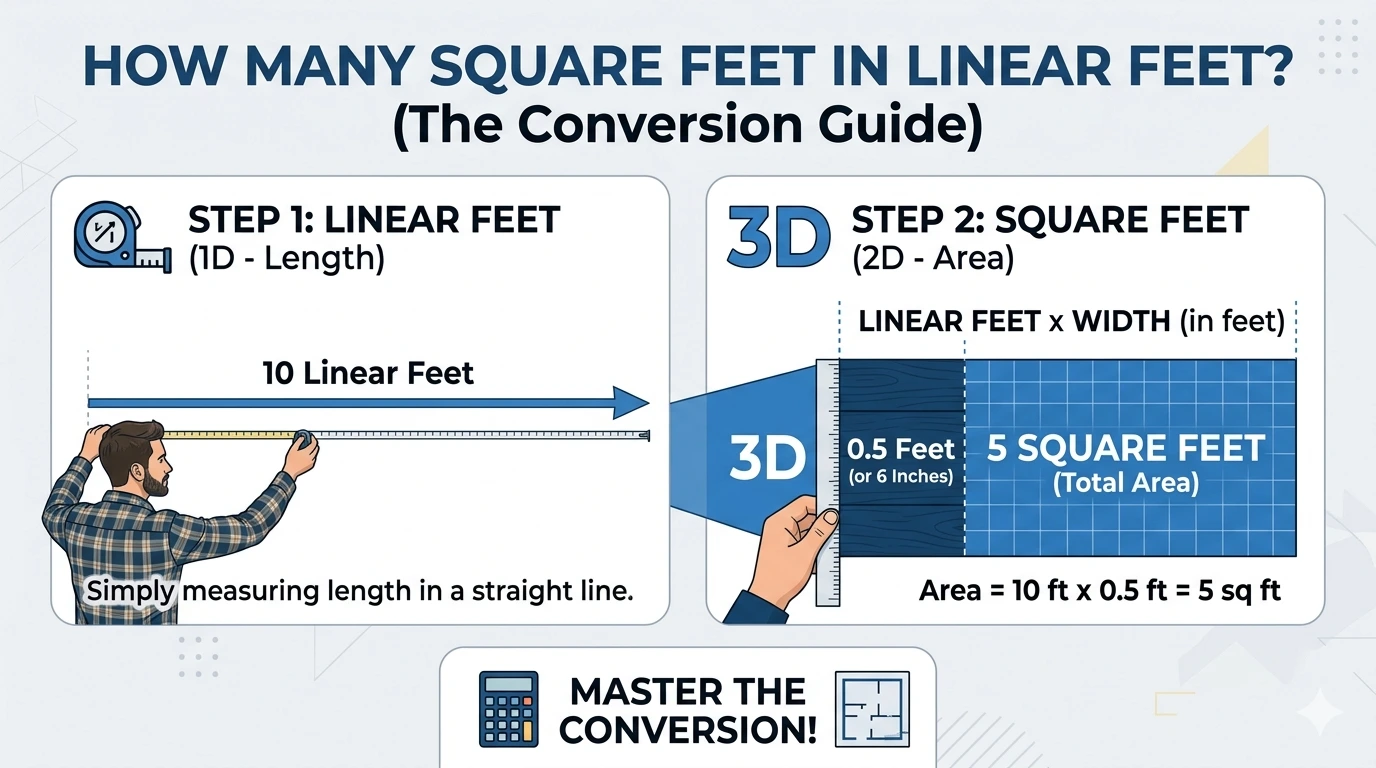
To find out how many square feet in linear feet, you must know the width of the material or the space. The formula is a fundamental piece of geometry:
Square Feet = Linear Feet × Width (in feet)
If your width is in inches, you must first convert it to feet by dividing by 12. For example, a board that is 6 inches wide is actually 0.5 feet wide.
Step-by-Step Conversion Guide
- Measure the Length: Find the total linear feet of your space or material.
- Measure the Width: Determine how wide the object is.
- Convert Width to Feet: If the width is in inches, divide it by 12.
- Multiply: Multiply the linear feet by the width in feet.
Real-World Examples of the Calculation
Let’s look at how this works in common scenarios you might face during a renovation.
1. Hardwood Flooring
You are buying planks that are 5 inches wide. You have 500 linear feet of these planks.
- Width: 5 inches / 12 = 0.416 feet.
- Calculation: 500 linear feet × 0.416 feet = 208.33 square feet.
2. Decking Boards
Standard deck boards are often 5.5 inches wide (a “5/4 x 6” board). If you have a 10-foot long board:
- Width: 5.5 inches / 12 = 0.458 feet.
- Calculation: 10 linear feet × 0.458 feet = 4.58 square feet.
3. Mobile Home Dimensions
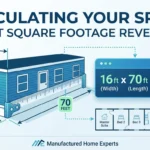
Consider the popular 16×70 mobile home. If you were measuring the “length” of the home as 70 linear feet, you would need the width (16 feet) to find the total area.
- Calculation: 70 linear feet × 16 feet = 1,120 square feet.
Quick Reference Conversion Table
Depending on the width of your material, one linear foot will equal a different amount of square footage. Use this chart for common material widths:
| Width of Material | Square Feet per 1 Linear Foot |
| 2 inches (0.16 ft) | 0.16 sq ft |
| 4 inches (0.33 ft) | 0.33 sq ft |
| 6 inches (0.50 ft) | 0.50 sq ft |
| 12 inches (1.0 ft) | 1.00 sq ft |
| 24 inches (2.0 ft) | 2.00 sq ft |
| 16 feet (Mobile Home) | 16.00 sq ft |
Why Does This Distinction Matter?
Knowing how many square feet in linear feet isn’t just about math; it’s about your wallet.
Avoiding Material Waste
Many retailers sell trim and lumber by the linear foot but sell flooring and tile by the square foot. If you confuse the two, you might order 100 linear feet of flooring when you actually needed 100 square feet. If those boards are only 3 inches wide, 100 linear feet would only cover 25 square feet—leaving you 75% short on your project!
Pricing Comparisons
Contractors often bid “by the square foot” for labor. However, they might buy their supplies by the “linear foot.” Being able to translate between the two allows you to double-check their estimates and ensure the material costs align with the project size.
Common Mistakes to Avoid
- Forgetting to Convert Inches to Feet: This is the #1 error. If you multiply 100 linear feet by 6 inches, you get 600. But 600 “inch-feet” isn’t a real unit. You must use 100 x 0.5 to get the correct 50 square feet.
- Assuming 1:1 Ratio: Many people assume 1 linear foot equals 1 square foot. This is only true if the object is exactly 12 inches wide.
- Ignoring the “Hitch” in Mobile Homes: When calculating the square footage of a 16×70 mobile home, remember that the 70 feet usually refers to the box length, not the towing hitch. Don’t include the hitch in your square footage math, or your flooring order will be too large.
Expert Tips for Accurate Measurement
- The “Waste Factor”: When converting linear feet to square feet for materials like wood, always add 10% to your final number. This accounts for mistakes, knots in the wood, or odd cuts at the corners.
- Use a Calculator: Even if the math seems simple, use a digital calculator to avoid decimal placement errors.
- Measure Twice: Measuring the width of a board at both ends is a good habit. Some rustic or hand-hewn materials have variable widths.
Frequently Asked Questions
1. Does 1 linear foot always equal 1 square foot?
No. They are only equal if the width of the item is exactly 12 inches (1 foot).
2. How do I find square feet if I only have linear feet?
You must find the width of the item. Multiply the linear feet by the width (measured in feet) to get the square footage.
3. Is a 16×70 mobile home exactly 1,120 square feet?
Mathematically, yes. 16 multiplied by 70 equals 1,120. However, interior wall thickness may slightly reduce the actual “walkable” living space.
4. Why is lumber sold in linear feet?
Lumber is often sold by length because the width and thickness are standardized (like a 2×4). Since the width is “fixed,” the only variable the customer needs to choose is the length.
5. How many square feet are in a 100 linear foot fence?
A fence is usually measured in linear feet because it is a “line.” However, if you are painting that fence and it is 6 feet tall, you would have 600 square feet of surface area to cover (100 linear feet x 6 feet high).
Conclusion
Determining how many square feet in linear feet is a simple process once you identify the width of your object. By remembering that Square Feet = Length x Width, you can confidently navigate home improvement stores and construction sites alike. Whether you are calculating the area of a 16×70 mobile home or just trying to buy enough baseboard for a guest room, keeping these units separate is the key to a professional-grade result. Stop guessing and start measuring—your budget will thank you!
Discover More:
How Many Square Feet in a 5×5 Room?
How Many Square Feet is a 16×70 Mobile Home? The Complete Guide
How Many Square Feet Is a Standard Two-Car Garage?