
Buying land is one of the most exciting steps toward homeownership. You can almost see the front porch, the sprawling garden, and the space where the kids will play. But before you break ground, you need to understand the math behind the dream. One of the most common questions from new builders is: how many feet in an acre for a house?
Understanding land measurements isn’t just for surveyors or real estate agents. It is vital for you to know exactly how much space you have for your home, driveway, and backyard. If you misjudge the size of an acre, you might find your dream floor plan doesn’t fit within the legal boundaries of your lot. In this guide, we will break down the numbers, visualize the dimensions, and help you plan your perfect homesite.
The Magic Number: Exactly How Many Feet in an Acre?
To start, we need to distinguish between “linear feet” and “square feet.” When people ask about “feet in an acre,” they are almost always referring to square footage—the total surface area of the land.
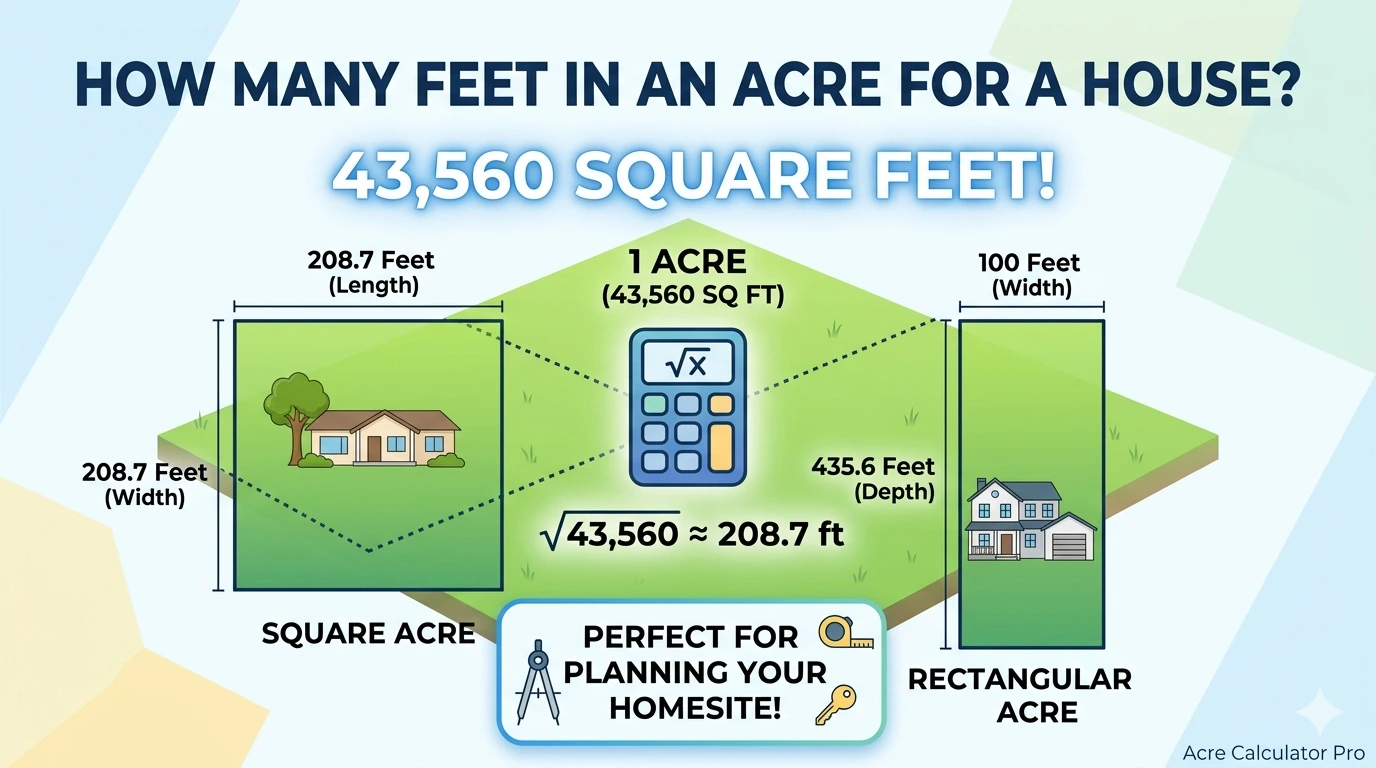
An acre consists of exactly 43,560 square feet.
This number is the gold standard in U.S. real estate. Whether the land is a perfect square, a long rectangle, or a strange triangle, if the total area adds up to 43,560 square feet, you have one acre.
Why 43,560?
The number seems random, but it has deep historical roots. An acre was originally defined as the amount of land one man could plow in a single day with a team of oxen. This was traditionally a “furlong” (660 feet) by a “chain” (66 feet). If you multiply $660 \times 66$, you get the modern standard of 43,560 square feet.
Visualizing an Acre: Linear Dimensions for Your House
While the square footage is fixed, the shape of an acre can vary. If you are looking at land for a house, the linear dimensions (the length and width of the property lines) are what determine where your house can sit.
The Square Acre
If an acre were a perfect square, each side would be approximately 208.71 feet long.
- Calculation: $\sqrt{43,560} \approx 208. linear feet$ per side.
Common Rectangular Lots
Most residential lots are not perfect squares. They are often rectangles to allow for “road frontage.” Here are common rectangular dimensions that equal one acre:
- 100 ft wide x 435.6 ft deep
- 150 ft wide x 290.4 ft deep
- 200 ft wide x 217.8 ft deep
Knowing how many feet in an acre for a house helps you visualize these boundaries. If you have a house that is 60 feet wide, a 100-foot wide acre lot gives you plenty of breathing room on either side of the structure.
How Much House Can You Fit on an Acre?
Just because you have 43,560 square feet doesn’t mean you can build a 40,000-square-foot house. When planning your build, you must consider the “footprint.”
The House Footprint vs. Living Space
If you build a 2,000-square-foot ranch (single story), the “footprint” on the land is 2,000 square feet. However, if you build a 2,000-square-foot two-story home, the footprint on the ground is only 1,000 square feet.
Understanding Setbacks and Easements
Local zoning laws will prevent you from building right up to the edge of your property.
- Front Setback: Usually 20–50 feet from the road.
- Side Setbacks: Often 10–20 feet from neighbors.
- Rear Setbacks: Typically 20–30 feet from the back line.
If you have a square acre (209 x 209 feet) and a 30-foot setback on all sides, your “buildable” area shrinks significantly. Instead of 209 feet of width, you only have 149 feet.
Comparing Lot Sizes: What is Right for You?
When shopping for land, you will see various sizes. Knowing the square footage helps you compare value.
| Lot Size | Square Footage | Visualization |
| 1/4 Acre | 10,890 sq ft | Standard suburban lot; easy to mow. |
| 1/2 Acre | 21,780 sq ft | Room for a large house and a small pool. |
| 1 Acre | 43,560 sq ft | About the size of a football field (minus endzones). |
| 2 Acres | 87,120 sq ft | Plenty of privacy; room for a workshop or barn. |
Practical Examples: One Acre in Real Life
To truly understand how many feet in an acre for a house, it helps to use real-world comparisons.
- The American Football Field: A standard football field is 360 feet long and 160 feet wide (including endzones), totaling 57,600 square feet. An acre is roughly 75% of a football field.
- The 16×70 Mobile Home: If you place a standard 16×70 mobile home (1,120 square feet) on a one-acre lot, the home occupies only 2.5% of the land. This leaves a massive amount of room for landscaping and privacy.
- Parking Spaces: A standard parking spot is about 180 square feet. You could fit approximately 240 cars on a single acre (though you’d have no room to drive them out!).
Expert Tips for Land Buyers
- Check the Topography: An acre of flat land is much more “useful” than an acre on a steep cliff. When calculating how many feet in an acre for a house, remember that some of those feet might be unbuildable.
- Look for Utilities: If the acre is far from the road, you may have to pay for hundreds of linear feet of pipes and wires to reach your house.
- Get a Survey: Never rely on “eyeballing” an acre. Markers can move over decades. A professional surveyor will tell you exactly where your 43,560 square feet begin and end.
- Think About Maintenance: A full acre is a lot of grass. If you aren’t prepared for hours of mowing, a half-acre might be a better fit.
Common Mistakes to Avoid
- Confusing Gross vs. Net Acreage: Sometimes the “acre” you buy includes the land under the public road at the front of the property. This is “gross” acreage. The “net” acreage is the usable land behind the road easement.
- Ignoring Easements: A utility company might have a “right of way” through your acre. You own those feet, but you can’t build a house on them.
- Assuming All Acres are Squares: As we discussed, an acre can be a very long, thin strip of land. A 50-foot wide acre would be nearly 900 feet long—this might be too narrow for the house you want to build.
Frequently Asked Questions
1. How many linear feet are around the perimeter of an acre?
If the acre is a perfect square (208.7ft per side), the perimeter is approximately 835 linear feet. If it is a long rectangle (100ft x 435.6ft), the perimeter increases to 1,071 linear feet.
2. Can I build two houses on one acre?
This depends entirely on local zoning. Some areas require a minimum of one acre per “dwelling unit,” while others allow for “Accessory Dwelling Units” (ADUs) or higher density.
3. Is an acre bigger than a hectare?
No. An acre is 43,560 square feet, while a hectare is approximately 107,639 square feet. One hectare is about 2.47 acres.
4. How much does it cost to fence one acre?
Since a square acre has a perimeter of about 835 feet, and fencing is sold by the linear foot, you would multiply 835 by the price per foot of your chosen material.
5. How many feet in an acre for a house if the lot is triangular?
The square footage remains the same: 43,560. However, the linear feet on the sides will vary. You would use the formula $Area = \frac{1}{2} \times base \times height$ to ensure the triangle equals 43,560.
Conclusion
When you ask how many feet in an acre for a house, the answer is a blend of hard math and practical design. Knowing that you have 43,560 square feet to work with is the foundation of your project. By understanding the linear dimensions—whether it’s the 209-foot side of a square lot or the 435-foot depth of a narrow one—you can choose a house plan that fits perfectly within your boundaries.
Remember to account for setbacks, easements, and the shape of the land. A one-acre lot offers a wonderful balance of space and manageability, providing plenty of room for a large home like a 1,120-square-foot 16×70 manufactured home while leaving over 97% of the land open for your enjoyment. Take your time, get a survey, and enjoy the process of turning those square feet into a home.
Discover More:
1How Many Square Feet is a 16×70 Mobile Home? The Complete Guide
How Many Square Feet Is a Standard Two-Car Garage?
How Many Square Feet in Linear Feet? The Ultimate Conversion Guide