

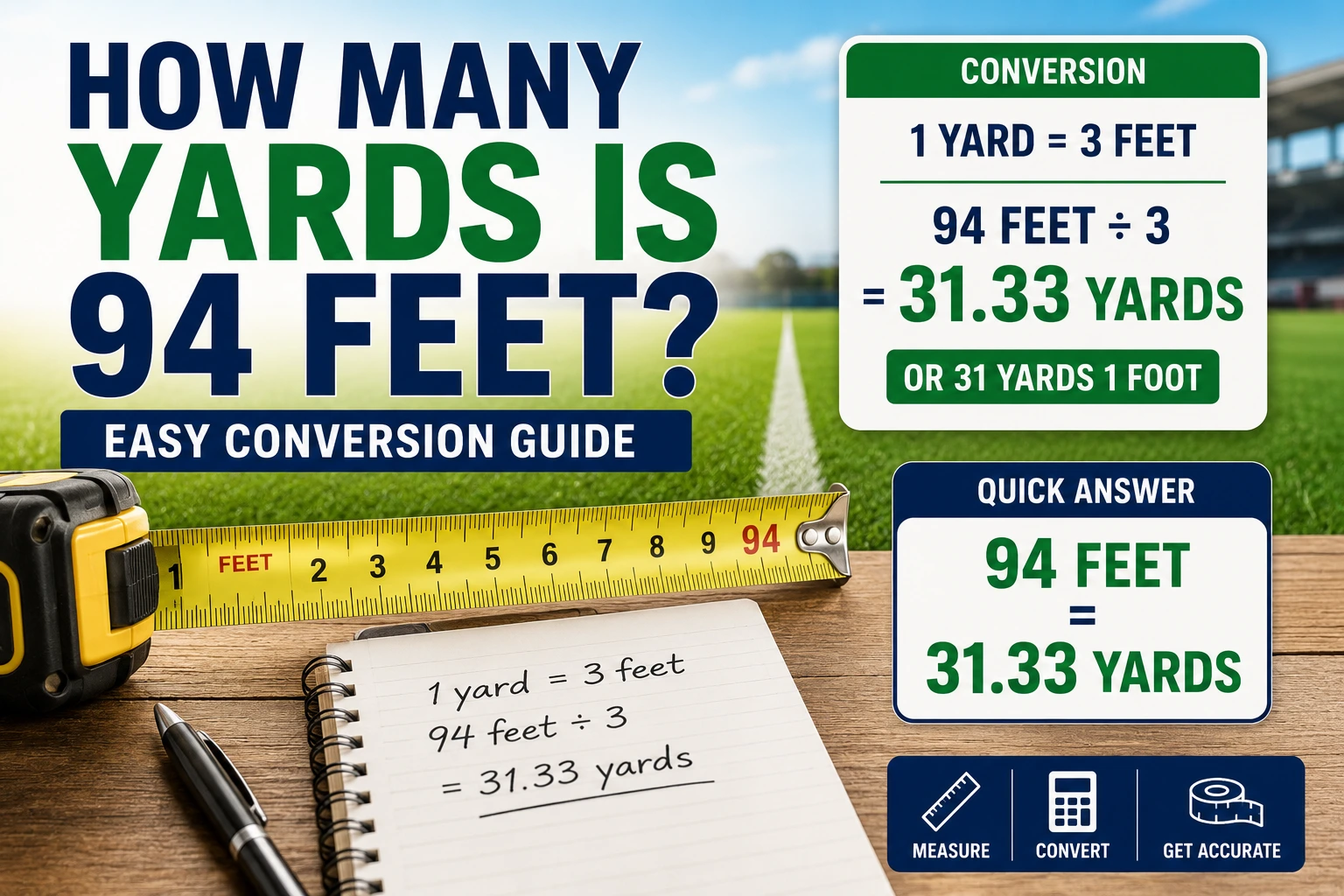
If you’ve ever needed to convert a measurement from feet to yards, you may have asked yourself: how many yards is 94 feet?
Whether you’re working on a construction project, measuring a sports field, planning landscaping work, or solving a math problem, understanding unit conversions can save time and prevent mistakes.
The good news is that converting feet to yards is simple because both units belong to the same measurement system. Once you know the basic formula, you can convert any length in seconds.
The quick answer is:
94 feet equals 31.33 yards.
In this guide, you’ll learn exactly how to calculate the conversion, understand the relationship between feet and yards, see practical examples, and use conversion charts for future reference.
Quick Answer
For readers looking for a fast solution:
94 Feet = 31.33 Yards
Using the standard conversion:
1 yard=3 feet
And:
94÷3=31.33
Therefore:
94 feet = 31.33 yards (approximately)
Or:
94 feet = 31 yards and 1 foot
Both answers are correct depending on whether you want a decimal or mixed-unit measurement.
Understanding Feet and Yards
Before converting measurements, it helps to understand the units involved.
What Is a Foot?
A foot is a unit of length commonly used in the United States and a few other countries.
One foot equals:
- 12 inches
- 0.333 yards
- 30.48 centimeters
- 0.3048 meters
The abbreviation for foot is:
ft
Examples:
- Door height: about 7 feet
- Ceiling height: about 8 feet
- Basketball hoop: 10 feet
What Is a Yard?
A yard is another unit of length in the imperial measurement system.
One yard equals:
- 3 feet
- 36 inches
- 0.9144 meters
The abbreviation for yard is:
yd
Examples:
- Football field measurements
- Fabric measurements
- Landscaping projects
- Property dimensions
Since a yard is larger than a foot, converting feet to yards results in a smaller numerical value.
How Many Yards Is 94 Feet?
Let’s solve the conversion step by step.
The Conversion Formula
To convert feet into yards:
Yards=3Feet
This works because every yard contains exactly three feet.
Step-by-Step Calculation
Given:
- Feet = 94
Apply the formula:
94 ÷ 3 = 31.3333
Rounded to two decimal places:
31.33 yards
So:
| Feet | Yards |
|---|---|
| 94 | 31.33 |
Expressing the Answer as Yards and Feet
Some people prefer a mixed measurement instead of decimals.
Since:
31 yards = 93 feet
And:
94 − 93 = 1 foot
The measurement can also be written as:
31 yards, 1 foot
This format is often used in construction and surveying.
Feet to Yards Conversion Chart
The following chart shows common conversions around 94 feet.
| Feet | Yards |
|---|---|
| 75 | 25 |
| 80 | 26.67 |
| 85 | 28.33 |
| 90 | 30 |
| 91 | 30.33 |
| 92 | 30.67 |
| 93 | 31 |
| 94 | 31.33 |
| 95 | 31.67 |
| 96 | 32 |
| 100 | 33.33 |
| 120 | 40 |
This chart can be useful when estimating measurements quickly.
Why Convert Feet to Yards?
Many industries and activities use yards rather than feet.
Understanding conversions helps ensure accuracy.
Construction Projects
Builders frequently switch between units.
For example:
- Lumber lengths may be measured in feet.
- Property dimensions may be discussed in yards.
Converting measurements keeps project plans consistent.
Sports and Athletics
Many sports use yards.
Examples include:
- Football fields
- Punt distances
- Passing statistics
A distance measured in feet often needs conversion to yards for reporting purposes.
Landscaping and Gardening
Landscape professionals often use yards when discussing:
- Sod installation
- Garden layouts
- Property boundaries
Converting 94 feet to 31.33 yards may make planning easier.
Fabric and Sewing
Fabric is commonly sold by the yard.
Knowing how many yards correspond to a measurement in feet helps buyers purchase the correct amount.
Real-World Examples of 94 Feet
Understanding what 94 feet looks like can make the conversion more meaningful.
Example 1: Basketball Court Length
A professional basketball court is 94 feet long.
Converting:
94 ÷ 3 = 31.33 yards
Therefore:
A regulation basketball court is approximately 31.33 yards long.
Example 2: Garden Fence
Suppose you’re installing a fence around one side of your property.
The side measures:
94 feet
In yards:
31.33 yards
This measurement may be easier when ordering fencing materials.
Example 3: Walking Distance
Imagine walking 94 feet down a hallway.
That distance equals:
31.33 yards
This helps compare the distance to sports fields or outdoor measurements.
Example 4: Construction Site
A contractor measures a foundation edge at 94 feet.
When converting for a project specification that uses yards:
94 feet = 31.33 yards
The conversion ensures consistency throughout the project.
Common Feet-to-Yards Conversions
Here are some frequently searched conversions.
| Feet | Yards |
|---|---|
| 3 | 1 |
| 6 | 2 |
| 9 | 3 |
| 12 | 4 |
| 15 | 5 |
| 30 | 10 |
| 45 | 15 |
| 60 | 20 |
| 75 | 25 |
| 90 | 30 |
| 94 | 31.33 |
| 150 | 50 |
| 300 | 100 |
Memorizing that 3 feet equals 1 yard makes all conversions easier.
Common Mistakes When Converting Feet to Yards
Although the math is simple, mistakes still happen.
Dividing by the Wrong Number
Some people mistakenly divide by:
- 12 (used for inches)
- 36 (used for inches per yard)
For feet-to-yards conversions:
Always divide by 3.
Confusing Feet and Inches
Feet and inches are different units.
Remember:
- 1 foot = 12 inches
- 1 yard = 3 feet
Mixing these conversions leads to errors.
Rounding Too Early
When working on precise projects:
Avoid rounding until the final answer.
For 94 feet:
Exact value = 31.333333…
Rounded value = 31.33 yards
Using the Wrong Measurement System
Feet and yards belong to the imperial system.
If you’re converting to metric units, use meters or centimeters instead.
Expert Tips for Accurate Measurements
Professionals rely on accurate conversions every day.
Keep a Conversion Chart Handy
Quick-reference charts save time and reduce mistakes.
Use Consistent Units
Convert all measurements to the same unit before calculating areas or volumes.
Double-Check Calculations
Even simple conversions can be entered incorrectly.
Understand Project Requirements
Some plans require:
- Decimal yards
- Whole yards
- Yards and feet
Know which format is expected.
Use Measurement Apps
Digital tools can help verify calculations quickly.
Practical Uses of Yard Measurements
Yards are widely used in:
- Sports fields
- Landscaping
- Real estate
- Surveying
- Construction
- Fabric sales
- Road planning
Because yards are larger than feet, they simplify measurements for longer distances.
9. FAQs
1. How many yards is 94 feet exactly?
94 feet equals 31.3333 yards, or approximately 31.33 yards.
2. How do you convert feet into yards?
Divide the number of feet by 3.
Formula:
Yards = Feet ÷ 3
3. Is 94 feet equal to 31 yards?
Not exactly.
31 yards equals 93 feet.
94 feet equals 31 yards and 1 foot.
4. Why are yards used instead of feet?
Yards simplify longer measurements and are commonly used in sports, landscaping, surveying, and fabric measurements.
5. What is the easiest way to remember feet-to-yards conversions?
Remember this simple rule:
1 yard = 3 feet
Then divide any number of feet by 3.
10. Conclusion
If you’re wondering how many yards is 94 feet, the answer is straightforward: 94 feet equals 31.33 yards, or 31 yards and 1 foot. By using the simple conversion formula of dividing feet by 3, you can quickly convert any measurement from feet to yards.
Whether you’re measuring a basketball court, planning a landscaping project, working in construction, or solving a math problem, understanding feet-to-yard conversions is a valuable skill. With the charts, formulas, and examples in this guide, you’ll be able to convert measurements confidently and accurately every time.
Discover more