
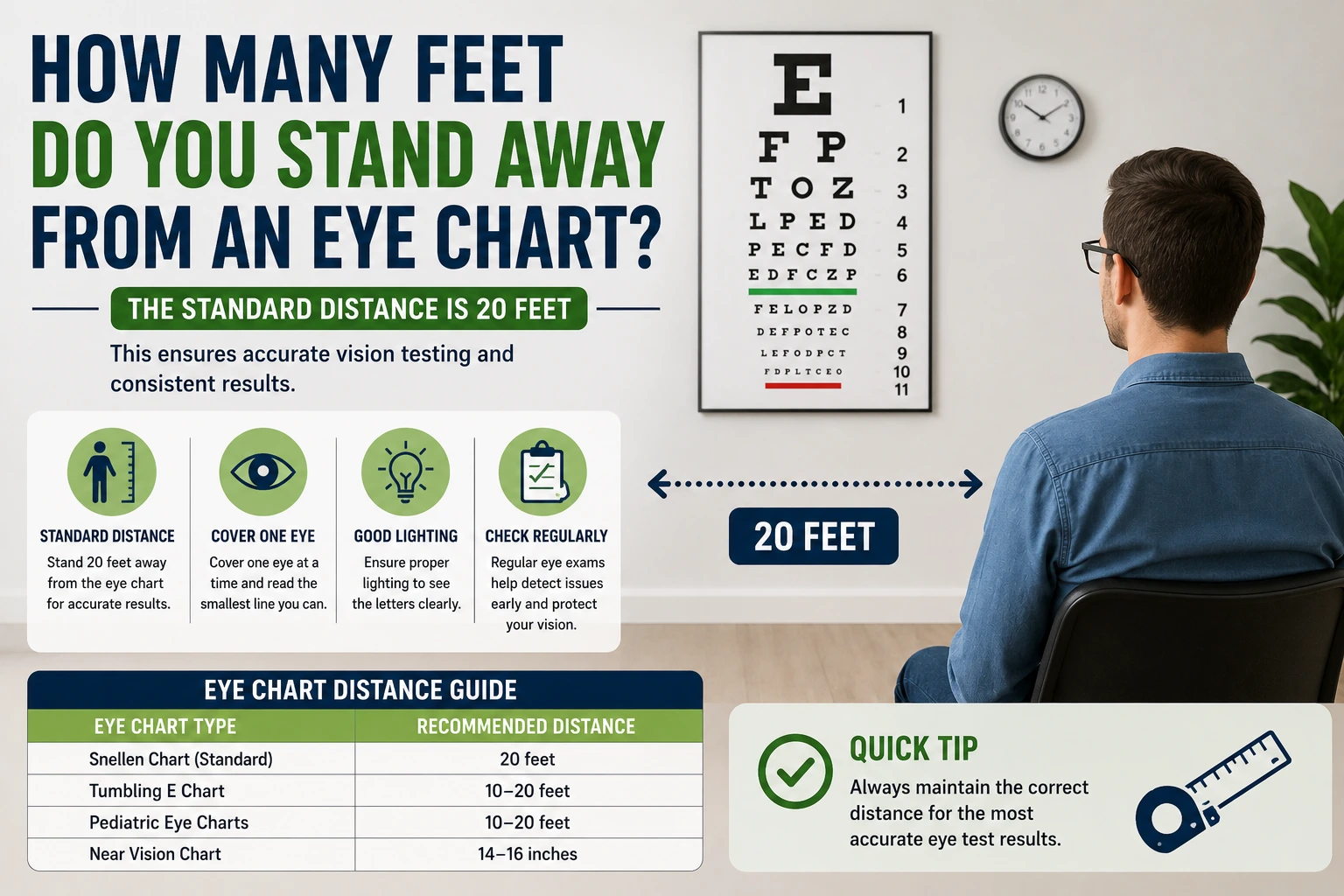
If you have ever visited an eye doctor or taken a vision screening, you may have wondered: “How many feet do you stand away from an eye chart?”
The standard distance for most eye chart tests is:
20 feet
This distance is used for traditional visual acuity tests, especially with the well-known Snellen eye chart. Standing 20 feet away allows eye care professionals to measure how clearly you can see at a standardized distance.
Understanding the correct eye chart distance is important because it helps ensure:
- Accurate vision results
- Proper glasses prescriptions
- Reliable eye health screening
- Consistent testing conditions
In this complete guide, you will learn how eye charts work, why 20 feet matters, different chart types, home testing tips, common mistakes, and what your vision scores really mean.
Understanding Eye Charts
Before learning testing distance, it helps to understand what an eye chart actually does.
What Is an Eye Chart?
An eye chart is a tool used to measure:
- Visual sharpness
- Clarity of vision
- Ability to recognize letters or symbols from a distance
Eye charts are commonly used during:
- Routine eye exams
- School screenings
- Driver’s license tests
- Vision health evaluations
Purpose of Vision Testing
Vision testing helps identify:
- Nearsightedness
- Farsightedness
- Astigmatism
- Vision loss
- Eye health problems
Regular eye exams can detect issues early before symptoms become severe.
How Many Feet Do You Stand Away From an Eye Chart?
The standard testing distance is:
20 feet away from the eye chart
This applies to most traditional:
- Snellen eye charts
- DMV eye exams
- School vision screenings
The 20-foot measurement became the standard because, at this distance, the eye muscles are relatively relaxed and focusing becomes more natural.
Why 20 Feet Matters
Many people ask why doctors specifically use 20 feet.
Optical Reasoning
At 20 feet:
- Light rays entering the eye become nearly parallel
- The eye requires minimal focusing effort
This creates a consistent and accurate vision measurement.
Standardized Testing
Using the same distance allows eye doctors to:
- Compare vision results accurately
- Track changes over time
- Standardize prescriptions
Without a fixed distance, vision scores would vary significantly.
Types of Eye Charts
Different eye charts are designed for different patients and testing situations.
Snellen Chart
The Snellen chart is the most common eye chart.
It contains:
- Large letters at the top
- Progressively smaller letters below
The famous “E” often appears on the first line.
Tumbling E Chart
This chart uses:
- Letter E symbols facing different directions
Patients indicate:
- Up
- Down
- Left
- Right
This helps people who:
- Cannot read letters
- Speak different languages
- Are young children
Pediatric Eye Charts
Children’s charts may use:
- Shapes
- Animals
- Symbols
- Pictures
These charts make testing easier for young patients.
How Eye Chart Testing Works
Vision testing follows a simple process.
Step-by-Step Testing Process
Typical testing includes:
- Standing 20 feet away
- Covering one eye
- Reading the smallest visible line
- Repeating with the other eye
- Testing both eyes together
Eye doctors may also use corrective lenses during testing.
Reading Results
The most common vision score is:
- 20/20 vision
This means:
- You can see at 20 feet what a person with normal vision should see at 20 feet.
Understanding 20/20 Vision
Many people misunderstand what 20/20 means.
What 20/20 Actually Means
The first number:
- Your testing distance
The second number:
- The distance a person with normal vision can read the same line
Better Than 20/20 Vision
Some people have:
- 20/15 vision
This means they can see at 20 feet what others must move to 15 feet away to see clearly.
Worse Than 20/20 Vision
If you have:
- 20/40 vision
You must stand 20 feet away to see what a normal person sees at 40 feet.
Home Eye Chart Testing Tips
Many people perform basic vision checks at home.
Measure the Correct Distance
Use a tape measure to mark:
20 feet
Accuracy matters for reliable results.
Use Good Lighting
Poor lighting affects vision test accuracy.
The room should be:
- Bright
- Evenly lit
- Free from glare
Print the Chart Properly
If using a printable chart:
- Use correct scaling
- Avoid resizing
- Follow instructions carefully
Incorrect print sizes create inaccurate results.
Cover One Eye at a Time
Testing eyes separately helps identify:
- Uneven vision
- Weak eye performance
- Potential vision imbalance
Common Eye Chart Testing Mistakes
Small mistakes can affect test results.
Standing Too Close
Being closer than 20 feet may:
- Make letters easier to read
- Produce falsely good results
Squinting
Squinting temporarily sharpens vision.
Doctors usually recommend:
- Relaxing your eyes
- Reading naturally
Poor Lighting Conditions
Dim rooms can:
- Blur letters
- Reduce contrast
- Affect performance
Memorizing the Chart
Some people accidentally memorize letter patterns.
Eye clinics often use:
- Randomized digital charts
- Different chart versions
Eye Chart Distance Comparison Table
| Eye Chart Type | Standard Distance |
|---|---|
| Snellen chart | 20 feet |
| DMV vision test | 20 feet |
| Pediatric charts | 10–20 feet |
| Near vision chart | 14–16 inches |
| Digital eye charts | Variable |
What Happens If You Cannot Stand 20 Feet Away?
Some clinics have limited space.
In these cases, doctors may use:
- Mirrors
- Digital charts
- Adjusted optical systems
These methods simulate a 20-foot distance accurately.
Benefits of Regular Vision Testing
Routine vision checks provide many benefits.
Early Detection of Eye Problems
Eye exams may detect:
- Glaucoma
- Cataracts
- Macular degeneration
- Diabetes-related vision changes
Improved Daily Life
Clear vision improves:
- Driving safety
- Reading comfort
- Work performance
- School learning
Better Prescription Accuracy
Correct testing distance ensures:
- Accurate glasses
- Better contact lens fitting
Why Eye Exams Matter Beyond Vision
Eye doctors can also detect:
- High blood pressure
- Diabetes
- Neurological issues
- Autoimmune conditions
This makes eye exams important for overall health.
Expert Tips for Accurate Vision Testing
Professionals recommend several best practices.
Relax Your Eyes Before Testing
Avoid excessive screen use before exams when possible.
Wear Existing Glasses if Asked
Some tests measure:
- Corrected vision
- Uncorrected vision
Follow your doctor’s instructions carefully.
Schedule Regular Eye Exams
Adults should generally have periodic eye exams even without noticeable symptoms.
Children often require more frequent screening during development.
FAQs
1. How many feet do you stand away from an eye chart?
The standard distance is 20 feet for most visual acuity tests.
2. Why are eye charts tested at 20 feet?
At 20 feet, the eyes focus naturally with minimal strain, creating accurate standardized results.
3. What is 20/20 vision?
It means you can see at 20 feet what a person with normal vision sees at 20 feet.
4. Can I do an eye chart test at home?
Yes, but you must:
- Measure distance accurately
- Use proper lighting
- Print the chart correctly
5. Are all eye charts tested at 20 feet?
No. Some pediatric and digital charts use shorter distances.
Conclusion
If you are asking “how many feet do you stand away from an eye chart,” the standard answer is:
20 feet
This distance allows eye doctors and vision screenings to measure visual clarity accurately and consistently. Whether you are taking a professional eye exam, preparing for a driver’s license test, or checking your eyesight at home, maintaining the correct testing distance is extremely important.
Understanding how eye charts work also helps you better interpret vision scores like 20/20 and recognize the importance of regular eye care. Accurate testing, proper lighting, and consistent exams can help protect your vision and overall eye health for years to come.
Discover more
1 pallet of sod is how many square feet