

f you’re shipping products, managing warehouse inventory, or calculating freight costs, you’ve likely wondered how many cubic feet on a pallet. The answer depends on the pallet’s dimensions and the height of the goods stacked on it.
Unlike weight, pallet volume is not fixed. A standard pallet may hold anywhere from a few cubic feet to over 100 cubic feet depending on how high products are stacked.
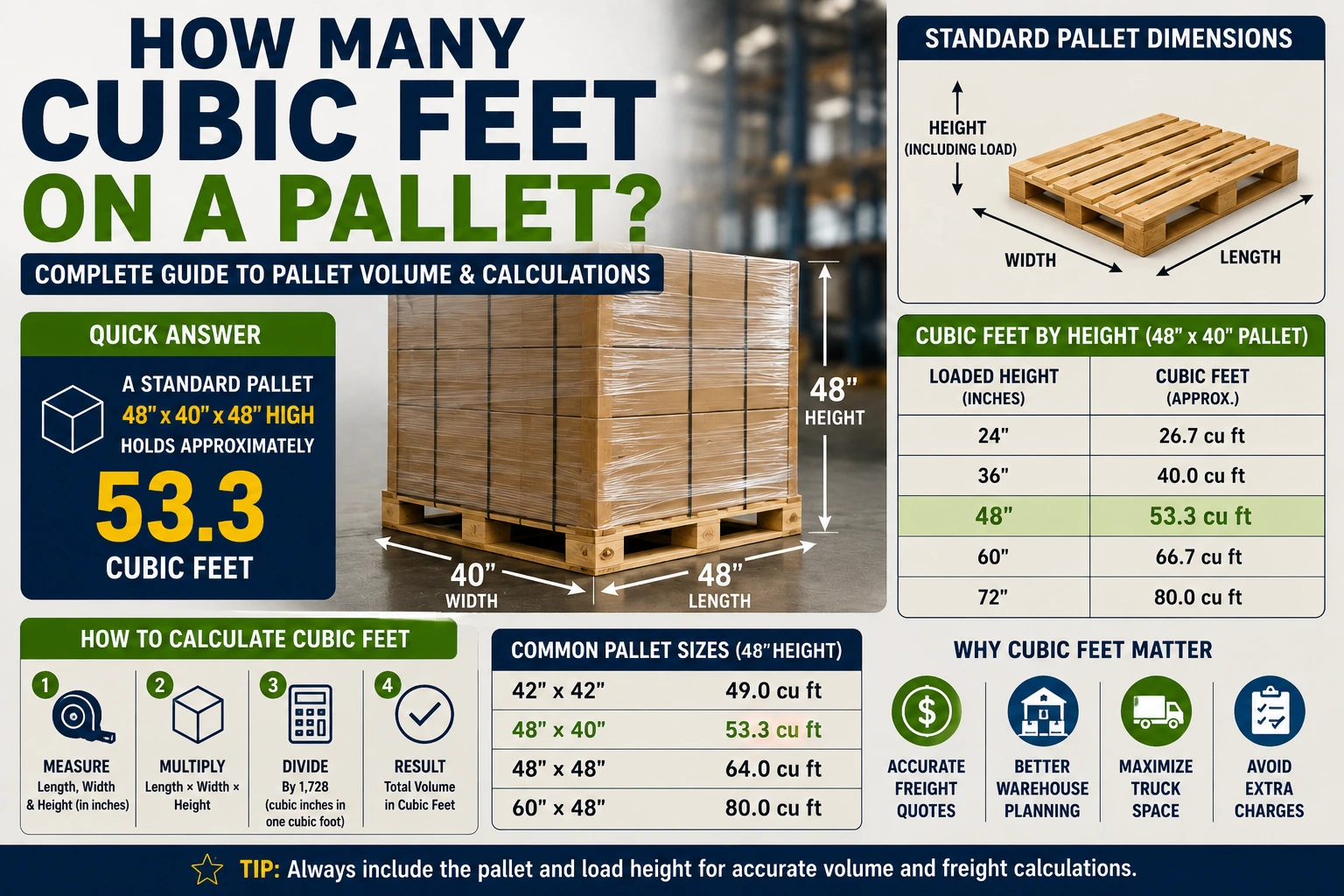
For example, a standard 48-inch × 40-inch pallet loaded to 48 inches high contains approximately 53.3 cubic feet of space.
Understanding pallet cubic footage is important because many freight carriers, warehouses, and logistics providers use volume calculations to determine shipping costs, storage requirements, and freight classifications.
In this guide, you’ll learn how to calculate pallet cubic feet, understand standard pallet dimensions, and avoid common shipping mistakes.
Quick Answer: How Many Cubic Feet on a Pallet?
The most common pallet in North America measures:
- 48 inches long
- 40 inches wide
The volume depends on the total loaded height.
Common Examples
| Pallet Size | Height | Cubic Feet |
|---|---|---|
| 48″ × 40″ | 24″ | 26.7 cu ft |
| 48″ × 40″ | 36″ | 40.0 cu ft |
| 48″ × 40″ | 48″ | 53.3 cu ft |
| 48″ × 40″ | 60″ | 66.7 cu ft |
| 48″ × 40″ | 72″ | 80.0 cu ft |
Therefore, when people ask how many cubic feet on a pallet, the most common answer is:
Approximately 53 cubic feet for a standard pallet loaded to 48 inches high.
Understanding Pallet Cubic Feet
Before calculating pallet volume, it’s important to understand what cubic feet actually measures.
What Is Cubic Feet?
Cubic feet measures three-dimensional space:
- Length
- Width
- Height
Unlike square footage, which measures surface area, cubic feet measures total volume.
Why Pallet Volume Matters
Pallet volume affects:
- Freight pricing
- Storage planning
- Warehouse capacity
- Load optimization
- Dimensional weight calculations
Accurate measurements help businesses reduce shipping costs and maximize space efficiency.
How Many Cubic Feet on a Standard Pallet?
The standard U.S. pallet measures:
- 48 inches × 40 inches
This equals:
- 13.33 square feet of floor space
Once products are stacked, the height determines total cubic feet.
Example
Dimensions:
- Length: 48 inches
- Width: 40 inches
- Height: 48 inches
Formula:
48 × 40 × 48 = 92,160 cubic inches
Convert to cubic feet:
92,160 ÷ 1,728 = 53.3 cubic feet
Result:
53.3 cubic feet
Standard Pallet Dimensions and Volume Chart
The following chart shows common pallet heights and corresponding cubic footage.
| Length | Width | Height | Cubic Feet |
| 48″ | 40″ | 24″ | 26.7 |
| 48″ | 40″ | 36″ | 40.0 |
| 48″ | 40″ | 48″ | 53.3 |
| 48″ | 40″ | 60″ | 66.7 |
| 48″ | 40″ | 72″ | 80.0 |
This chart provides a quick reference for most freight calculations.
How to Calculate Cubic Feet on a Pallet
Calculating pallet volume is straightforward.
Step 1: Measure Length
Measure the longest side.
Example:
48 inches
Step 2: Measure Width
Measure the shorter side.
Example:
40 inches
Step 3: Measure Height
Measure from the floor to the highest point of the load.
Example:
48 inches
Step 4: Convert to Cubic Feet
Formula:
(Length × Width × Height) ÷ 1,728
Why 1,728?
Because:
12 × 12 × 12 = 1,728 cubic inches per cubic foot.
Example Calculation
48 × 40 × 48 = 92,160 cubic inches
92,160 ÷ 1,728 = 53.3 cubic feet
Common Pallet Sizes and Their Cubic Feet
Not all pallets use standard dimensions.
48″ × 40″ GMA Pallet
Most common shipping pallet.
42″ × 42″ Pallet
Often used in telecommunications and paint industries.
48″ × 48″ Pallet
Common in chemical and beverage industries.
Volume Comparison
| Pallet Size | Height | Cubic Feet |
| 42″ × 42″ | 48″ | 49.0 |
| 48″ × 40″ | 48″ | 53.3 |
| 48″ × 48″ | 48″ | 64.0 |
Larger pallet footprints naturally increase total cubic volume.
Why Freight Companies Use Cubic Feet
Freight carriers rely heavily on volume measurements.
Dimensional Weight
Light but bulky shipments may be charged based on volume rather than actual weight.
Freight Class
The National Motor Freight Classification system considers:
- Density
- Handling
- Liability
- Stowability
Density often depends on cubic feet calculations.
Truck Capacity
Carriers need accurate volume measurements to maximize trailer utilization.
Real-World Pallet Volume Examples
Let’s look at practical scenarios.
Example 1: E-Commerce Shipment
Products:
- Small boxed electronics
Pallet dimensions:
- 48″ × 40″ × 48″
Volume:
53.3 cubic feet
Example 2: Food Distribution
Stacked cases:
- 48″ × 40″ × 60″
Volume:
66.7 cubic feet
Example 3: Industrial Equipment
Height:
72 inches
Volume:
80 cubic feet
Understanding these numbers helps optimize shipping decisions.
Benefits of Knowing Pallet Cubic Feet
Better Freight Quotes
Accurate measurements prevent pricing surprises.
Improved Warehouse Planning
Volume calculations help estimate storage capacity.
Increased Truck Efficiency
Knowing pallet size improves trailer loading strategies.
Better Inventory Management
Warehouse managers can allocate space more effectively.
Common Mistakes When Calculating Pallet Volume
Ignoring Total Height
Many people measure only the pallet footprint.
Height significantly impacts volume.
Forgetting Unit Conversions
Freight companies may request:
- Inches
- Feet
- Cubic feet
- Cubic meters
Always verify the required unit.
Measuring Only the Product
The pallet itself contributes to total height.
Using Rounded Measurements
Even small errors can affect freight costs.
Expert Tips for Accurate Pallet Measurements
Measure the Highest Point
Always include:
- Packaging
- Stretch wrap
- Protective materials
Verify Carrier Limits
Many carriers impose maximum pallet heights.
Common limits:
- 48 inches
- 60 inches
- 72 inches
Record Measurements Consistently
Create a standard measurement process for all shipments.
Use Freight Calculators
Many logistics platforms provide automated volume calculators.
Summary: How Many Cubic Feet on a Pallet?
The answer depends on pallet dimensions and loaded height. A standard 48-inch × 40-inch pallet loaded to 48 inches high contains approximately 53.3 cubic feet.
To calculate cubic feet on any pallet:
Length × Width × Height ÷ 1,728
Understanding how many cubic feet on a pallet helps improve freight planning, warehouse efficiency, storage management, and shipping cost accuracy.
Whether you’re shipping a single pallet or managing hundreds of loads, accurate volume calculations are essential for successful logistics operations.
9. FAQs
How many cubic feet is a standard pallet?
A standard 48″ × 40″ pallet loaded to 48 inches high contains approximately 53.3 cubic feet.
What formula calculates pallet cubic feet?
Use:
(Length × Width × Height) ÷ 1,728
Why do freight companies use cubic feet?
Cubic feet helps determine shipment density, freight class, storage needs, and dimensional weight charges.
Does pallet height affect cubic feet?
Yes. Height directly impacts total volume. Doubling the height nearly doubles the cubic feet.
How many cubic feet is a pallet loaded to 60 inches?
A standard 48″ × 40″ pallet loaded to 60 inches high contains approximately 66.7 cubic feet.
10. Conclusion
If you’re asking how many cubic feet on a pallet, the answer depends on the pallet’s dimensions and loaded height. For the most common 48″ × 40″ pallet stacked to 48 inches high, the total volume is approximately 53.3 cubic feet.
By understanding pallet volume calculations, businesses can obtain more accurate freight quotes, improve warehouse organization, optimize truck loading, and reduce shipping expenses. Accurate cubic-foot measurements are one of the most valuable tools in modern logistics and supply chain management.
Discover more