

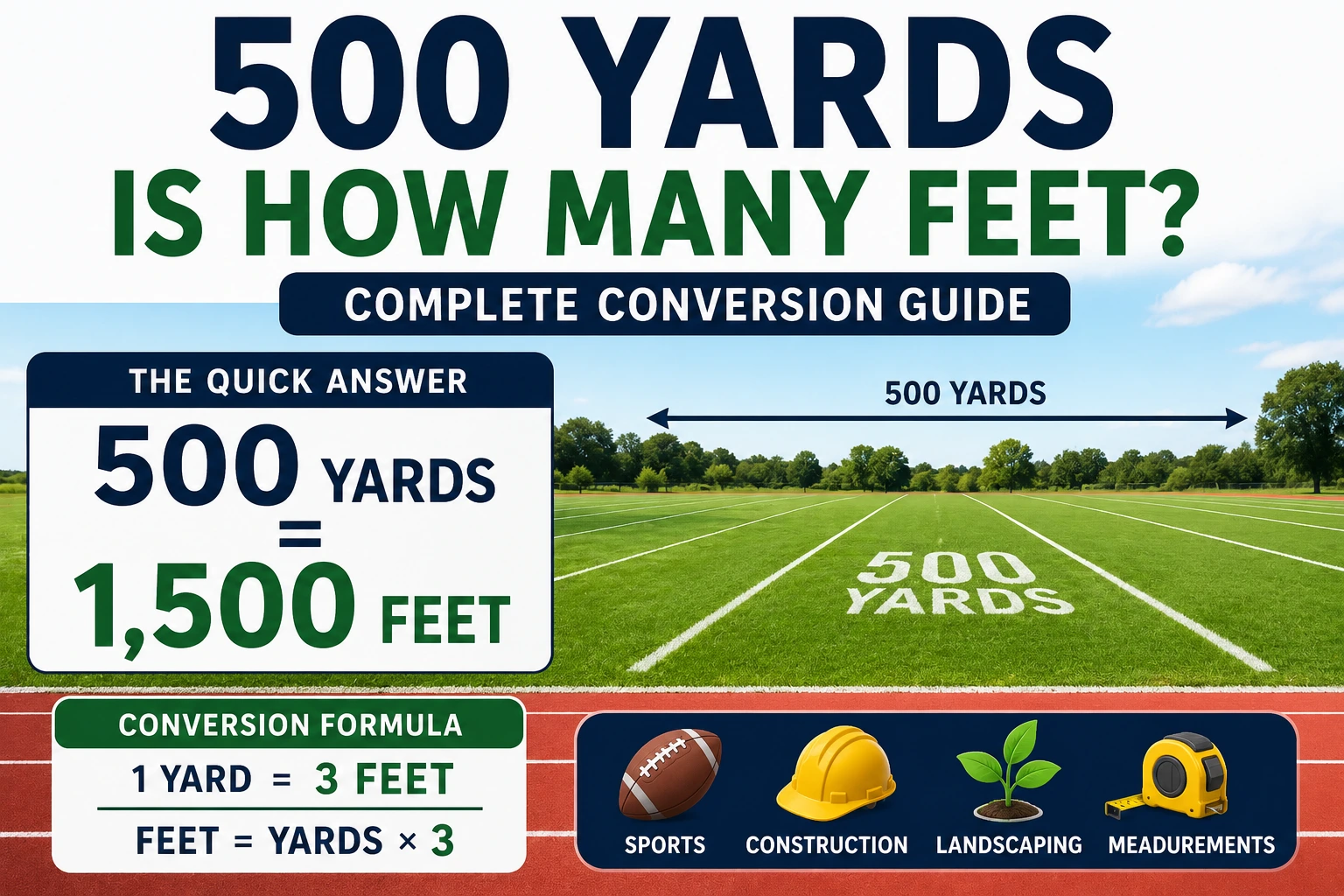
If you’re asking 500 yards is how many feet, the answer is straightforward.
Using the standard conversion rule:
500×3=1500
500 yards equals 1,500 feet.
This conversion is commonly used in sports, construction, landscaping, surveying, real estate, and educational settings. Whether you’re measuring a running distance, planning a project, or solving a math problem, knowing how to convert yards into feet can save time and improve accuracy.
In this guide, you’ll learn the exact conversion formula, practical examples, conversion charts, and useful tips for working with yards and feet.
Quick Answer
500 yards = 1,500 feet
Since every yard contains 3 feet, simply multiply the number of yards by 3.
For example:
- 500 yards × 3 = 1,500 feet
The result is:
500 yards equals 1,500 feet.
Understanding Yards and Feet
Before converting measurements, it’s helpful to understand these units.
What Is a Yard?
A yard is a unit of length used primarily in the United States and a few other countries that follow the imperial measurement system.
One yard equals:
- 3 feet
- 36 inches
- 0.9144 meters
The yard is commonly used for:
- Sports fields
- Landscaping projects
- Fabric measurements
- Construction planning
- Property measurements
What Is a Foot?
A foot is another unit of length in the imperial system.
One foot equals:
- 12 inches
- 0.333 yards
- 0.3048 meters
Feet are widely used when measuring:
- Room dimensions
- Building heights
- Walking distances
- Furniture sizes
- Home improvement projects
Because yards and feet belong to the same measurement system, converting between them is very simple.
How to Convert 500 Yards to Feet
The conversion process takes only a few seconds.
Conversion Formula
To convert yards into feet, use this formula:
Feet=Yards×3
Since each yard contains exactly 3 feet, multiplying by 3 gives the answer.
Step-by-Step Calculation
Let’s convert 500 yards.
Step 1: Identify the number of yards
- 500 yards
Step 2: Multiply by 3
500 × 3 = 1,500
Step 3: Add the unit
1,500 feet
Final Answer:
500 yards = 1,500 feet
500 Yards to Feet Conversion Table
The following table shows common yard-to-feet conversions.
| Yards | Feet |
|---|---|
| 50 | 150 |
| 100 | 300 |
| 200 | 600 |
| 300 | 900 |
| 400 | 1,200 |
| 500 | 1,500 |
| 600 | 1,800 |
| 700 | 2,100 |
| 800 | 2,400 |
| 1,000 | 3,000 |
This chart can help you estimate distances without doing calculations each time.
What Does 1,500 Feet Look Like?
Many people understand the number 1,500, but visualizing the distance can be challenging.
Here are some practical comparisons.
Football Field Comparison
A standard American football field measures:
- 100 yards long
- 300 feet long
Therefore:
- 500 yards equals 5 football fields
- 1,500 feet equals 5 football fields
This comparison makes it easier to picture the distance.
Walking Distance Example
The average person walks approximately:
- 3 to 4 miles per hour
- Around 250 feet per minute
At that pace:
- Walking 1,500 feet takes roughly 6 minutes
This means 500 yards is a short but noticeable walking distance.
Construction and Landscaping Example
Contractors often measure property boundaries, driveways, fences, and utility lines in feet.
A 500-yard distance could represent:
- A long property boundary
- A utility trench
- A roadway section
- A large landscaping project
Converting to feet provides greater precision for planning and material estimation.
Why Yard-to-Feet Conversions Matter
Converting yards to feet is important because many projects require measurements in feet rather than yards.
Construction Projects
Builders frequently use feet when:
- Measuring foundations
- Calculating lumber requirements
- Planning layouts
- Estimating material quantities
Landscaping
Landscapers often convert yards into feet when measuring:
- Garden beds
- Irrigation systems
- Retaining walls
- Property lines
Sports Applications
Sports commonly use yards.
Examples include:
- Football fields
- Golf courses
- Running drills
Converting yards into feet can provide more detailed measurements.
Education
Students frequently encounter yard-to-feet conversion questions in math and science classes.
Understanding the formula helps solve these problems quickly.
Common Yard-to-Feet Conversions
Here are some frequently searched conversions.
| Yards | Feet |
|---|---|
| 1 yard | 3 feet |
| 5 yards | 15 feet |
| 10 yards | 30 feet |
| 25 yards | 75 feet |
| 50 yards | 150 feet |
| 100 yards | 300 feet |
| 250 yards | 750 feet |
| 500 yards | 1,500 feet |
| 750 yards | 2,250 feet |
| 1,000 yards | 3,000 feet |
Learning these common values can save time during calculations.
Real-World Uses of 500 Yards
The distance of 500 yards appears more often than many people realize.
Running and Fitness
Athletes use yard measurements for:
- Sprint intervals
- Conditioning drills
- Track workouts
- Endurance training
A 500-yard run equals 1,500 feet.
Golf
Golf courses often measure holes in yards.
A 500-yard par-5 hole is equivalent to:
- 1,500 feet
This helps golfers understand hole length more precisely.
Property Measurement
Surveyors and real estate professionals may measure large lots in yards while construction plans use feet.
Converting ensures consistency between documents.
Utility Installation
Utility companies often install:
- Water lines
- Electrical conduits
- Communication cables
Distances may start in yards but require conversion to feet for installation specifications.
Common Conversion Mistakes
Although yard-to-feet conversions are simple, mistakes still happen.
Forgetting the Conversion Factor
Some people mistakenly multiply by 12 because they confuse feet with inches.
Remember:
- Yards to feet = multiply by 3
- Feet to inches = multiply by 12
Using the Wrong Formula
Always use:
Feet = Yards × 3
Avoid unnecessary calculations.
Mixing Measurement Systems
Do not combine:
- Yards
- Feet
- Meters
Without proper conversion.
Keep all measurements in the same unit before performing calculations.
Calculator Entry Errors
Typing incorrect numbers is surprisingly common.
Double-check:
- Original measurement
- Conversion factor
- Final result
Expert Tips for Accurate Measurement Conversions
Professionals use several techniques to avoid conversion errors.
Memorize Key Relationships
Remember:
- 1 yard = 3 feet
- 1 foot = 12 inches
- 1 yard = 36 inches
These basic relationships simplify many calculations.
Use Estimation Checks
Ask yourself:
“Does the answer seem reasonable?”
Since feet are smaller units than yards, the resulting number should always be larger.
For example:
- 500 yards → 1,500 feet
This makes sense because 1,500 is larger than 500.
Write Units Clearly
Always label measurements with units.
Instead of writing:
- 1500
Write:
- 1,500 feet
This prevents confusion.
Convert Before Calculating Area or Volume
When solving larger problems involving area or volume, convert all measurements into the same unit first.
This helps avoid costly mistakes in construction, engineering, and design work.
9. FAQs
1. 500 yards is how many feet?
500 yards equals 1,500 feet.
2. What is the formula for converting yards to feet?
Multiply the number of yards by 3.
Feet = Yards × 3
3. How many football fields is 500 yards?
Since a football field is 100 yards long, 500 yards equals approximately 5 football fields.
4. How many feet are in 1 yard?
There are exactly 3 feet in 1 yard.
5. Is 1,500 feet the same as 500 yards?
Yes. Both measurements represent the same distance.
10. Conclusion
If you’ve been wondering 500 yards is how many feet, the answer is simple: 500 yards equals 1,500 feet. By using the straightforward conversion formula of multiplying yards by 3, you can quickly convert distances for sports, construction, landscaping, surveying, and everyday measurements.
Understanding this conversion not only helps with math problems but also improves accuracy when planning projects and interpreting measurements. Whether you’re calculating a football field distance, estimating property dimensions, or working on a DIY project, knowing that 500 yards equals 1,500 feet makes measurement conversions fast and easy.
Discover more