

The ocean covers more than 70% of Earth’s surface, yet much of it remains unexplored. One question many people ask is: how many feet underwater can a human go?
The answer depends on several factors, including whether a person is diving without equipment, using scuba gear, or relying on specialized deep-sea technology. Human beings can survive at remarkable depths, but water pressure increases quickly and creates serious risks.
While recreational divers usually stay within safe limits, professional divers and record holders have reached depths that seem almost unbelievable.
In this guide, you’ll learn exactly how deep humans can go underwater, what happens to the body at different depths, and the safety limits that every diver should know.
Quick Answer
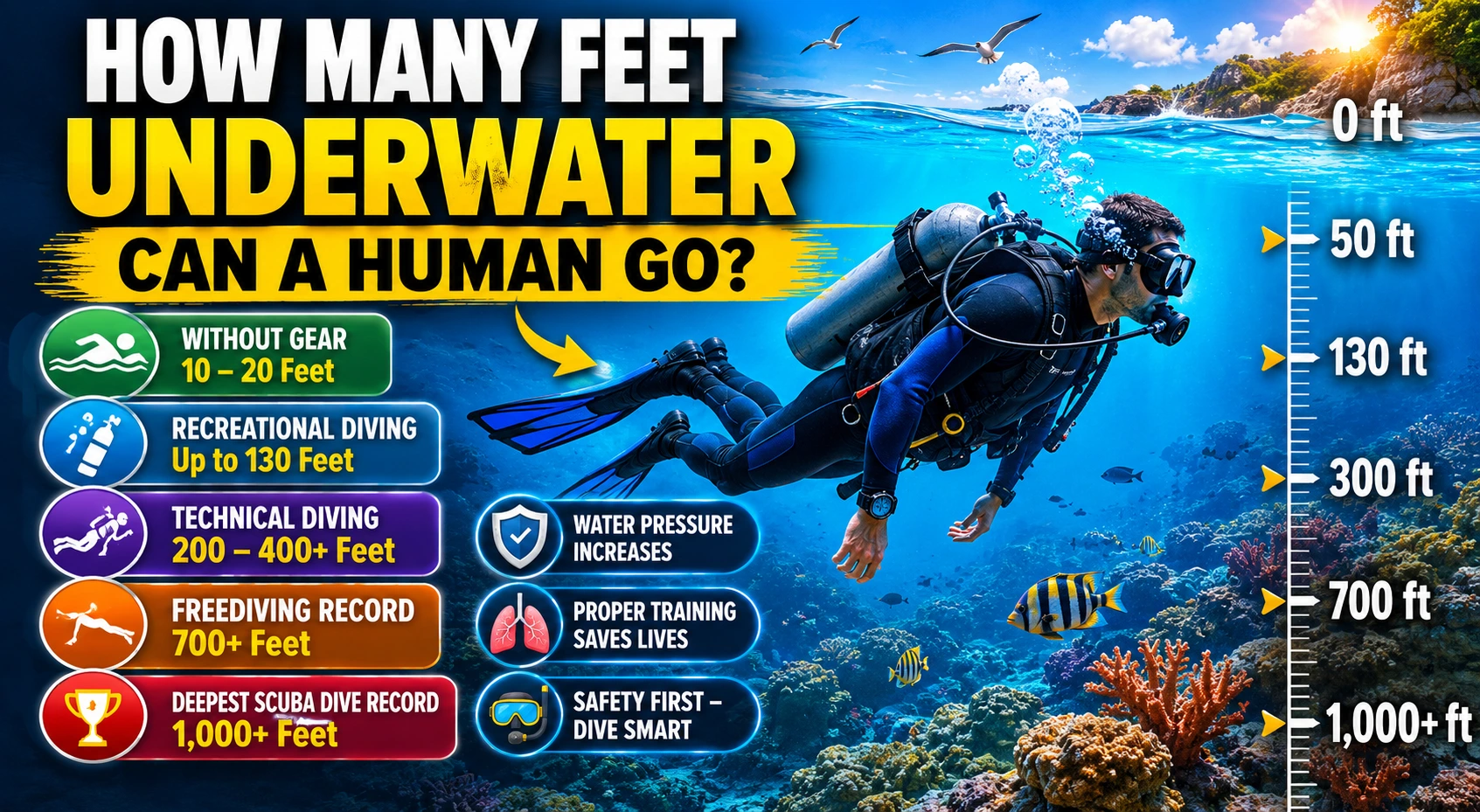
The maximum depth a human can reach depends on the diving method:
| Diving Type | Approximate Depth |
|---|---|
| Swimming without gear | 10–20 feet |
| Recreational scuba diving | 130 feet |
| Advanced technical diving | 300+ feet |
| Professional saturation diving | 1,000+ feet |
| Record freediving | Over 700 feet |
| Deepest scuba dive record | Over 1,000 feet |
Most people should never attempt extreme depths without specialized training and equipment.
Understanding Human Limits Underwater
Humans are not naturally designed to live underwater. Unlike fish, we rely on air-filled lungs and are affected by increasing pressure as we descend.
The deeper you go:
- Pressure increases
- Breathing becomes more difficult
- Oxygen management becomes critical
- Risk of injury rises
- Specialized equipment becomes necessary
Because of these factors, there is no single answer to how many feet underwater a human can go.
How Many Feet Underwater Can a Human Go Without Equipment?
Without scuba gear or breathing apparatus, most people can only dive relatively shallow depths.
A casual swimmer may reach:
- 10–20 feet comfortably
- 30–40 feet with practice
Freedivers train extensively to hold their breath and descend much deeper.
Elite freedivers can exceed:
- 300 feet
- 400 feet
- 500 feet
Some world-record freedivers have descended beyond 700 feet using specialized techniques and years of training.
These achievements represent the limits of human breath-hold capability.
How Many Feet Underwater Can a Human Go With Scuba Gear?
Scuba equipment dramatically extends human underwater capability.
Recreational Diving Limits
Most recreational diving organizations recommend a maximum depth of:
130 feet (40 meters)
At this depth:
- Divers can safely manage air consumption
- Risks remain relatively controlled
- Standard scuba certifications apply
Many recreational divers never go deeper than 60–100 feet.
Technical Diving Limits
Technical divers use advanced training and specialized gas mixtures.
These divers may reach:
- 200 feet
- 300 feet
- 400 feet
Technical diving requires:
- Decompression stops
- Backup breathing systems
- Advanced planning
- Specialized certifications
Mistakes at these depths can be fatal.
What Happens to the Human Body Underwater?
Understanding depth limits requires understanding water pressure.
Water Pressure Explained
Every 33 feet of seawater adds approximately one atmosphere of pressure.
At sea level, we experience:
- 1 atmosphere
At 33 feet:
- 2 atmospheres
At 66 feet:
- 3 atmospheres
At 99 feet:
- 4 atmospheres
Pressure increases rapidly as depth increases.
Effects on Lungs and Ears
As pressure rises:
- Air spaces compress
- Ears require equalization
- Sinuses experience stress
- Lung volume decreases
Failure to equalize properly can cause pain or injury.
Nitrogen Absorption
Breathing compressed air underwater causes nitrogen to dissolve into body tissues.
Too much nitrogen can lead to:
- Nitrogen narcosis
- Decompression sickness
- Reduced judgment
- Serious medical emergencies
This is one reason divers must ascend slowly.
The Deepest Human Dives Ever Recorded
Humans have pushed underwater exploration far beyond ordinary limits.
Deepest Scuba Dive
The deepest recorded scuba dive exceeded:
1,000 feet
Such dives require:
- Multiple gas mixtures
- Extensive planning
- Support teams
- Hours of decompression
These are not typical recreational dives.
Deepest Freedive
Elite freedivers have descended beyond:
700 feet
These athletes spend years training their bodies to tolerate:
- Extreme pressure
- Limited oxygen
- Long breath-hold times
Their achievements represent some of the most impressive physical feats in the world.
How Pressure Changes With Depth
The following chart shows how pressure increases underwater.
| Depth | Total Pressure |
|---|---|
| Surface | 1 atmosphere |
| 33 feet | 2 atmospheres |
| 66 feet | 3 atmospheres |
| 99 feet | 4 atmospheres |
| 132 feet | 5 atmospheres |
| 165 feet | 6 atmospheres |
| 330 feet | 11 atmospheres |
At 330 feet, the human body experiences approximately eleven times the pressure found at sea level.
Comparing Different Diving Depths
To understand these depths, consider the following comparisons.
| Depth | Example |
|---|---|
| 12 feet | Residential swimming pool |
| 30 feet | Beginner dive site |
| 60 feet | Popular reef diving depth |
| 130 feet | Recreational diving limit |
| 300 feet | Technical diving range |
| 1,000 feet | Professional deep diving |
Most marine life that recreational divers see exists within the upper 100 feet of water.
Risks of Going Too Deep Underwater
Deep diving comes with significant hazards.
Decompression Sickness
Also called “the bends.”
Occurs when dissolved gases form bubbles inside the body during rapid ascent.
Symptoms include:
- Joint pain
- Dizziness
- Paralysis
- Breathing problems
Nitrogen Narcosis
Often called the “martini effect.”
Can cause:
- Poor decision-making
- Confusion
- Slower reaction times
Oxygen Toxicity
High oxygen levels under pressure can trigger:
- Muscle twitching
- Vision problems
- Seizures
Equipment Failure
At greater depths:
- Air consumption increases rapidly
- Equipment stress rises
- Emergency situations become harder to manage
Safety Tips for Deep Diving
If you plan to dive, safety should always come first.
Get Proper Certification
Never exceed your training level.
Follow Depth Limits
Stay within recommended limits for your certification.
Dive With a Buddy
A diving partner can help during emergencies.
Monitor Air Supply
Deep dives consume air much faster than shallow dives.
Ascend Slowly
Controlled ascents reduce decompression risks.
Use Proper Equipment
Deep diving requires equipment specifically designed for increased pressure.
Common Myths About Human Diving Depth
Myth 1: Anyone Can Dive Hundreds of Feet
Reality: Deep diving requires extensive training and specialized equipment.
Myth 2: Pressure Only Affects the Ears
Reality: Pressure impacts the entire body.
Myth 3: More Air Means Unlimited Depth
Reality: Human physiology creates limits regardless of air supply.
Myth 4: Deep Diving Is Always Dangerous
Reality: Proper training and procedures make diving relatively safe.
Future of Deep-Sea Human Exploration
Technology continues to expand human access to the ocean.
Modern innovations include:
- Advanced diving suits
- Saturation diving systems
- Underwater habitats
- Deep-sea submarines
- Pressure-resistant life support systems
These technologies allow humans to explore depths that would otherwise be impossible.
However, direct human diving still faces biological limitations imposed by pressure and breathing requirements.
9. FAQs
1. How many feet underwater can a human safely go?
Most recreational divers can safely dive to 130 feet with proper certification and equipment.
2. What is the deepest a human has gone underwater?
Professional divers and record holders have exceeded 1,000 feet using specialized equipment and procedures.
3. Can a human dive 500 feet underwater?
Yes, but only with advanced technical training, specialized gas mixtures, and extensive safety planning.
4. Why can’t humans go extremely deep underwater?
Increasing pressure affects breathing, body tissues, and gas absorption, creating serious physiological risks.
5. How deep can a person go without scuba gear?
Most swimmers reach 10–20 feet, while elite freedivers can exceed 700 feet under controlled conditions.
10. Conclusion
If you’re wondering how many feet underwater can a human go, the answer varies widely depending on training, equipment, and diving method. Recreational scuba divers typically stay within 130 feet, while technical and professional divers can reach several hundred feet or even more than 1,000 feet under specialized conditions. The deeper a person goes, the greater the effects of water pressure, nitrogen absorption, and oxygen management. Understanding these limits is essential for safe underwater exploration. While modern technology has expanded what humans can achieve beneath the surface, respecting depth limits remains critical for every diver.
Discover more