
If you’re setting up a cornhole game for a backyard barbecue, family gathering, league match, or tournament, one of the first questions you’ll ask is how many feet apart are cornhole boards.
The distance between boards plays a major role in game difficulty, fairness, and overall enjoyment. Too close, and the game becomes too easy. Too far apart, and players may struggle to score consistently.
The official answer is simple:
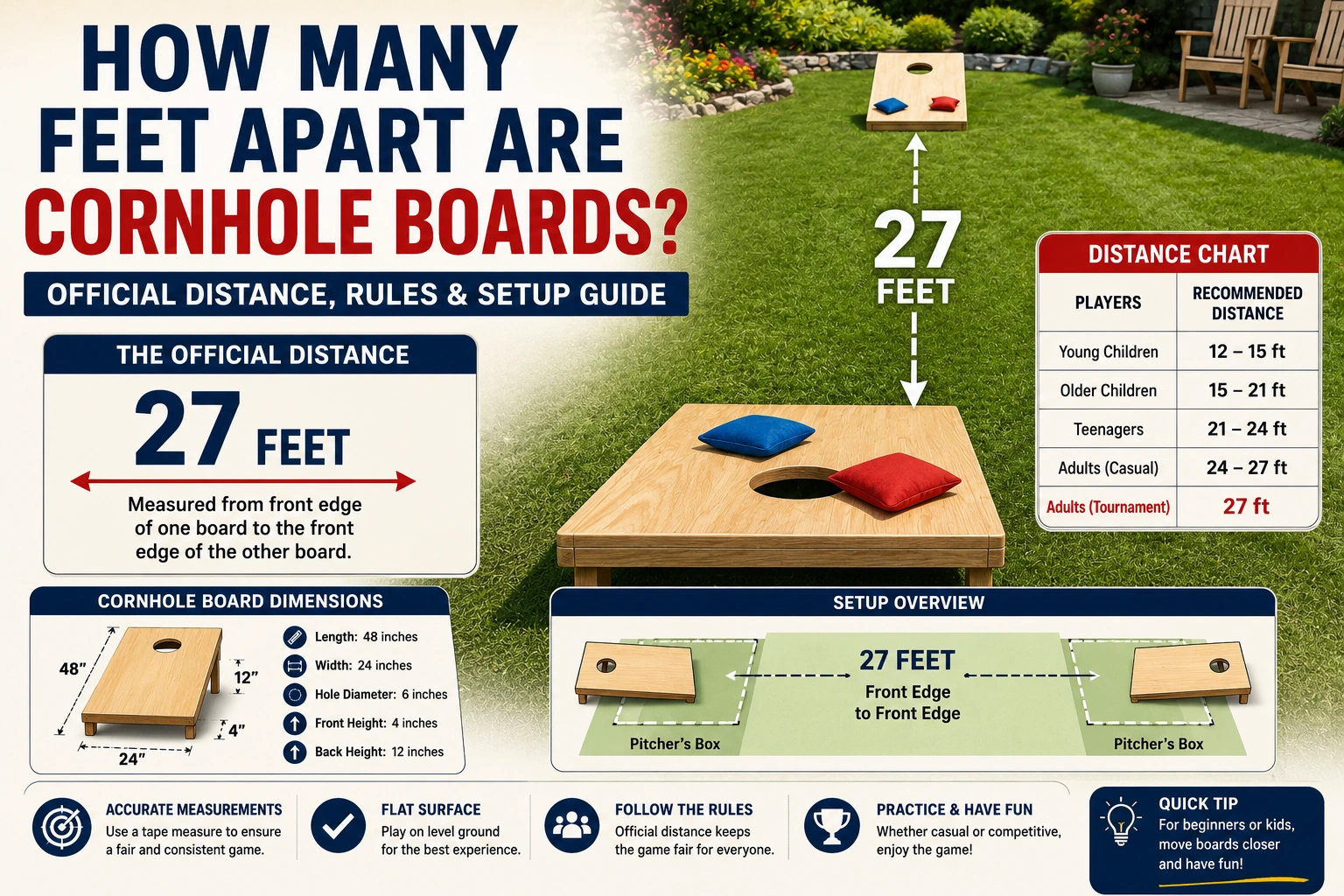
Cornhole boards should be placed 27 feet apart from the front edge of one board to the front edge of the other board for adult play.
This is the standard used in professional and tournament competitions throughout the United States.
In this guide, you’ll learn official cornhole distances, court dimensions, setup instructions, youth adjustments, and expert tips for creating the perfect cornhole court.
Quick Answer: How Many Feet Apart Are Cornhole Boards?
For official adult play:
27 feet
The measurement is taken:
From the front edge of one board to the front edge of the opposite board.
Here is a quick reference:
| Type of Play | Board Distance |
|---|---|
| Adult Tournament Play | 27 feet |
| Casual Adult Play | 24–27 feet |
| Youth Players | 12–21 feet |
| Beginners | 15–24 feet |
Most competitive players use the official 27-foot distance.
Understanding Official Cornhole Board Distance
Before setting up your court, it’s important to understand why the official distance exists.
Adult Tournament Distance
Official cornhole organizations use:
27 feet between front edges
This creates a challenging but fair throwing distance.
Players stand beside the board and toss bean bags toward the opposing board.
The 27-foot spacing has become the recognized standard across leagues and tournaments.
Recreational and Casual Play Distance
Not everyone plays competitively.
Families and casual players often shorten the distance.
Common recreational setups include:
- 24 feet
- 21 feet
- 18 feet
Reducing the distance can make the game more enjoyable for beginners and younger players.
How Many Feet Apart Are Cornhole Boards According to Official Rules?
Most major cornhole organizations follow the same board spacing standard.
The official measurement is:
27 feet from front edge to front edge
Another way to measure is:
33 feet from the hole center of one board to the hole center of the opposite board.
The relationship looks like this:
| Measurement Method | Distance |
|---|---|
| Front Edge to Front Edge | 27 ft |
| Hole Center to Hole Center | 33 ft |
Both measurements describe the same court setup.
Cornhole Court Dimensions Explained
Proper board spacing is only one part of the setup.
A regulation court includes several components.
Board Dimensions
Official cornhole boards measure:
| Dimension | Measurement |
|---|---|
| Length | 48 inches |
| Width | 24 inches |
| Hole Diameter | 6 inches |
| Front Height | 4 inches |
| Rear Height | 12 inches |
These dimensions ensure consistency across games.
Pitcher’s Box
Players throw from designated areas called pitcher’s boxes.
Each side of the court contains:
- Left pitcher’s box
- Right pitcher’s box
Players must remain inside these boundaries while throwing.
Foul Lines
The front edge of each board acts as the foul line.
Crossing the foul line while throwing may result in penalties during competitive play.
Step-by-Step Guide to Setting Up Cornhole Boards
Setting up a cornhole court is straightforward.
Step 1: Choose a Flat Surface
Ideal surfaces include:
- Grass
- Concrete
- Asphalt
- Packed dirt
Avoid steep slopes.
Step 2: Measure 27 Feet
Use a tape measure to mark:
27 feet between the front edges of both boards.
Step 3: Align the Boards
Ensure the boards face each other directly.
Misalignment can affect gameplay.
Step 4: Check Stability
Boards should sit firmly without wobbling.
Step 5: Mark Pitching Areas
If desired, mark foul lines and pitching boxes.
Your court is now ready for play.
Cornhole Distance Chart by Age Group
Different age groups often require different distances.
| Player Group | Recommended Distance |
|---|---|
| Young Children | 12–15 ft |
| Older Children | 15–21 ft |
| Teenagers | 21–24 ft |
| Adults (Casual) | 24–27 ft |
| Adults (Tournament) | 27 ft |
Adjusting distance helps maintain fun and fairness.
Why Proper Board Spacing Matters
Many players underestimate the importance of accurate spacing.
Ensures Fair Competition
Equal distances create consistent gameplay.
Improves Skill Development
Players learn proper throwing techniques.
Matches Tournament Conditions
Practicing at regulation distance prepares players for competition.
Creates Balanced Gameplay
Correct spacing prevents games from becoming too easy or too difficult.
Enhances Enjoyment
A properly set-up court provides the best playing experience.
Real-World Cornhole Setup Examples
Backyard Family Gathering
Players:
Adults and children
Recommended distance:
18–24 feet
This setup keeps the game fun for everyone.
Community Tournament
Players:
Experienced adults
Recommended distance:
27 feet
Matches official tournament standards.
School Event
Players:
Children ages 8–12
Recommended distance:
12–18 feet
Shorter distances improve participation and success rates.
Common Mistakes When Setting Up Cornhole Boards
Measuring From the Wrong Point
The official measurement is:
Front edge to front edge
Not back edge to back edge.
Ignoring Surface Conditions
Uneven ground affects gameplay.
Using Incorrect Board Sizes
Homemade boards should match official dimensions whenever possible.
Misaligned Boards
Boards must face each other directly.
Choosing a Distance That’s Too Difficult
Adjust for skill level when necessary.
Tournament vs Backyard Cornhole Setup
Understanding the difference helps players choose the right court.
| Feature | Backyard Setup | Tournament Setup |
|---|---|---|
| Distance | 18–27 ft | 27 ft |
| Surface | Any Flat Area | Regulated Court |
| Board Size | Variable | Official Size |
| Competition Level | Casual | Competitive |
| Court Markings | Optional | Required |
Backyard games prioritize fun, while tournaments prioritize consistency.
Expert Tips for the Perfect Cornhole Court
Use a Measuring Tape
Avoid estimating distances.
Face Boards Directly
Proper alignment improves fairness.
Maintain Boards
Check for damage and loose components.
Practice at Regulation Distance
Serious players should always train at 27 feet.
Consider Lighting
Evening games benefit from proper illumination.
Strong Summary: How Many Feet Apart Are Cornhole Boards?
If you’re wondering how many feet apart are cornhole boards, the official answer is 27 feet from the front edge of one board to the front edge of the other board.
This distance is used in professional tournaments and provides the standard level of challenge expected in competitive play. Recreational players and younger participants can shorten the distance to suit their skill level, but practicing at regulation spacing is the best way to improve your game.
Frequently Asked Questions
How many feet apart are cornhole boards in official tournaments?
Official tournament boards are placed 27 feet apart, measured from front edge to front edge.
How far apart are cornhole holes?
The centers of the holes are approximately 33 feet apart.
Can children use a shorter distance?
Yes. Many youth games use distances between 12 and 21 feet.
Is 27 feet measured from the front or back of the boards?
The official measurement is taken from the front edge of each board.
What is the best distance for casual backyard play?
Most casual players use between 18 and 24 feet, depending on age and skill level.
Conclusion
Knowing how many feet apart are cornhole boards is essential for creating a fair and enjoyable playing experience. The official regulation distance is 27 feet from front edge to front edge, which is the standard used in leagues and tournaments nationwide.
Whether you’re hosting a backyard gathering, organizing a community event, or preparing for competition, proper board spacing helps ensure consistent gameplay and better skill development. By following official dimensions and adjusting distances when necessary for younger or beginner players, you can create the perfect cornhole setup for any occasion.
Discover more